When the Pattern Is Gone: 3D Scanning a 55-Year-Old Casting for Foundry and Machine Shop Review
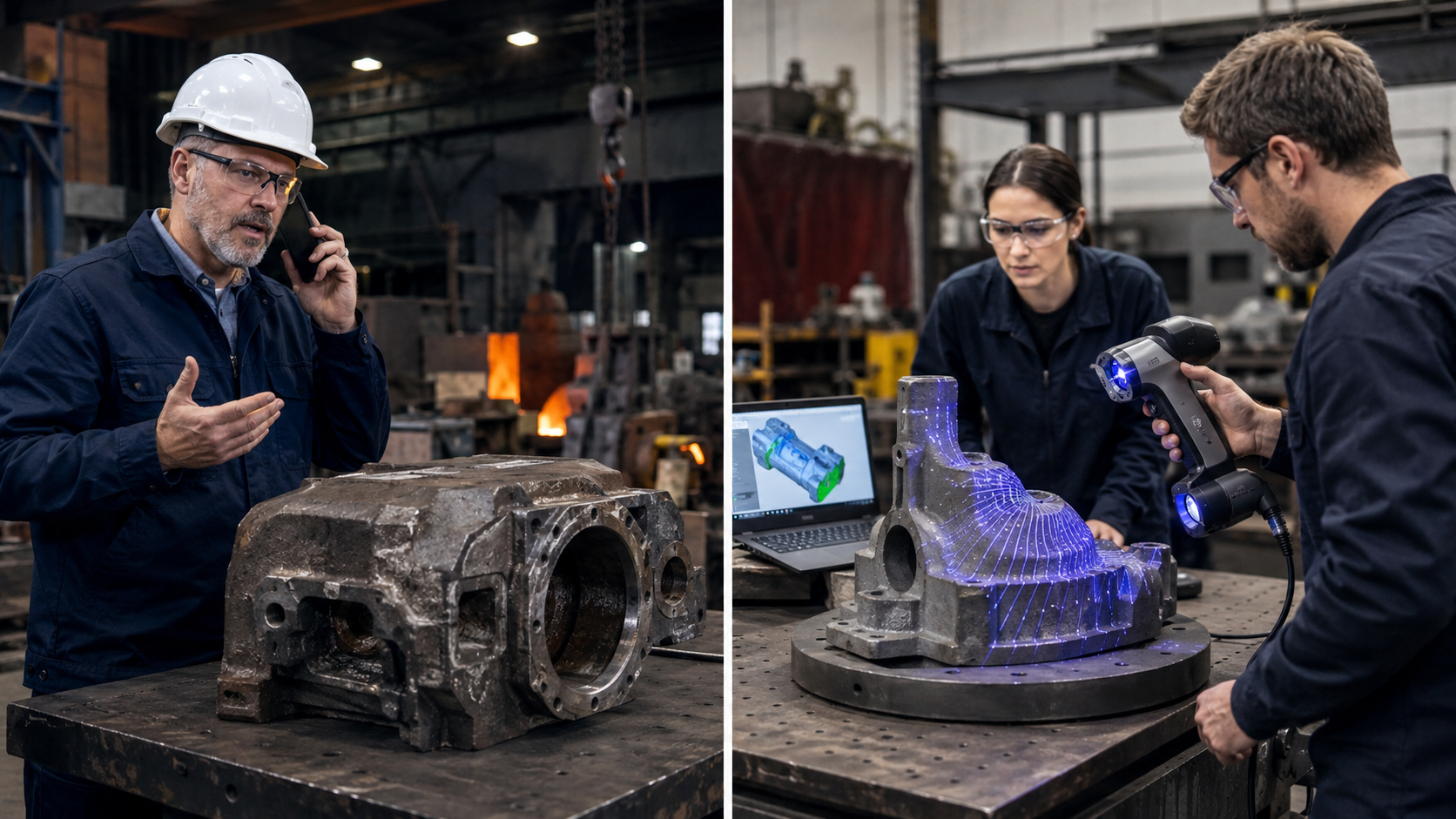
A foundry partner recently called us with a problem that will sound familiar to anyone who works with older industrial parts.
They had a casting that needed to be evaluated and potentially reproduced. The part was over 50 years old and weighed a beefy 47 pounds. There was a drawing, but no one was fully confident that the drawing reflected the part as it exists today. There was also an existing casting, but it had decades of wear on it.
The original patterns should have been the best source of truth. Unfortunately, those patterns had been taken back by the customer years earlier, left outside, exposed to the weather, and ultimately destroyed.
That left the foundry with a difficult situation:
- They had a worn casting.
- They had an uncertain drawing.
- They had no usable pattern equipment.
- And they had a customer who still needed answers.
The phone call was straightforward: Can JaegerTech help us make sense of this?
The Problem With Legacy Castings
This is one of the harder realities of foundry and machine shop work. Older parts often outlive the documentation that created them.
Drawings get revised, copied, marked up, or lost. Pattern equipment gets damaged, modified, misplaced, or destroyed. The people who knew the history of the job retire or move on. Meanwhile, the machine, pump, housing, fixture, or production asset that depends on the casting is still in service.
In this case, the foundry had been around since 1965 and had the experience to understand the problem. What they did not have was a clean, reliable, modern reference of the part.
The casting itself could still provide useful information, but it was not perfect. It had wear. It had age. It had handling challenges. At 47 pounds, it was not something everyone wanted to repeatedly move around, flip over, inspect, photograph, and pass between the foundry, machine shop, and customer.
The project needed a better reference point.
Our Approach: Scan the Existing Casting
JaegerTech scanned the casting to create a digital reference model that could be reviewed by the project team.
Because the part was heavy and had geometry that needed to be captured from multiple angles, setup was important. We raised the casting using 1-2-3 blocks so the scanner could see more of the lower edges, transitions, and underside features. That simple setup choice helped improve access and reduced the need to guess at hidden areas.
This is an important part of practical scanning work. A scan is not just about waving a scanner around a part. The part has to be staged so useful geometry can actually be captured.
The goal was not to create a perfect replacement for engineering review, foundry judgment, or machining experience. The goal was to create a useful digital asset from the best physical evidence still available.
Why a Digital Reference Changes the Conversation
Before the scan, the project had several disconnected sources of information.
The drawing existed, but may not have been current.
The casting existed, but was worn.
The original patterns were gone.
The machine shop needed to understand what could be machined.
The foundry needed to understand what could be cast.
The customer needed a path forward.
The scan gave everyone something they could look at together.
Instead of relying only on a 55-year-old worn casting and an uncertain drawing, the foundry and machine shop now had a shared digital reference. They could inspect the geometry, discuss surfaces, identify questionable areas, compare features, and begin separating known information from unknown information.
That is where 3D scanning provides real industrial value.
It does not magically solve every question. It does not automatically tell you what the original pattern looked like. It does not know which surfaces are worn, which features were intentional, or which dimensions are critical.
But it gives the team a common starting point.
And on legacy work, that matters.
Creating a Digital Twin Adds Insurance
The scan also creates something more durable than a one-time project reference. It creates the beginning of a digital twin.
For legacy castings, a digital twin is a form of insurance.
Patterns can be lost.
Drawings can be outdated.
Castings can wear.
Institutional knowledge can disappear.
Physical parts can be damaged, misplaced, or scrapped.
When the only reference is a single aging casting, the entire project is still vulnerable. If that part is damaged or lost, the remaining geometry may be gone with it.
By creating a digital twin, the foundry and machine shop gain a digital record that can be backed up, shared, measured, marked up, and used for future work. It can support reverse engineering, pattern design, machining discussions, inspection planning, customer review, and long-term replacement planning.
In this case, the original patterns had already been lost once. Digitizing the remaining casting helped reduce the risk of losing the part a second time.
From Physical Uncertainty to a Usable Digital Asset
This project was not about scanning for the sake of scanning.
It was about taking a difficult legacy manufacturing problem and reducing uncertainty.
The foundry had a part that needed to be understood. The machine shop needed visibility into the geometry. The customer had an old casting, a questionable drawing, and no remaining pattern equipment. Everyone involved needed a practical way to move the project forward.
By scanning the casting, JaegerTech helped create a digital reference that could be used by both the foundry and the machine shop. That reference does not replace good engineering, but it supports better decisions.
It allows the team to ask better questions:
- Which surfaces are worn?
- Which features need machining allowance?
- Which dimensions should be verified against the drawing?
- Which areas need foundry input before pattern work begins?
- Where does the casting still provide useful information?
- Where is more interpretation required?
Those questions are much easier to answer when everyone is looking at the same digital model.
Why This Matters for Foundries, Machine Shops, and Industrial Customers
Many industrial parts are still in service long after the original documentation becomes unreliable. In some cases, the only remaining information is an old drawing, a worn casting, or a pattern that may or may not still represent the part correctly.
That creates risk for everyone involved.
For the foundry, bad information can lead to bad tooling.
For the machine shop, unclear geometry can lead to machining surprises.
For the customer, uncertainty can mean delays, added cost, or difficulty keeping older equipment running.
3D scanning helps reduce that risk by capturing what still exists and turning it into a usable digital asset.
For legacy casting projects, scanning can help:
- Preserve existing part geometry before more damage or wear occurs
- Create a digital twin for future reference
- Reduce repeated handling of heavy or fragile parts
- Give foundries and machine shops a shared review model
- Compare worn parts against old drawings
- Support reverse engineering and new pattern development
- Improve communication before tooling or machining begins
- Document uncertainty instead of ignoring it
That last point is important. Scanning does not eliminate uncertainty, but it helps make uncertainty visible. Once the team can see the part digitally, they can decide what needs to be measured, corrected, rebuilt, or reviewed.
Helping Manufacturers Recover Legacy Parts
At JaegerTech, this is the kind of industrial problem we like solving.
Sometimes the job starts with a CAD file. Sometimes it starts with a print. Sometimes it starts with a damaged pattern or a worn casting sitting on a pallet.
In this case, it started with a phone call from a foundry partner:
- A 55-year-old casting.
- A 47-pound part.
- A drawing no one fully trusted.
- Patterns that had been destroyed.
- A lot of uncertainty.
3D scanning gave the foundry and machine shop a better way to evaluate the part, communicate about the project, and begin building a path forward.
For older castings, obsolete parts, damaged patterns, and incomplete drawings, a digital twin can provide another layer of insurance. It helps preserve what still exists before it is lost, worn further, or forgotten.
If you have a legacy casting, damaged pattern, worn part, or outdated drawing, JaegerTech can help capture the geometry, create a digital reference, and support the next step toward reproduction, repair, or replacement.
About the Author: jaegertechgroup.com

STAY IN THE LOOP
Subscribe to our free newsletter.
Leave A Comment
From Hesitation to Hands-On: Bringing Large-Format 3D Printing Into a Prosthetics and Orthotics Practice For many prosthetics and orthotics practitioners, the potential
Using 3D Printing to De-Risk Production Tooling Production tooling is expensive for a reason. Whether the final process is injection molding, thermoforming,
From 3D Scan to Perfect Fit: The Corvette Bumper Project Moves Forward A few weeks ago, we shared a project that demonstrated
Great Conversations and New Connections at SMD in Huntsville Last week, Janelle and I had the opportunity to attend SMD in Huntsville,