
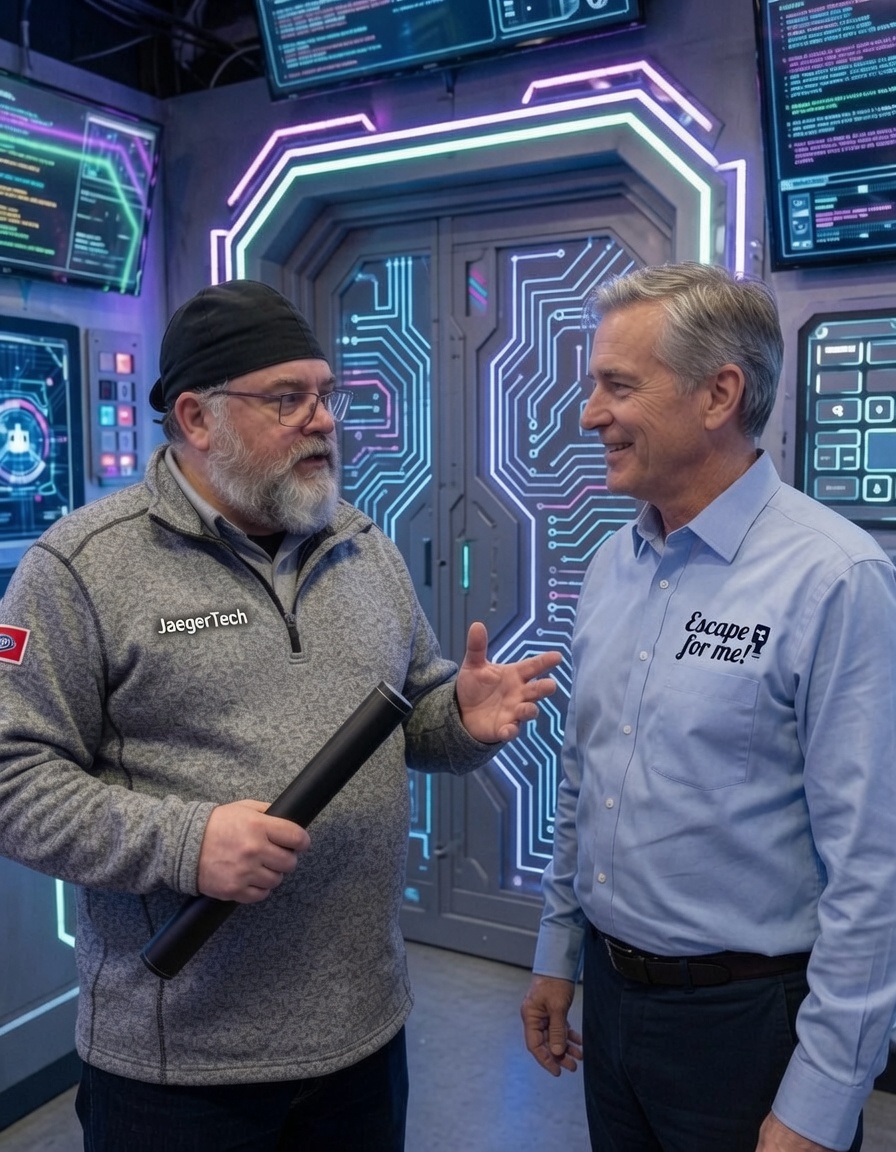
Same-Day 3D Printed RFID Prop Repair Helped Get an Escape Room Back in Service
Escape rooms are built around one simple promise: the room has to work.
The puzzles need to trigger. The props need to survive customer interaction. The electronics need to stay hidden but functional. The physical parts need to hold up through repeated use by people who are excited, rushed, confused, and sometimes a little too enthusiastic.
A local escape room operator recently contacted JaegerTech after customers damaged a 3D printed prop that housed an RFID sensor. That sensor was part of the room’s game logic, so the issue was not just cosmetic. If the RFID prop could not function correctly, the room could not operate the way it was designed to operate.
This was not a “we will get to it next week” problem.
The room needed to be operational. Bookings were at risk. Revenue was at risk. The operator needed replacement parts immediately.
JaegerTech helped 3D print the needed replacement components and get the equipment back up the same day. Then, within 48 hours, we designed an improved version of the prop with substantially less capability of being damaged during normal customer use.
That is the difference between simply replacing a broken part and helping solve the underlying problem.
The Real Problem Was Downtime
In an escape room, a small broken part can create a large operational problem.
An RFID sensor may be hidden inside a prop, cartridge, token, book, box, artifact, fuse, medallion, or other themed object. To the player, it may simply look like part of the story. To the room, it may be a critical trigger that tells the control system a puzzle has been solved.
If that prop breaks, the electronics may no longer be held in the right position. The sensor may not read consistently. The prop may not fit where it belongs. The puzzle may fail to trigger. The game master may have to intervene. In the worst case, the room may need to be taken out of service.
That is what makes escape room repairs different from ordinary replacement parts.
The question is not only:
How much does this plastic part cost?
The better question is:
How much money do we lose while this room is down?
For this job, speed mattered. The operator did not need a long procurement cycle or a distant vendor. They needed a practical replacement part fast enough to get the game running again.
Why Escape Room Parts Are Hard to Replace
Escape rooms are full of custom parts.
Some are decorative. Some are structural. Some hide sensors, RFID capsules, magnets, reed switches, wiring, or electronics. Some guide players through a puzzle without them realizing it. Some are built into props, cabinets, drawers, locks, doors, cartridges, or set pieces.
Many of these parts are not standard catalog items.
They may have been made by the original room designer, a franchise supplier, a prop shop, a local fabricator, or someone who is no longer involved. Even when a replacement exists, ordering it may take too long. Shipping alone can turn a simple repair into several days of downtime.
That is where local 3D printing becomes valuable.
JaegerTech was able to look at what failed, understand what the RFID prop needed to do, and produce functional replacement parts fast enough to help get the room running again the same day.
Step One: Get the Game Running Again
Emergency repair work is different from normal product development.
The first question is not always, “What is the perfect long-term design?”
The first question is:
What does this part need to do so the room can safely and reliably operate again today?
For an RFID prop, that may mean more than simply copying the outside shape. The replacement needs to hold the RFID sensor securely, protect it from normal customer handling, fit into the existing room hardware, and allow the sensor to read correctly.
Depending on the application, the part may need:
- Proper sensor placement
- Correct internal clearance
- A secure pocket for the RFID component
- Enough wall thickness to survive handling
- A reliable fit with the existing prop or fixture
- A design that can be printed quickly and repeatably
- A way to assemble or service the sensor if needed
For this escape room repair, the first priority was functional uptime. JaegerTech used 3D printing to produce replacement components quickly, allowing the operator to get the equipment back into service without waiting on a distant vendor, long lead time, or expensive custom fabrication process.
Step Two: Improve the Prop So It Is Harder to Damage
Getting the room back up the same day solved the immediate revenue problem.
But stopping there would have left the operator exposed to the same failure again.
Within 48 hours, JaegerTech designed an improved version of the prop with substantially less capability of being damaged during normal use. The goal was not just to duplicate the original part. The goal was to understand how customers were interacting with it, where the original design was vulnerable, and how the replacement could better survive repeated handling.
That is where 3D printing becomes more than emergency repair.
It becomes rapid iteration.
A replacement part can restore service. An improved replacement part can reduce the chance of future downtime.
For interactive environments like escape rooms, that distinction matters. Customers will continue to pull, twist, lift, slide, and handle the props. The room has to be designed around that reality. A fragile component hidden inside a game-critical prop can become a recurring maintenance problem unless the design is improved.
By moving from same-day replacement to a stronger revised design within 48 hours, the operator gained both immediate recovery and a better long-term solution.
Same-Day Manufacturing Has Real Business Value
The material cost of a printed replacement part is usually not the most important number.
The important number is the value of keeping the room open.
If an escape room has several bookings scheduled, a broken RFID prop can quickly cost far more than the part itself. Lost reservations, staff downtime, refunds, customer frustration, and emergency troubleshooting all add up.
That is why same-day repair capability matters.
Local additive manufacturing gives escape room operators a way to respond quickly when something breaks. Instead of waiting days or weeks, a damaged component can often be measured, redesigned, printed, tested, and returned to service in a much shorter window.
For businesses that depend on physical experiences, that speed protects revenue.
Built for Enthusiastic Customers
Escape room customers are not gently inspecting props behind glass.
They are pulling, turning, sliding, twisting, lifting, opening, closing, searching, and solving under pressure. Even well-designed rooms take abuse. Over time, parts wear. Occasionally, customers get too enthusiastic and damage something.
That is not unusual. It is part of operating an interactive attraction.
The better question is whether the room has a maintenance and replacement strategy.
A fragile custom RFID prop with no backup can shut down a room. A critical component with a digital file and spare inventory becomes much easier to manage. A redesigned component that is harder to damage becomes better still.
3D printing is especially useful for escape rooms because many replacement parts are low-volume, custom, and geometry-specific. The business may only need one, two, or five pieces. Traditional manufacturing is often too slow or too expensive for that kind of repair. 3D printing is built for it.
From Emergency Repair to Better Spare Parts
This project solved an immediate problem, but it also points to a better long-term strategy for escape room operators.
Critical parts should not exist as one-of-one items with no backup.
If an RFID prop can shut down a room, it should be documented. If it breaks frequently, it should be improved. If it is difficult to buy, it should be digitized. If it is essential to gameplay, it should probably have spares on hand.
JaegerTech can help escape room operators build a more reliable parts strategy by:
- Reproducing damaged or missing props
- Creating digital files for critical components
- 3D printing spare RFID housings and inserts
- Improving weak or frequently broken designs
- Producing low-volume replacement parts locally
- Supporting urgent repairs when rooms go down
- Reducing dependency on long vendor lead times
The goal is not just to fix one broken part.
The goal is to keep the room running.
Practical Support for Real Escape Room Problems
This was a real repair for a real escape room operator.
Customers damaged a 3D printed prop.
The prop housed an RFID sensor.
The sensor was part of the room’s game logic.
The equipment could not function correctly.
The operator was at risk of losing revenue.
Replacement parts were needed immediately.
JaegerTech helped 3D print the parts and get the room back up the same day.
Within 48 hours, JaegerTech also designed an improved version of the prop with substantially less capability of being damaged.
That is the practical value of local 3D printing and rapid design support.
For escape rooms, haunted attractions, museums, themed environments, arcades, and other interactive experiences, the equipment has to work. When custom parts fail, waiting on a replacement can be expensive. When the same weak design is put back into service unchanged, the problem may come back.
JaegerTech helps bridge that gap with fast, practical, local manufacturing support. We can help reproduce broken parts, improve fragile designs, print replacements, and build a better spare parts strategy for interactive environments.
If your escape room has broken props, damaged RFID housings, missing puzzle components, fragile mechanisms, or custom parts that are difficult to replace, JaegerTech can help reproduce, improve, and 3D print replacement parts quickly.
When the room is down, speed matters.
We help get the game running again, then help make it harder to break next time.
About the Author: jaegertechgroup.com

STAY IN THE LOOP
Subscribe to our free newsletter.
Leave A Comment
3D Printed Escape Room Props, Puzzle Housings, and Themed Mechanisms Escape rooms depend on objects that feel real. A puzzle box, control
3D Printing for Museums: Fossil Recreation, Exhibit Models, Replicas, and Educational Displays Museums often need objects that can be handled, displayed, studied,