
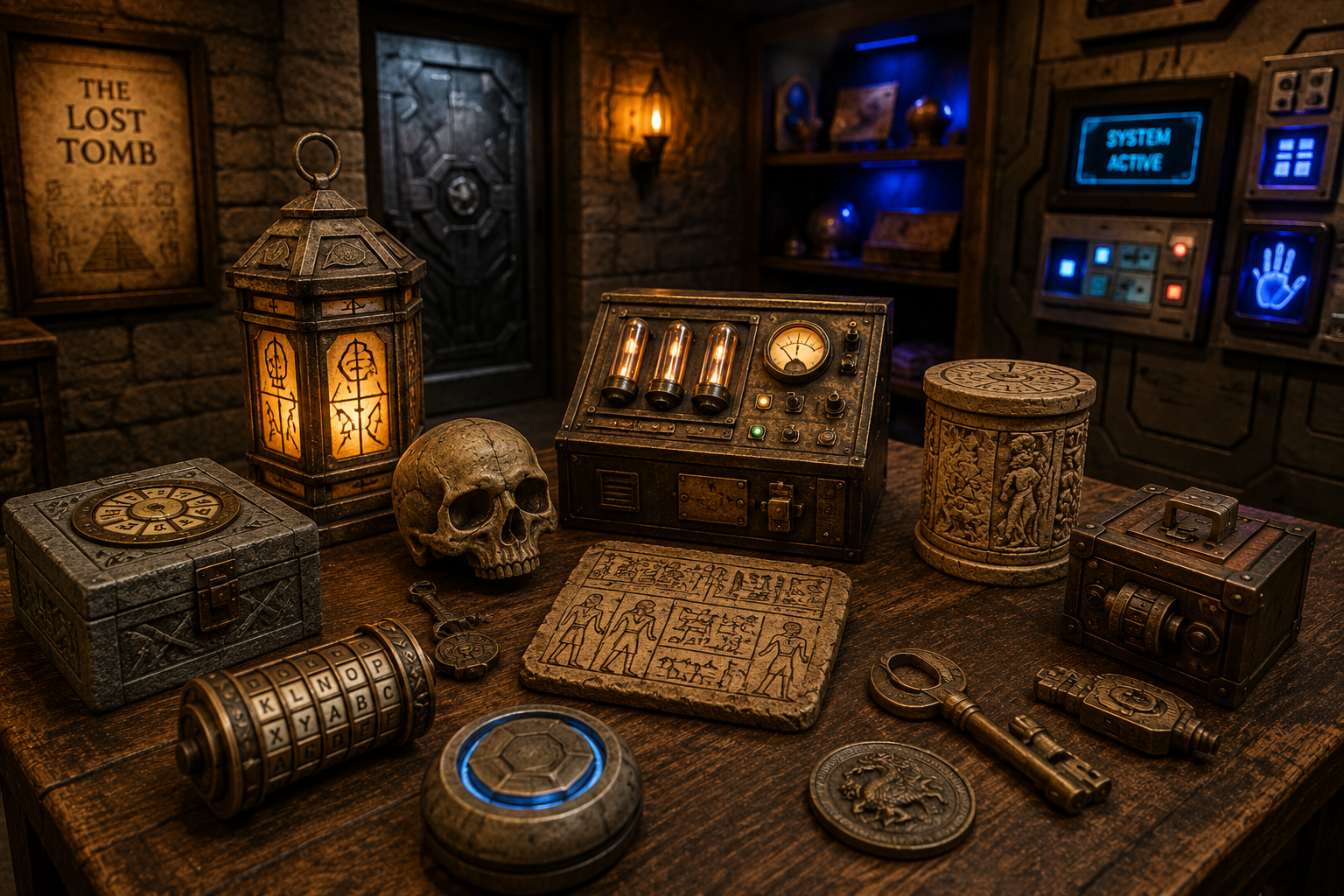
3D Printed Escape Room Props, Puzzle Housings, and Themed Mechanisms
Escape rooms depend on objects that feel real.
A puzzle box, control panel, artifact, decoder wheel, hidden switch, or themed mechanism has to do more than look interesting. It has to survive repeated handling, fit the room’s story, and keep working after dozens or hundreds of guests use it.
That is a good fit for additive manufacturing.
3D printing allows escape room owners and designers to create custom props, replacement parts, puzzle housings, and themed objects without committing to expensive tooling or mass production.
Escape Rooms Need Custom Parts
Most escape room props are not standard products.
A pirate room may need an aged compass housing. A laboratory room may need a fake diagnostic device. A space-themed room may need a glowing reactor core. A museum or archaeology room may need fossil fragments, relics, or ancient tablets.
These are not items most businesses can buy from a catalog.
3D printing makes it practical to create one-off or low-volume parts that match the theme of the room.
Common examples include:
- Puzzle boxes
- Decoder wheels
- RFID token holders
- Magnetic latch housings
- Fake control panels
- Themed buttons and knobs
- Hidden compartment parts
- Wall-mounted puzzle plates
- Artifact replicas
- Fossil or archaeology props
- Sci-fi device enclosures
- Replacement handles, hinges, and covers
For escape rooms, the value is not just the printed part. The value is a prop that fits the story, the puzzle, and the abuse level.
Puzzle Housings and Electronics Integration
Many escape room props include electronics.
A printed enclosure can be designed around the actual components inside the prop. That may include LEDs, sensors, switches, RFID readers, servos, magnets, batteries, speakers, or small control boards.
This is where additive manufacturing is especially useful.
Instead of forcing electronics into a generic box, the housing can be designed around the puzzle.
A custom prop housing can include:
- Internal board mounts
- Wire channels
- Battery access panels
- Hidden fasteners
- Service openings
- Light pipes
- Magnet pockets
- Sensor mounts
- Speaker openings
- Replaceable wear parts
This makes the prop easier to build, easier to repair, and easier to maintain.
For escape room operators, maintenance matters. If a part fails on a Saturday night, the room may lose bookings. Designing the prop for service access from the beginning can save time later.
Durable Props for Repeated Handling
Escape room guests are not gentle.
They pull, twist, drop, shake, and force things. A prop that looks good but breaks easily will become a problem quickly.
Material choice matters.
For decorative props, PLA or resin may be enough. For high-touch props, tougher materials are usually better. PETG, ASA, TPU, nylon, and reinforced materials may be better choices depending on the application.
Examples:
- PETG for general-purpose housings and handled parts
- ASA for painted props and stronger display pieces
- TPU for bumpers, grips, pads, or flexible parts
- Nylon or nylon-CF for mechanical parts, pivots, and wear areas
- Resin for high-detail decorative inserts
The best material depends on how the prop will be used. A skull on a shelf does not need the same material as a knob that gets turned 100 times a day.
Themed Objects and Visual Props
Some props are mostly visual.
These may include ancient relics, alien devices, fossil fragments, medical experiment pieces, industrial gauges, oversized keys, or cursed objects. In those cases, the printed part is often just the starting point.
Finishing is what makes the object believable.
A printed prop can be sanded, painted, weathered, dry brushed, stained, coated, or combined with lights and hardware. A simple 3D print can become a worn metal device, a stone tablet, a bone fragment, a sci-fi control unit, or a museum-style artifact.
This is especially useful for themed rooms where the prop needs to match a specific environment.
A clean plastic print may not be convincing. A finished, painted, and weathered print can be.
Replacement Parts and Repairs
Escape room props break.
That creates a second use case for 3D printing: replacement parts.
Many rooms have older props that are no longer available, custom-built, or difficult to repair. A broken knob, latch cover, token, hinge, tray, or bracket may shut down part of the experience.
3D printing can often reproduce or improve those parts.
Replacement parts may include:
- Knobs
- Handles
- Covers
- Tokens
- Puzzle pieces
- Hinges
- Mounts
- Clips
- Trays
- Bezels
- Access panels
- Button guards
In some cases, the replacement can be made stronger than the original. The part can also be redesigned to reduce future failures.
Prototyping New Room Concepts
Escape room designers often need to test ideas before committing to final props.
A puzzle may look good on paper but fail during testing. The object may be too confusing, too fragile, too small, too easy to force, or too hard to reset.
3D printing supports quick iteration.
A designer can test the size, shape, fit, function, and handling before investing in the final finished prop. If the first version needs changes, the model can be revised and printed again.
That is useful for:
- New room development
- Puzzle testing
- Reset procedure testing
- Guest handling tests
- Electronics fit checks
- Mounting and installation checks
- Backup prop creation
For low-volume custom work, this is often faster and more practical than traditional fabrication.
Design for Maintenance
A good escape room prop should be designed for the operator, not just the guest.
That means thinking about what happens after the room opens.
Can the battery be changed? Can the electronics be reached? Can the prop be mounted securely? Can a broken wear part be replaced? Can staff reset the puzzle quickly? Can guests accidentally damage the mechanism?
These details matter.
A well-designed prop may include hidden screws, removable panels, replaceable inserts, stronger mounting points, or internal reinforcement. These features are easier to include when the part is designed specifically for the application.
Practical Takeaway
Escape room props are a strong fit for additive manufacturing because they are usually custom, low-volume, themed, and frequently changed or repaired.
3D printing can support puzzle housings, visual props, electronics integration, replacement parts, and new room prototyping. The best results come from matching the material, finish, and design to the way the prop will actually be used.
At JaegerTech, we help turn custom prop ideas into practical physical parts. That may include themed objects, puzzle housings, replacement components, electronics enclosures, and durable pieces designed for repeated guest handling.
If you are developing a new room, repairing an existing prop, or building a themed mechanism, JaegerTech can help review the design, material choice, durability needs, and manufacturing approach before you commit to a build.
About the Author: jaegertechgroup.com

STAY IN THE LOOP
Subscribe to our free newsletter.
Leave A Comment

Same-Day 3D Printed RFID Prop Repair Helped Get an Escape Room Back in Service Escape rooms are built around one simple promise:
3D Printing for Museums: Fossil Recreation, Exhibit Models, Replicas, and Educational Displays Museums often need objects that can be handled, displayed, studied,