
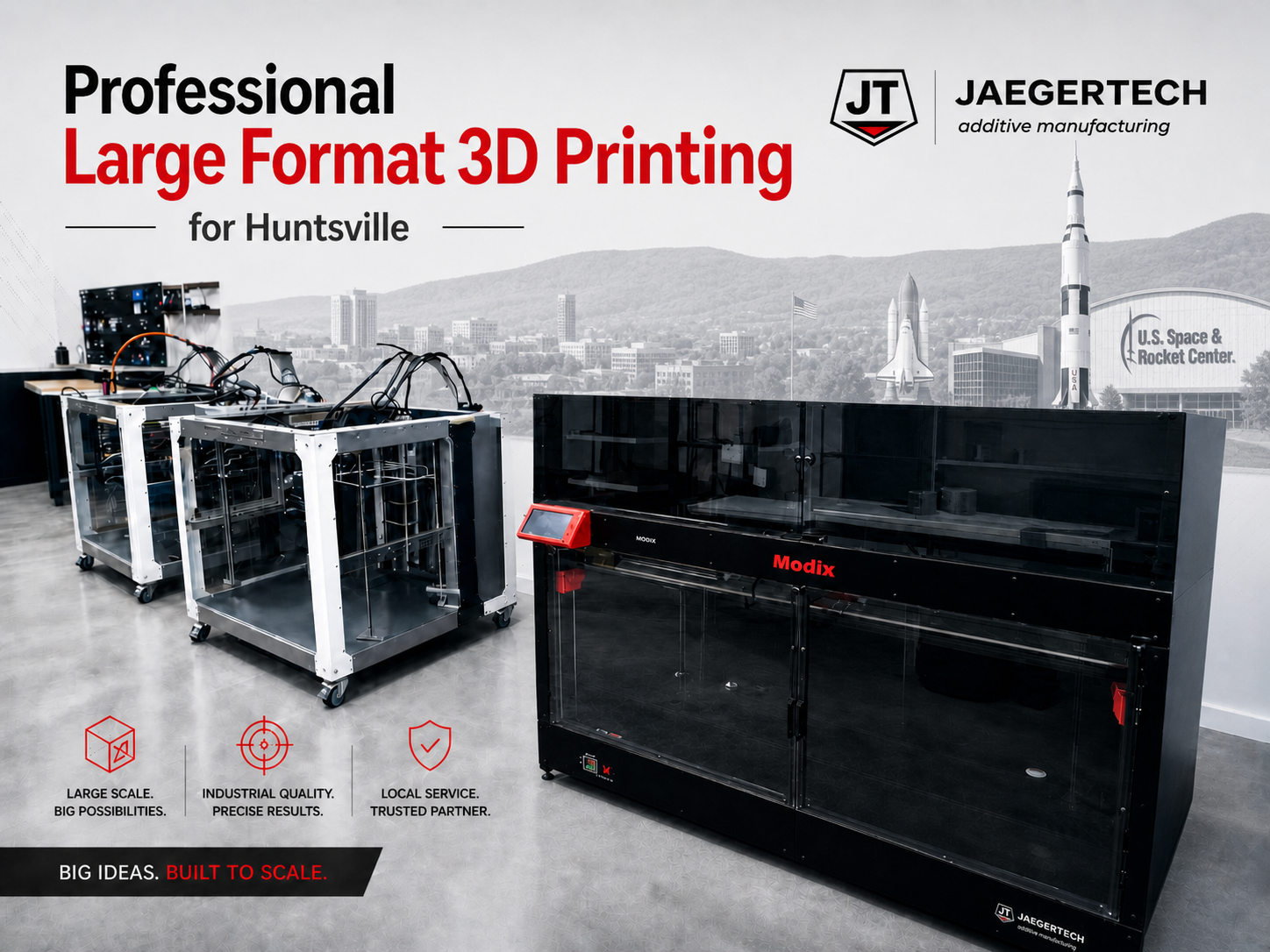
Modernizing Large-Format 3D Printers Instead of Replacing Them
One of the biggest advantages of open-source and openly serviceable 3D printers is that they do not have to become obsolete just because some of their components are aging.
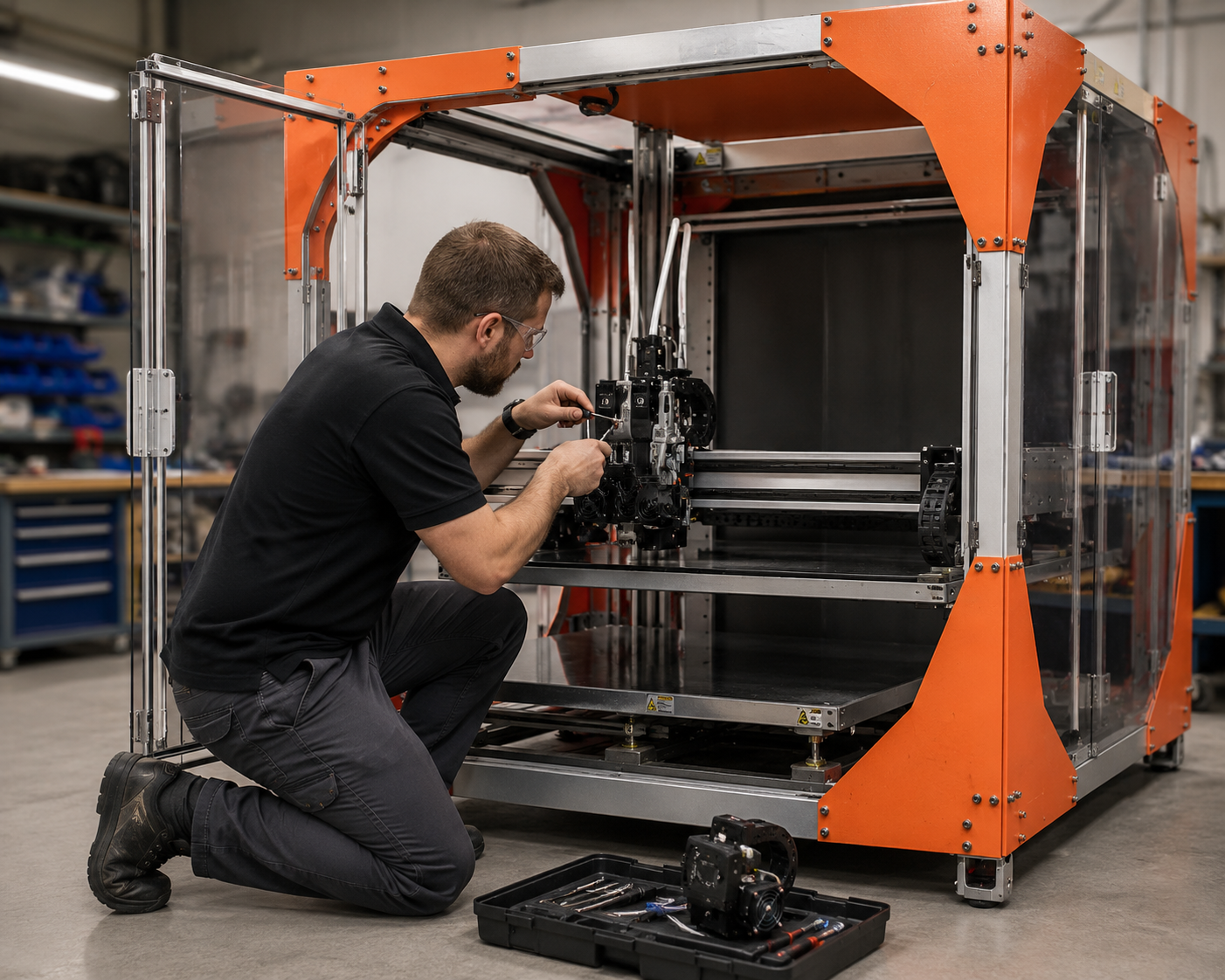
At Jaeger Technology Group, we have been rebuilding and modernizing several of our large-format machines, including our Modix Big 120X and Stacker 4XL printers, rather than replacing otherwise capable industrial platforms.
These machines still have excellent mechanical foundations. Large frames, substantial build volumes, rigid motion systems, and proven structures are expensive to replace. In many cases, it makes more sense to upgrade the systems around them.
That is exactly what we are doing.
Proven Hardware, Now Being Modernized
It is worth noting that we are not rebuilding these machines because the original platforms were poor performers.
Quite the opposite.
Our primary Stacker 4XL is still running on its original control boards and original hotends, with more than 789 days of logged operating time.
That is more than two years of cumulative runtime on the core hardware.
That kind of service life says a lot about the underlying platform.
What we are doing now is taking machines with proven frames and mechanics and updating them with newer motors, modern toolheads, improved build surfaces, and more current control hardware where it makes sense.
In some cases, the original components are still doing their job remarkably well. In others, years of production use have created a good opportunity to rebuild the machine around the way we work today.
The objective is not replacement for replacement’s sake. It is to preserve what has proven durable while adding the capabilities we now need.
New Motors, New Toolheads, More Capability
Several of these machines have accumulated years of heavy production use, including long multi-day prints.
As part of the rebuild process, we are replacing aging motors and updating the motion hardware where appropriate. We are also moving toward newer toolhead designs with better hotends, improved extruders, more reliable filament paths, and greater material flexibility.
The goal is not simply to restore the machines to their original condition.
We are retooling them to be more capable than they were when they were new.
That includes improvements aimed at:
- higher-flow extrusion
- more reliable large-nozzle printing
- better TPU and flexible-material handling
- improved PETG, ASA, nylon, and engineering-material performance
- easier hotend and nozzle service
- improved cable management
- better thermal reliability during long prints
For a production shop, those improvements can be much more valuable than simply buying another stock machine.
Updating the Build Surface
The build platforms are being modernized as well.
Depending on the machine and application, we have upgraded or are evaluating PEI build surfaces and removable cold-plate systems.
Modern removable build plates can make a significant difference on large-format printers. They can simplify part removal, reduce downtime between jobs, improve repeatability, and make it easier to select a surface appropriate for the material being printed.
PEI remains one of the most useful general-purpose surfaces for many engineering thermoplastics, while interchangeable plates give us more flexibility when running different materials and applications.
The Advantage of Open-Source Equipment
This is where open-source and serviceable machine architectures really prove their value.
A closed machine can become difficult to support once the manufacturer stops producing a particular controller, toolhead, motor, or software version.
An open platform gives us much more freedom.
We can replace motors with current components. We can install modern extruders and hotends. We can change controllers. We can upgrade firmware. We can improve sensors, wiring, networking, and safety systems without waiting for the original manufacturer to release a proprietary upgrade kit.
In effect, the printer becomes a machine platform rather than a disposable appliance.
That matters even more with large-format equipment, where the frame and mechanical structure may still represent thousands of dollars of value long after the original electronics have become dated.
Rebuilding Around the Way We Actually Work
We are also using these rebuilds as an opportunity to standardize the machines around our own shop workflow.
Rather than maintaining several completely different generations of hardware, we are working toward more common:
- toolheads
- hotends
- nozzles
- motors
- controllers
- wiring practices
- network architecture
- slicer profiles
- spare parts
That simplifies maintenance and reduces the number of unique components we need to keep on the shelf.
It also means that when a machine goes down, we are more likely to have the parts and knowledge required to get it running again quickly.
More Than a Repair Project
These rebuilds are not simply maintenance projects.
They are part of a broader effort to increase the capability of the shop.
By completely rebuilding and retooling these machines, we can use equipment we already know well while expanding what it can do.
That means better support for:
- large industrial prototypes
- tooling and fixtures
- patterns
- production aids
- engineering thermoplastics
- flexible materials
- larger nozzles and higher deposition rates
- longer unattended production runs
Instead of buying entirely new systems every time our requirements change, we can selectively improve the machines we already own.
Extending the Useful Life of Industrial Equipment
There is a tendency in technology to assume that newer automatically means better.
In manufacturing, that is not always true.
A large, rigid, proven machine with modern electronics and a current extrusion system can be more useful than replacing it with a completely new platform that still has to be qualified, tuned, and integrated into the shop.
The Modix and Stacker rebuilds are a good example.
We are keeping the parts of the machines that still make sense and replacing the parts that no longer do.
The result should be a group of large-format printers with modern toolheads, refreshed motion systems, better build surfaces, improved reliability, and significantly broader material capability.
Our primary Stacker 4XL has already accumulated more than 789 days of logged runtime on its original boards and hotends. Rather than treating machines like that as obsolete, we see a proven mechanical platform worth continuing to invest in.
By combining that durability with modern motors, toolheads, build surfaces, electronics, and controls, we can extend the useful life of these systems while giving them capabilities they never had when they left the factory.
That is one of the real advantages of open-source manufacturing equipment: the machine can evolve along with the shop.
Need an Older 3D Printer Brought Back to Life?
If you have a large-format or industrial 3D printer that is mechanically sound but suffering from outdated electronics, worn motors, obsolete toolheads, or limited material capability, it may be worth rebuilding instead of replacing.
Jaeger Technology Group can help modernize, rebuild, and retool existing machines with updated controls, motors, hotends, extruders, build surfaces, and networking.
Have an older machine you want to get productive again? Call us.
About the Author: jaegertechgroup.com

STAY IN THE LOOP
Subscribe to our free newsletter.
Leave A Comment
How Large-Format 3D Printing Helped Validate a Production Mold in 9 Days When an energy company was preparing to invest in an
From 3D Scan to Perfect Fit: The Corvette Bumper Project Moves Forward A few weeks ago, we shared a project that demonstrated
Still Using Cura or Simplify3D? JaegerTech Can Help Build an OrcaSlicer Profile for Your 3D Printer A 3D printer does not become
Preventive Maintenance for 3D Printers: In-Shop and On-Site Service A 3D printer rarely fails without warning. Belts loosen, bearings collect debris, nozzles