
FDM / FFF 3D Printing Materials: Choosing the Right Plastic for the Job
You picked a material, ran the print, and the part warped off the bed. Or it looked perfect until someone left it in a hot car. Or it snapped on the first real load. Choosing the wrong plastic for an FDM/FFF print isn’t just a wasted spool — it’s wasted time, machine hours, and sometimes a missed deadline.
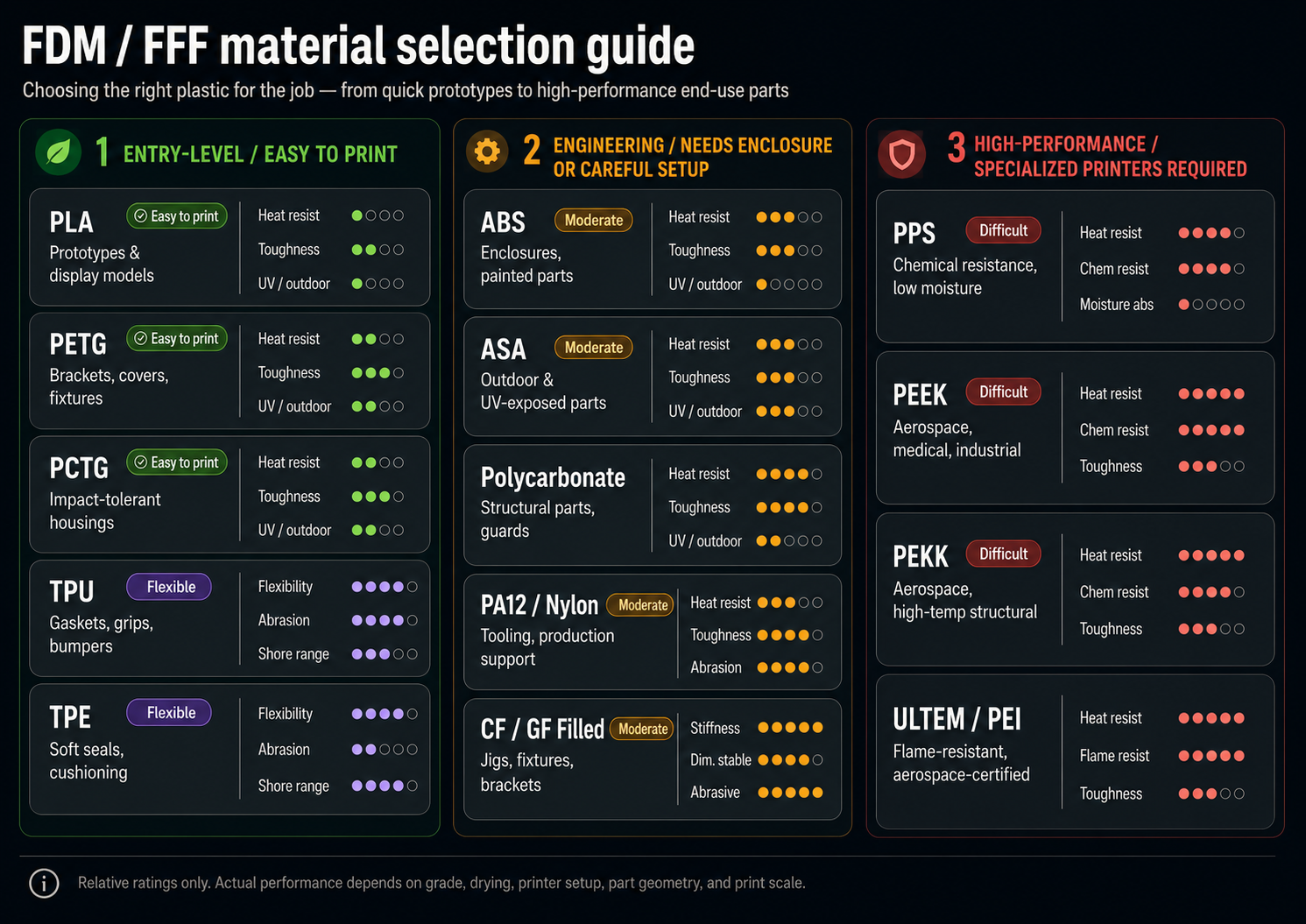
This guide covers the most common FDM/FFF materials, from PLA to PEEK, with a practical focus on what each one is actually good for, where it falls short, and what it takes to print well. A comparison table at the end makes it easy to scan.
How to Choose: Start With the Use Case
Before picking a material, answer these four questions:
- What temperature will the part see? Ambient shop use is very different from a hot vehicle, an oven, or an industrial environment.
- What mechanical demands does it face? Static load, impact, flex, vibration, and fatigue each favor different materials.
- Where will it live? Indoors, outdoors, in chemicals, in contact with food or skin?
- How big is it, and what does the finished part need to look like? Part size and finishing method both constrain your options more than most people expect.
With those answers in hand, the material choice usually narrows quickly.
A Note on Safety Before We Get Into Materials
All FDM/FFF materials are heated industrial plastics. Even common ones can release fumes, odors, and ultrafine particles during printing. Post-processing — sanding, drilling, cutting, machining — adds a second layer of risk that’s easy to overlook.
General shop practice for FDM/FFF work:
- Good room ventilation; enclosed printers for higher-temperature materials
- Safety glasses during support removal, cutting, sanding, or machining
- Gloves when handling hot components or sharp edges
- Respiratory protection when generating dust
- HEPA vacuuming rather than compressed air for cleanup
- Review the material Safety Data Sheet (SDS) for any production job
- Dry and store filament properly
For common materials in a well-ventilated space, basic PPE is usually enough. Higher-temperature materials, fiber-reinforced filaments, and solvent finishing all require more. Safety is part of the material decision, not an afterthought. Each material section below includes any specific precautions worth knowing.
PLA: Easy to Print, Right for Prototypes
PLA is the most forgiving FDM/FFF material. It prints easily, holds fine detail, and warps less than nearly any engineering plastic. That makes it ideal for concept models, visual prototypes, fit checks, and display parts.
What it’s not good for: anything that needs heat resistance, outdoor durability, or long-term mechanical toughness. In a hot vehicle or direct summer sun, PLA softens and deforms.
Best for: visual prototypes, form/fit models, display pieces, low-stress brackets, casting patterns, educational parts
PLA is often the right starting point, just not the final answer.
PETG: The Workhorse General-Purpose Material
PETG offers a practical balance of printability, toughness, chemical resistance, and moderate temperature performance. It’s generally tougher than PLA, resists moisture better, and holds up to many common chemicals. It’s a bit stringier to print and less rigid than PLA, but for parts that need to actually work, it’s usually the better default.
Best for: functional prototypes, brackets, covers, shop fixtures, guards, light-duty production parts
When a part needs real durability but doesn’t justify the process demands of ABS, nylon, or polycarbonate, PETG is often the right call.
PCTG: When PETG Isn’t Quite Tough Enough
PCTG is closely related to PETG but typically more impact-resistant and ductile. It’s the next step when PETG is almost right but a bit too brittle or stiff. Chemical resistance is comparable, and it’s easier to handle than higher-temperature engineering materials.
Best for: functional housings, covers and guards, durable prototypes, production components where impact tolerance matters
ABS: Tough, but Demands Respect
ABS has a long manufacturing history and remains useful where good toughness, decent heat resistance, and sandable/paintable surfaces are needed. The challenge is its printing behavior: ABS warps and cracks without proper thermal control. Large parts generally require an enclosed printer, good bed adhesion, and careful setup.
Best for: functional prototypes, enclosures, cosmetic/painted parts, components that need more heat resistance than PLA or PETG
Safety note: ABS produces noticeable fumes during printing. Use an enclosed printer with filtration or exhaust and avoid prolonged fume exposure. When sanding, cutting, or machining, use dust collection and respiratory protection. Solvent smoothing requires chemical-resistant gloves, eye protection, ventilation, and fire awareness.
ABS is a capable material, but not a casual one.
ASA: ABS with Better Weather Resistance
ASA performs similarly to ABS but with meaningfully better UV and weather resistance. For outdoor parts, exterior housings, and anything exposed to sustained sunlight, ASA is almost always the better choice over ABS, PLA, PETG, or PCTG. Like ABS, it benefits from an enclosed printer and careful thermal management.
Best for: outdoor brackets and covers, exterior housings, UV-exposed parts, automotive and equipment components
Safety note: Same precautions as ABS – Ventilation during printing, dust control and respiratory protection during post-processing.
Polycarbonate: Strong, Tough, and Heat Resistant
Polycarbonate (PC) offers excellent toughness, impact resistance, and higher heat tolerance than most common FDM/FFF materials. It’s demanding to print — requiring high nozzle temperatures, a heated bed, an enclosed printer, and strict moisture control. Wet PC prints poorly and produces weak parts. When processed correctly, it’s one of the strongest engineering options available in filament form.
Best for: structural brackets and housings, impact-resistant guards, mechanical components, heat-resistant fixtures, some transparent/translucent applications
Safety note: PC prints at high temperatures. You will need to treat the hot end, bed, and chamber as burn hazards. Use heat-resistant gloves when handling hot components. Dust control and respiratory protection during machining or sanding.
Don’t treat PC as a simple upgrade from PETG. The machine, geometry, drying, and thermal control all matter significantly.
Polyamide (Nylon): PA6, PA11, PA12, PA66
Nylons are valued for toughness, fatigue resistance, and abrasion resistance. All grades are very moisture-sensitive, wet nylon prints poorly and produces inconsistent mechanical properties. Disciplined drying and sealed storage are non-negotiable.
PA6 — Strong and tough, but absorbs more moisture than other grades. Good for durable functional parts, fixtures, and abrasion-resistant components where careful handling is feasible.
PA11 — Better ductility and impact resistance than PA6. The right pick for clips, snap-fits, and parts subject to repeated flexing where toughness matters more than rigidity.
PA12 — Lower moisture absorption than PA6, good dimensional stability and chemical resistance. A practical industrial nylon widely available in reinforced grades and commonly used in production support parts.
PA66 — Higher strength, stiffness, and heat resistance than PA6 or PA12. More challenging to print; suited for higher-temperature mechanical and wear applications where the machine and process can support it.
Safety note: Nylon dust from sanding, drilling, or machining requires eye protection, dust collection, and respiratory protection.
Reinforced Filaments: Carbon Fiber and Glass Fiber Filled
Chopped carbon and glass fiber reinforcement is available in many base materials — most often nylon, PETG, polycarbonate, and higher-performance polymers. Reinforcement improves stiffness and dimensional stability meaningfully, but these are chopped fibers, not continuous fiber composites. They don’t replicate the strength of a layup.
These materials are also abrasive, requiring hardened nozzles and wear-resistant extruder components.
Best for: jigs and fixtures, tooling, brackets, production aids, lightweight structural components
Safety note: Sanding, grinding, filing, drilling, or cutting reinforced parts releases airborne plastic dust and fiber fragments. Use wet sanding or local dust extraction, a properly fitted respirator, safety glasses, and HEPA vacuuming for cleanup. Don’t treat fiber-filled post-processing dust as a minor nuisance.
Flexible Materials: TPU and TPE
Flexible materials are used when a part needs elasticity, grip, shock absorption, or rubber-like behavior. Flexibility is measured in Shore hardness — common FDM/FFF flexibles range from around Shore 60A (very soft) to Shore 95A (firm flexible).
TPU is more printable than most soft TPEs, with good abrasion resistance and resilience. Firmer grades (85A–95A) work on many direct-drive machines; softer grades need more process control.
Best for: gaskets, pads, grips, bumpers, flexible hinges, vibration-damping parts
TPE covers a broader family of thermoplastic elastomers — often softer and more rubber-like than TPU, and harder to print reliably. Very low durometer materials require direct-drive extrusion, slow speeds, and a well-constrained filament path.
Best for: soft seals, rubber-like covers, cushioning, low-durometer prototypes
Safety note: TPU and TPE are generally lower-odor than ABS or ASA, but formulations vary — review the SDS for industrial or proprietary grades. Use dust control and respiratory protection when sanding or machining.
PPS: Chemical Resistance and Dimensional Stability
Polyphenylene Sulfide (PPS) occupies a useful spot between nylon/polycarbonate and the PEEK/PEKK family. It offers excellent chemical resistance, very low moisture absorption, good dimensional stability, and continuous-use temperature ratings that exceed most mid-range engineering materials.
PPS is not as widely known as nylon or PEEK in additive manufacturing, but it’s worth considering when the application involves aggressive chemicals, sustained heat, or environments where moisture-sensitive nylons would be problematic.
Best for: chemically aggressive environments, high-temperature fixtures, components where low moisture absorption matters, industrial tooling
PPS requires a capable printer with high nozzle temperatures and good thermal management — not as demanding as PEEK, but not beginner territory either.
High-Performance Materials: PEEK, PEKK, and ULTEM/PEI
These materials are used in demanding aerospace, industrial, medical, and chemical environments where common engineering plastics fall short. They require specialized printers, very high nozzle temperatures, heated chambers, and careful process knowledge. These are industrial polymer processing operations requiring the right equipment.
PEEK offers high temperature resistance, excellent chemical resistance, and strong mechanical properties. Very high nozzle and chamber temperatures are required. Poorly printed PEEK may look acceptable while having weak layer bonding or poor crystallinity.
PEKK is in the same polyaryletherketone family as PEEK and can be somewhat more processable depending on the grade — but still demands a capable high-temperature machine and controlled conditions.
ULTEM/PEI is not a polyaryletherketone, but belongs in this discussion because it’s used in many of the same demanding contexts. It offers high heat resistance, flame resistance, strength, and dimensional stability. Common grades include ULTEM 9085 and ULTEM 1010. It’s often specified not because it’s the strongest option available, but because of its combination of thermal performance, flame behavior, and certification history in aerospace and industrial applications.
Best for all three: high-temperature components, chemical-resistant parts, aerospace and industrial applications, medical and laboratory tooling, electrical insulation, flame-resistant components
Safety note: Treat printing as an industrial process — enclosed equipment, ventilation, and burn protection. When machining or finishing, use dust collection, respiratory protection, and eye protection. Review supplier SDS documentation for production work.
Part Size Changes Everything
A material that works well on a small bracket can become very difficult at larger scale. Big prints create longer thermal gradients, more accumulated shrinkage, and more opportunity for the process to drift. The part may come off the printer looking acceptable, then show warping, layer separation, or cracking after machining, coating, or heat exposure.
This is especially true of ABS, ASA, PC, nylons, fiber-filled materials, and high-performance polymers.
Practical approaches for large parts:
- Split the design into bonded or mechanically fastened sections
- Use a more dimensionally stable material
- Add ribs or internal structure to control distortion
- Run smaller test sections before committing to the full build
- Use heated chambers and larger nozzles for process stability
- Dry filament before and throughout the print
Sometimes the right engineering decision is to design around the process rather than force a large, difficult geometry through in one piece.
Material Comparison Table
| Material | Temp Resistance | Toughness | Printability | Moisture Sensitivity | UV/Weather | Typical Use Case |
|---|---|---|---|---|---|---|
| PLA | Low | Low–Moderate | Very Easy | Low | Poor | Prototypes, display models |
| PETG | Moderate | Moderate | Easy | Low | Fair | Functional parts, brackets, covers |
| PCTG | Moderate | Moderate–High | Easy | Low | Fair | Housings, impact-tolerant parts |
| ABS | Moderate–High | Moderate–High | Moderate (needs enclosure) | Low | Poor | Enclosures, painted parts |
| ASA | Moderate–High | Moderate–High | Moderate (needs enclosure) | Low | Good | Outdoor parts, UV-exposed components |
| Polycarbonate | High | High | Difficult | Moderate | Fair | Structural parts, impact guards |
| PA6 | Moderate–High | High | Moderate | High | Fair | Fixtures, abrasion-resistant parts |
| PA11 | Moderate | High | Moderate | Moderate | Fair | Snap-fits, flexible-tough parts |
| PA12 | Moderate–High | High | Moderate | Low–Moderate | Fair | Production support, tooling |
| PA66 | High | High | Difficult | Moderate | Fair | Wear parts, high-temp mechanical |
| CF/GF Filled | Varies | Moderate (stiff/brittle) | Moderate (abrasive) | Varies | Varies | Jigs, fixtures, structural aids |
| TPU | Low–Moderate | High (flexible) | Moderate | Low | Fair | Gaskets, grips, bumpers |
| TPE | Low–Moderate | High (flexible) | Difficult | Low | Fair | Soft seals, cushioning |
| PPS | High | Moderate–High | Difficult | Very Low | Good | Chemical environments, hot fixtures |
| PEEK | Very High | High | Very Difficult | Very Low | Good | Aerospace, medical, industrial |
| PEKK | Very High | High | Very Difficult | Very Low | Good | Aerospace, high-temp structural |
| ULTEM/PEI | Very High | High | Very Difficult | Very Low | Good | Aerospace ducting, flame-resistant parts |
Trademark Notice: FDM® and Fused Deposition Modeling® are registered trademarks of Stratasys, Ltd. FFF (Fused Filament Fabrication) is used as the generic industry term for material-extrusion filament printing. ULTEM® is a registered trademark of SABIC or its affiliates; ULTEM 9085 and ULTEM 1010 designate material grades associated with that trademark. All other product names and trademarks referenced are the property of their respective owners. Use of these terms is descriptive only and does not imply endorsement or affiliation.
About the Author: jaegertechgroup.com

STAY IN THE LOOP
Subscribe to our free newsletter.
Leave A Comment
From 3D Scan to Perfect Fit: The Corvette Bumper Project Moves Forward A few weeks ago, we shared a project that demonstrated

Great Conversations and New Connections at SMD in Huntsville Last week, Janelle and I had the opportunity to attend SMD in Huntsville,
Custom 3D Printed Speaker Pods for a 2005 Ford Mustang Sometimes the problem is not the speaker. It is everything around it.
Still Using Cura or Simplify3D? JaegerTech Can Help Build an OrcaSlicer Profile for Your 3D Printer A 3D printer does not become