
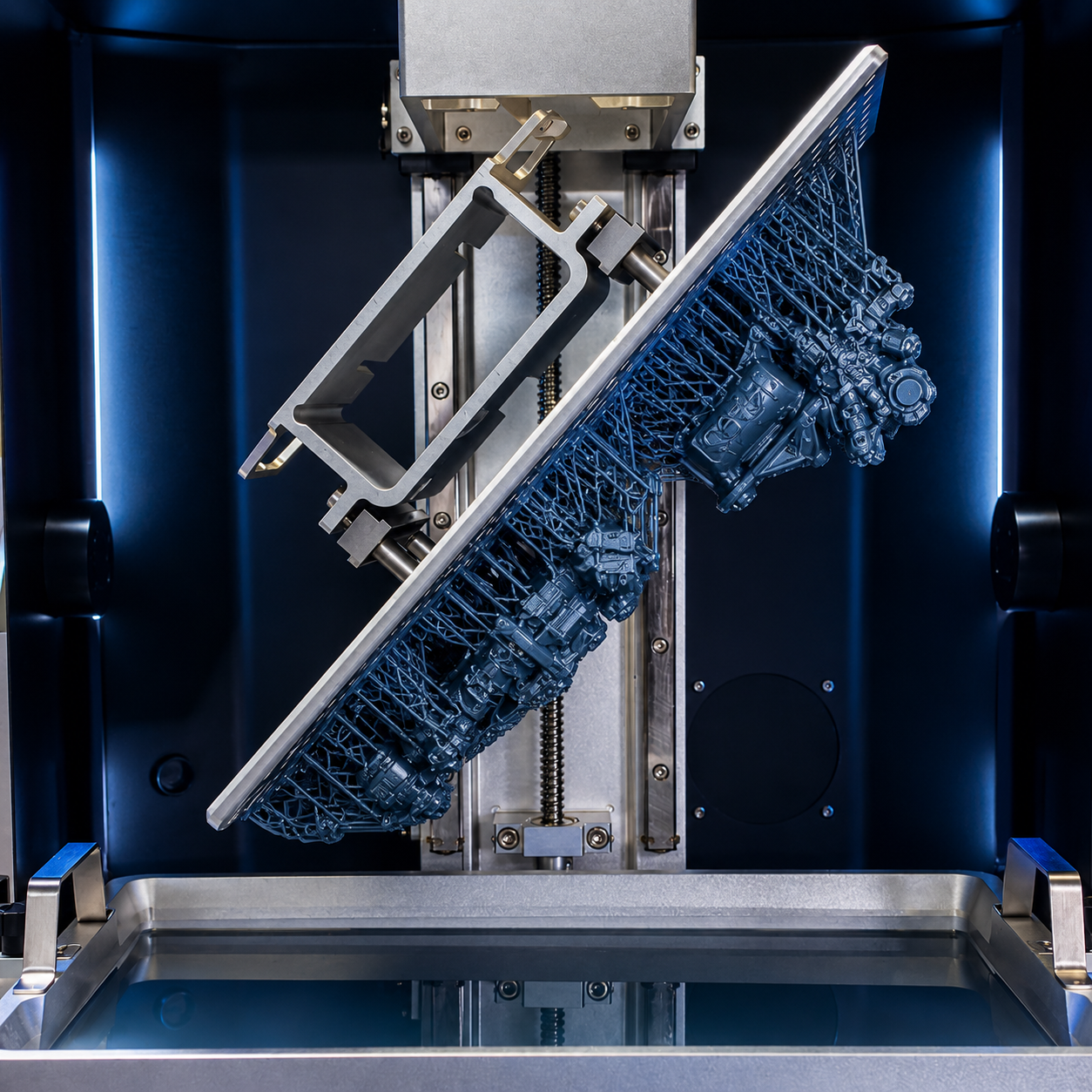
How Photopolymer Resin 3D Printing Works
Photopolymer resin 3D printing is one of the best additive manufacturing processes for producing highly detailed, smooth, visually impressive parts. Compared with filament-based 3D printing, resin printing can capture fine surface detail, small features, organic shapes, sharp edges, and complex textures with very little visible layer stepping. This is why resin printing is widely used for miniatures, dental models, jewelry patterns, engineering prototypes, medical models, casting patterns, display models, and small production components.
The basic idea is simple: liquid resin is selectively hardened by light. The printer starts with a vat of liquid photopolymer resin. A build platform lowers into the resin, and ultraviolet or near-ultraviolet light exposes a thin layer of the material. Wherever the light hits, the resin cures into a solid. The printer then lifts or separates that layer from the vat film, moves to the next layer height, and repeats the process until the part is complete.
What Makes Photopolymer Resin Cure?
Photopolymer resins contain light-sensitive chemistry. Most 3D printing resins include several major components:
A monomer or oligomer base, which forms the body of the cured plastic.
A photoinitiator, which reacts when exposed to the correct wavelength of light.
Pigments, fillers, stabilizers, and additives that control color, opacity, viscosity, flexibility, toughness, cure speed, and surface finish.
When the printer’s UV light activates the photoinitiator, the photoinitiator creates reactive chemical species that start linking the resin molecules together. This is called polymerization. In practical terms, the exposed liquid resin changes from a fluid into a solid plastic.
Most desktop and industrial resin printers use light around 405 nm, although other wavelengths exist in specialized systems. The resin must be matched to the printer’s light source, exposure intensity, layer height, and intended use. A resin that works beautifully on one printer may need significant exposure tuning on another.
Why Resin Printing Looks So Good
Resin printing can produce beautiful results because it does not extrude a bead of plastic through a nozzle. In FDM or FFF printing, the part is built from roads of melted filament. Those roads create visible layer lines and surface texture. Resin printing instead cures an entire cross-section from liquid, often at very fine layer heights.
This allows resin printers to create:
- Very fine surface detail
- Smooth curves and organic shapes
- Sharp text, logos, and small features
- Thin walls and delicate geometry
- Highly accurate display models
- Cleaner surfaces than typical filament prints
In many cases, resin parts look closer to molded parts than typical FDM prints. This is especially true after proper washing, curing, support removal, sanding, priming, or painting.
There are several major resin printing technologies. SLA uses a laser to trace each layer. DLP uses a projected image to cure a whole layer at once. MSLA/LCD resin printing uses an LCD mask and UV light array to expose each layer. All three rely on the same basic concept: controlled light exposure turns selected regions of liquid resin into solid plastic.
Common Types of Photopolymer Resin
Photopolymer resins are not all the same. The material choice matters as much as the printer:
- Standard model resin is used for general visual models, miniatures, prototypes, and display parts. It prints easily and captures detail well, but it is often brittle compared with engineering plastics.
- Tough or ABS-like resin is designed to improve impact resistance and reduce brittleness. These materials are often better for functional prototypes, housings, brackets, clips, and parts that need limited handling strength.
- Flexible and elastic resin can produce rubber-like parts, gaskets, grips, seals, cushions, and compliant features. These resins are usually more difficult to print, clean, and support than standard resin.
- High-temperature resin is formulated for applications where heat resistance matters, such as tooling, fixtures, thermoforming masters, or engineering prototypes exposed to elevated temperatures. These materials may require more careful post-curing.
- Dental and medical model resin is used for dental models, surgical guides, anatomical models, and similar applications. Some materials are biocompatible after validated processing, but biocompatibility depends on the specific resin, printer, wash process, cure process, and regulatory documentation.
- Castable resin is used for jewelry, dental casting, and investment casting patterns. These materials are designed to burn out more cleanly than ordinary resin, though burnout behavior varies significantly by brand, geometry, shell system, and process.
- Clear resin can produce transparent or semi-transparent parts. It can be polished, coated, or clear-coated for improved optical clarity, but most clear resin prints are not optically perfect without significant finishing.
- Filled or ceramic-loaded resin contains solid particles to improve stiffness, heat resistance, surface quality, or casting/burnout behavior. These materials can be useful but often require more aggressive mixing, careful handling, and more difficult cleanup.
The Challenges of Resin Printing
Resin printing is capable of excellent results, but it is not magic. The process has real limitations.
The first major issue is brittleness. Many photopolymer resins are more brittle than thermoplastics such as nylon, polycarbonate, PETG, or polypropylene. Even “tough” resins may not behave like injection-molded ABS or nylon. Parts can crack, chip, creep, or fail under impact depending on the material and geometry.
Another challenge is UV sensitivity and aging. Since these materials cure through light exposure, additional UV exposure from sunlight or shop lighting can continue to affect the material over time. Some resins become more brittle, yellow, or dimensionally unstable with age and UV exposure.
Resin printing also involves post-processing. Parts usually need to be washed in alcohol or a dedicated cleaning solution, dried, support structures removed, and then post-cured under UV light. The final properties of the part depend heavily on proper post-processing. Under-cured parts may remain soft or tacky. Over-cured parts may become more brittle.
Dimensional accuracy can also be affected by shrinkage, exposure settings, support placement, peel forces, and orientation. Resin prints can be very accurate, but they are not automatically perfect. Large flat surfaces, thin walls, tall parts, and hollow parts may warp, cup, crack, or trap uncured resin if not designed correctly.
Undesirable Characteristics
The biggest practical drawback is that uncured resin is messy and should be treated with respect. Liquid photopolymer resin can irritate skin and eyes, and repeated exposure can lead to sensitization. Gloves, eye protection, ventilation, careful cleanup, and proper waste handling are important.
Resin parts can also have a surface inhibition layer, often leaving them slightly tacky before washing and curing. Supports may leave marks that require sanding or finishing. Hollow parts may trap resin inside if drain holes are not properly designed. Thin unsupported sections can distort or fail during the peel cycle.
Other undesirable characteristics can include:
Chemical odor during printing and cleaning
Higher consumable cost than many FDM materials
Messy vats, films, gloves, wipes, and wash containers
Limited heat resistance in standard resins
Poor long-term outdoor performance unless specifically formulated
Support scars on cosmetic surfaces
Cracking risk in thick or hollow sections
Less forgiving behavior than many thermoplastic materials
For larger parts, resin printing can become expensive and difficult. Large resin vats require significant material volume just to operate. Large cross-sections increase peel forces. Large parts may need to be split, keyed, bonded, and finished. For many large functional parts, FDM, CNC machining, urethane casting, or other processes may be more appropriate.
Where Resin Printing Excels
Photopolymer resin printing is excellent when detail, surface finish, and fine features matter. It is especially useful for prototypes where appearance is important, small components with delicate geometry, casting patterns, medical and anatomical models, jewelry masters, dental work, and high-detail presentation models.
It is less ideal when the part needs high impact strength, long-term outdoor durability, high fatigue resistance, high heat resistance, or large-scale structural performance. There are specialty resins that improve some of these characteristics, but material selection and process control become critical.
The Bottom Line
Photopolymer resin 3D printing produces beautiful parts because it uses light to cure extremely fine layers of liquid plastic into precise solid geometry. The process can deliver exceptional detail, smooth surfaces, and visually impressive models that are difficult to match with filament-based printing.
However, resin printing has tradeoffs. The materials can be brittle, messy, UV-sensitive, and dependent on careful post-processing. The best results come from matching the resin, printer, exposure settings, part orientation, support strategy, and final curing process to the actual application.
For cosmetic models, detailed prototypes, casting patterns, dental models, and small precision parts, photopolymer resin can be an outstanding choice. For large, heavily loaded, outdoor, or high-impact parts, it should be evaluated carefully against other manufacturing methods.
About the Author: jaegertechgroup.com

STAY IN THE LOOP
Subscribe to our free newsletter.
Leave A Comment
From 3D Scan to Perfect Fit: The Corvette Bumper Project Moves Forward A few weeks ago, we shared a project that demonstrated

Great Conversations and New Connections at SMD in Huntsville Last week, Janelle and I had the opportunity to attend SMD in Huntsville,
Custom 3D Printed Speaker Pods for a 2005 Ford Mustang Sometimes the problem is not the speaker. It is everything around it.
Still Using Cura or Simplify3D? JaegerTech Can Help Build an OrcaSlicer Profile for Your 3D Printer A 3D printer does not become