Using 3D Printing to De-Risk Production Tooling
Production tooling is expensive for a reason. Whether the final process is injection molding, thermoforming, casting, composite layup, or another manufacturing method, tooling represents a serious commitment in both cost and schedule.
That is why one of the most valuable uses of 3D printing is not replacing tooling.
It is reducing risk before the tooling is made.
At Jaeger Technology Group, we often use additive manufacturing to help customers physically validate a design before they release it for an expensive mold, fixture, die, or other production tool.
CAD Is Important, but a Physical Part Tells You More
Modern CAD systems are excellent.
You can check interference, measure clearances, simulate assemblies, and review geometry in detail before anything is manufactured.
But a physical prototype can still reveal things that are easy to overlook on a screen.
That can include:
- mounting access
- fastener clearance
- cable routing
- ergonomics
- assembly sequence
- interference with neighboring components
- surface transitions
- overall scale
- service access
- unexpected flex or stiffness
- whether a part simply feels right in the application
For larger industrial components, these issues become even more important because the cost of getting the final tool wrong can be significant.
The Cost of a Prototype Is Small Compared With the Cost of a Tooling Change
Once a production mold or tool has been completed, changing the design can become expensive very quickly.
Even what looks like a minor revision in CAD may require:
- re-machining mold steel
- welding and re-cutting tooling
- modifying inserts
- changing cooling or ejector features
- producing new fixtures
- delaying validation runs
- rescheduling overseas manufacturing
The cost of a full-size prototype can be relatively small compared with any of those changes.
That makes prototyping a form of risk management.
The question is not simply:
“How much does the prototype cost?”
The better question is:
“What does it cost if we discover this problem after the tooling is already built?”
Large-Format 3D Printing Makes Full-Scale Validation Practical
This is where large-format additive manufacturing becomes particularly useful.
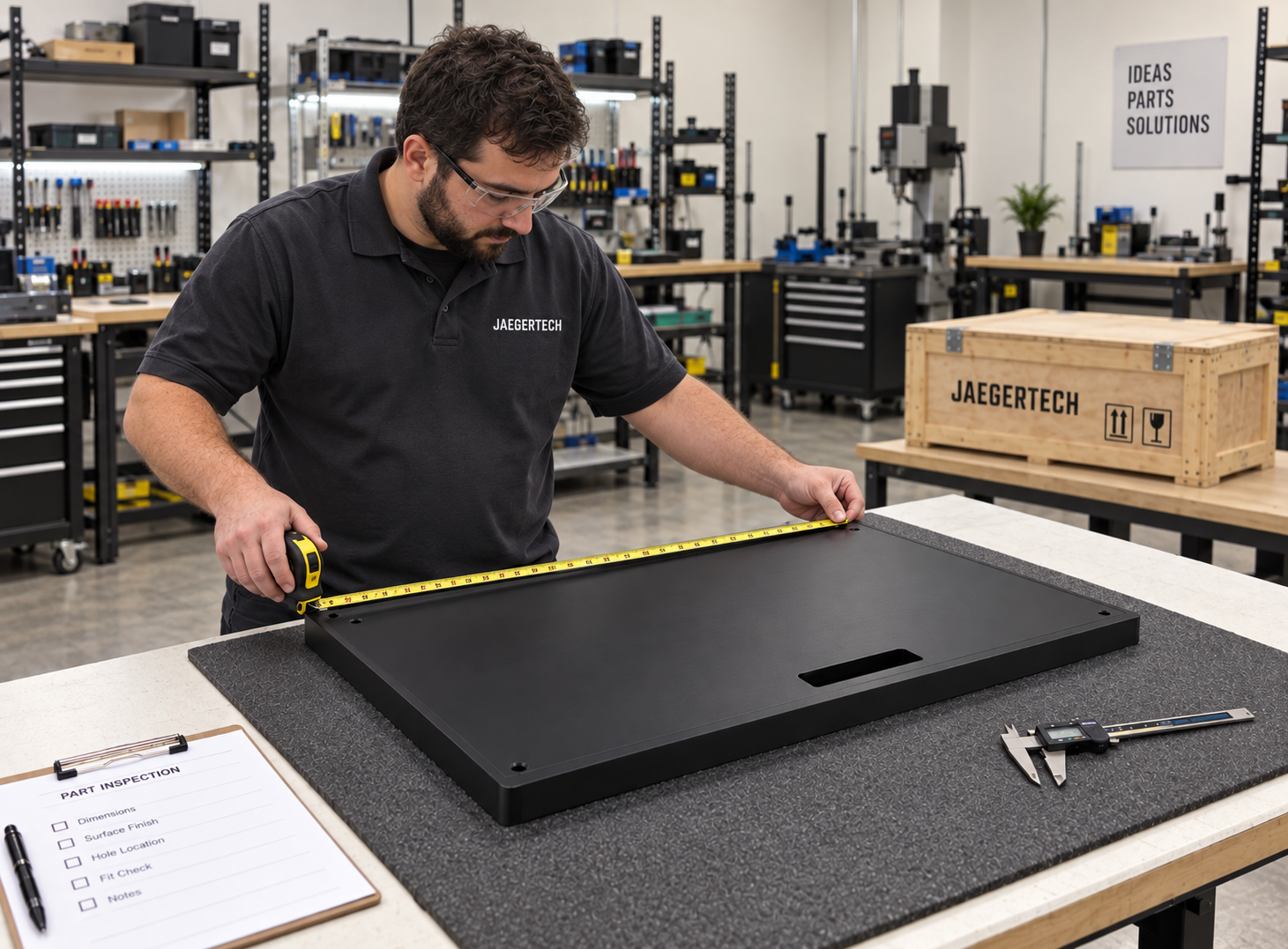
Instead of validating only a small section or scaled-down model, we can often produce a full-size prototype that represents the actual geometry of the intended production part.
Depending on the project, that prototype may include:
- mounting bosses
- screw locations
- ribs
- access openings
- mating surfaces
- snap or locating features
- assembly interfaces
- cable passages
- functional wall thicknesses
- exterior geometry
The prototype does not always need to use the final production material to provide useful information.
For many fit-and-function checks, the most important thing is that the geometry is accurate enough to test the real assembly.
Functional Prototypes Are More Valuable Than Appearance Models
There is an important distinction between an appearance model and a functional prototype.
An appearance model may be excellent for demonstrating the shape of a product.
A tooling-validation prototype needs to do more.
It should be designed around the questions the engineering team actually needs answered.
Does the assembly fit?
Can the technician reach the fastener?
Does the housing clear the connector?
Can the panel be installed without removing another component?
Does the mounting pattern line up with the existing equipment?
Can the part be handled and serviced as expected?
Those are the questions that can save real money before tooling.
Prototyping Can Also Protect the Schedule
Tooling risk is not only financial.
It is also about time.
Production tooling may involve outside mold shops, machine shops, foundries, or overseas suppliers. Once those schedules are set, missing a release date can push a project back significantly.
A fast prototype can help engineering teams make final decisions sooner.
That can mean:
- fewer rounds of CAD review
- faster customer approval
- earlier tool release
- fewer late engineering changes
- less chance of missing supplier production windows
- less disruption around overseas holidays or shutdown periods
In some cases, the prototype becomes the last practical checkpoint before the project moves into production.
3D Printing Does Not Need to Replace Traditional Manufacturing
This is an important point.
We do not look at every project and ask, “How can we 3D print the production part?”
Sometimes the correct answer is injection molding.
Sometimes it is machining.
Sometimes it is casting, thermoforming, sheet metal, or another conventional process.
The value of additive manufacturing is often in helping the customer get to that process with greater confidence.
A 3D-printed prototype can be the bridge between CAD and production.
A Better Way to Think About Prototype Cost
For industrial projects, a prototype should not necessarily be judged by whether it is cheaper than the eventual production part.
A one-off prototype almost never has the economics of a molded part produced by the thousands.
Instead, its value comes from the decisions it allows the customer to make.
If a prototype helps prevent:
- a mold revision
- a scrapped tool
- a delayed launch
- a missed production window
- an assembly problem
- a field-service issue
then the prototype may have paid for itself many times over.
Using Additive Manufacturing as Part of the Production Process
At Jaeger Technology Group, we see 3D printing as one part of a larger manufacturing toolkit.
We use additive manufacturing to support:
- fit checks
- functional prototypes
- tooling validation
- mold validation
- assembly verification
- patterns
- fixtures
- production aids
- low-volume manufacturing
- design revisions before production
The goal is not to force every component into additive manufacturing.
The goal is to use the right manufacturing method at the right stage of the project.
When expensive tooling is the next step, a full-size functional prototype can provide one final opportunity to verify the design while changes are still inexpensive.
That is where 3D printing can deliver some of its greatest value: not by replacing production tooling, but by helping make sure the tooling is right before the money is spent.
Need to Validate a Design Before Committing to Tooling?
If you are preparing for an expensive mold, fixture, die, casting pattern, or other production tool, a functional prototype may help identify problems before they become expensive.
Jaeger Technology Group can help turn your CAD into a full-size prototype for fit, function, assembly, and tooling validation.
Have a project approaching tooling release? Call us before you cut the tool.
About the Author: jaegertechgroup.com

STAY IN THE LOOP
Subscribe to our free newsletter.
Leave A Comment
Integrating a Tablet, Scanner, and Maintenance Hardware Into One Aerospace Field Tool In aerospace maintenance, the challenge is rarely just collecting information.
From 3D Scan to Perfect Fit: The Corvette Bumper Project Moves Forward A few weeks ago, we shared a project that demonstrated
Great Conversations and New Connections at SMD in Huntsville Last week, Janelle and I had the opportunity to attend SMD in Huntsville,
Custom 3D Printed Speaker Pods for a 2005 Ford Mustang Sometimes the problem is not the speaker. It is everything around it.