
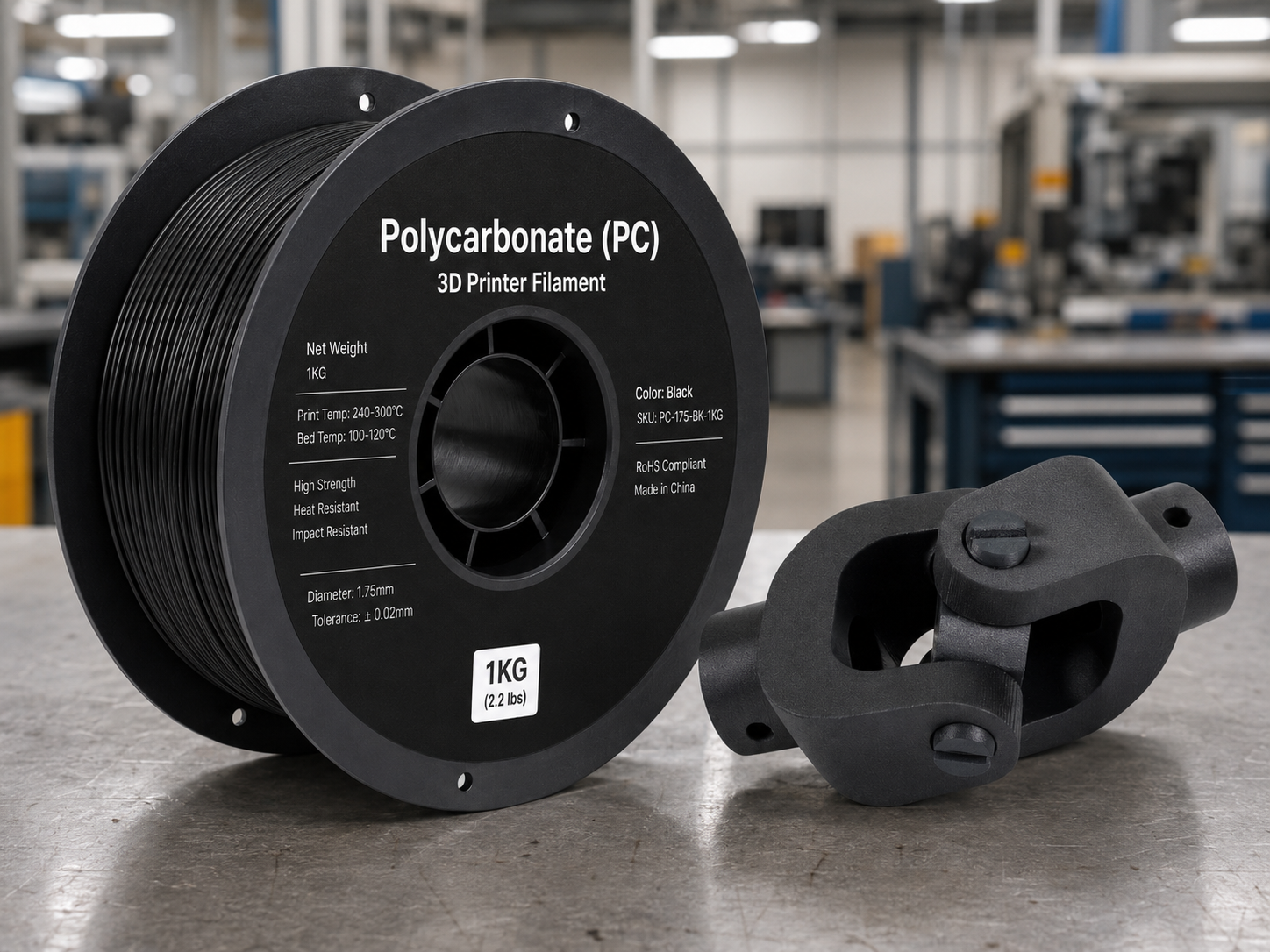
Polycarbonate and PC Blends for Strong Functional FDM / FFF Parts
Polycarbonate, often called PC, is a strong engineering thermoplastic used when a 3D printed part needs more toughness, heat resistance, and impact strength than common materials like PLA or PETG. In FDM/FFF printing, PC and PC blends can be useful for functional prototypes, brackets, fixtures, housings, tooling, and production support parts.
At Jaeger Technology Group LLC, we use polycarbonate and PC blends where the application justifies the extra process control. PC can be a strong material, but it is not as easy to print as PLA, PETG, or many general-purpose materials.
What Is Polycarbonate?
Polycarbonate is an engineering plastic known for:
- Impact resistance
- Toughness
- Heat resistance
- Dimensional stability when printed correctly
- Better strength than many common FDM materials
- Good performance in functional prototypes and industrial parts
In traditional manufacturing, polycarbonate is often used for protective covers, housings, guards, lenses, enclosures, and durable components. In 3D printing, it can serve similar roles when the printer, geometry, and process are appropriate.
Where Polycarbonate Works Well
PC can be a good choice for:
- Functional prototypes
- Strong brackets
- Tooling components
- Housings and enclosures
- Industrial covers and guards
- Assembly fixtures
- Production support parts
- Heat-resistant shop aids
- Impact-resistant parts
- Mechanical test parts
- Durable product development components
Polycarbonate is often selected when PLA is too brittle, PETG is not stiff or heat-resistant enough, and ABS or ASA does not provide the needed toughness.
PC Blends
Pure polycarbonate can be difficult to print. For that reason, many FDM/FFF materials are sold as PC blends. These blends are designed to improve printability, reduce warping, improve layer bonding, or combine properties from multiple polymers.
Common PC-related materials include:
- PC-ABS
- PC-PBT
- PC-PETG
- PC blends with additives
- Carbon-fiber-filled PC
- Flame-retardant PC blends
- ESD-safe PC blends
These blends can be very useful because they often print more reliably than pure PC while retaining some of the strength, heat resistance, and toughness benefits.
PC-ABS
PC-ABS is a common engineering blend that combines some of the toughness and heat resistance of polycarbonate with some of the processability and finishing behavior of ABS.
PC-ABS can be useful for:
- Functional housings
- Automotive-style prototypes
- Industrial enclosures
- Durable brackets
- Tooling and fixture components
- Product development parts
- Covers and guards
PC-ABS is often easier to print than pure PC, but it still benefits from an enclosed printer and controlled thermal environment.
PC-PBT
PC-PBT blends can offer a balance of toughness, chemical resistance, and dimensional stability, depending on formulation.
PC-PBT may be considered for:
- Industrial components
- Functional prototypes
- Fixtures
- Housings
- Parts exposed to oils or chemicals
- Durable production support parts
As with all blends, the actual performance depends heavily on the specific filament formulation.
Carbon-Fiber-Filled PC
Carbon-fiber-filled PC can improve stiffness and dimensional stability. It may also reduce some warping compared with unfilled PC, depending on the grade.
PC-CF can be useful for:
- Stiff brackets
- Strong fixtures
- Lightweight tooling
- Production aids
- Functional prototypes
- Parts needing better dimensional behavior
- Higher-stiffness housings
Carbon fiber can improve stiffness, but it does not make the part equally strong in every direction. Layer orientation still matters. Filled materials are also abrasive and generally require hardened nozzles.
Where PC Is Weak
Polycarbonate is strong, but it is not the answer for every application.
Potential limitations include:
- More difficult printing
- Warping
- Moisture sensitivity
- Higher nozzle temperature
- Higher bed temperature
- Enclosure requirement
- More expensive material
- Possible poor layer adhesion if printed too cold
- Reduced performance if wet
- Surface finish issues without proper tuning
PC is also not automatically the best choice for chemical exposure. Some chemicals can attack polycarbonate, so the actual use environment matters.
Printing Challenges
Polycarbonate requires more thermal control than many common FDM materials.
PC printing usually benefits from:
- High nozzle temperature
- High bed temperature
- Enclosed printer
- Dry filament
- Controlled cooling
- Proper bed adhesion
- Slow enough print speed for good layer bonding
- Correct part orientation
- Suitable build surface
Large PC parts can be especially challenging because warping and internal stress increase with part size.
Moisture Control
Like nylon, polycarbonate can absorb moisture from the air. Wet PC can cause poor surface finish, bubbling, stringing, weak parts, and inconsistent extrusion.
Good PC printing usually requires:
- Dry filament
- Dry storage
- Dry box use when needed
- Controlled handling
- Re-drying before printing if the filament has absorbed moisture
For serious functional parts, moisture control is not optional.
Heat Resistance
One reason to use PC is improved heat resistance compared with many common FDM materials. PC can be a strong candidate for parts that may see elevated temperatures where PLA, PETG, or even some ABS-style materials may soften too much.
Potential heat-related applications include:
- Warm-environment fixtures
- Durable housings
- Industrial covers
- Functional prototypes
- Automotive-style development parts
- Shop-floor components
The actual heat performance depends on the exact filament, print settings, annealing if applicable, and part geometry.
Impact Resistance and Toughness
Polycarbonate is often chosen for impact resistance. This can make it useful for guards, covers, housings, brackets, and parts that may be handled roughly.
However, FDM printed parts are anisotropic. That means they are not equally strong in every direction. A PC part can still split between layers if the orientation, temperature, design, or print settings are wrong.
For impact-resistant parts, consider:
- Layer orientation
- Wall thickness
- Fillets and radii
- Avoiding sharp internal corners
- Infill strategy
- Print temperature
- Dry filament
- Proper cooling control
PC for Jigs, Fixtures, and Tooling
Polycarbonate and PC blends can be useful for tooling when a part needs more toughness, heat resistance, or strength than basic materials.
Applications may include:
- Assembly fixtures
- Brackets
- Drill guides
- Handling aids
- Inspection fixtures
- Part nests
- Covers and guards
- Shop-floor tools
- Prototype tooling
- Production support components
For high-wear or precision applications, a hybrid approach may be better: printed PC body with metal bushings, inserts, pins, plates, or wear surfaces.
PC for Housings and Enclosures
PC and PC blends are useful for prototype housings and enclosures where the part needs better toughness or heat resistance than PLA or PETG.
Potential uses include:
- Electronics housings
- Industrial enclosures
- Protective covers
- Equipment guards
- Product development shells
- Automotive-style prototypes
- Snap-fit or assembled housings, depending on design
Design details matter. Bosses, clips, thin walls, screw holes, and sharp corners should be designed with FDM limitations in mind.
When PC Is Not the Best Choice
Polycarbonate may not be the right material when the project requires:
- Very low cost
- Easy printing
- Large parts without enclosure control
- High chemical resistance to incompatible solvents
- Flexible behavior
- Very high temperature service beyond PC capability
- Certified optical clarity from FDM printing
- Food-safe or medical compliance without validation
- Tight precision without machining
In those cases, PETG, PCTG, ASA, nylon, PPS, PEI, PEEK, machining, casting, or another process may be more appropriate.
PC vs. Nylon
PC and nylon are both useful engineering materials, but they behave differently.
| Factor | Polycarbonate / PC Blends | Nylon / Polyamide |
|---|---|---|
| General behavior | Tough, heat-resistant, impact-resistant | Tough, fatigue-resistant, wear-friendly |
| Moisture sensitivity | Moisture sensitive | Very moisture sensitive |
| Stiffness | Often fairly stiff, especially filled grades | Varies; PA-CF can be very stiff |
| Flexibility | Less flexible than many nylons | Often more ductile/flexible |
| Print difficulty | Moderate to high | Moderate to high |
| Best uses | Housings, guards, brackets, heat-resistant prototypes | Fixtures, brackets, wear parts, tough production aids |
The right choice depends on whether the part needs impact resistance, stiffness, wear behavior, chemical resistance, heat resistance, or flexibility.
PC vs. ABS / ASA
PC generally offers better impact resistance and heat resistance than standard ABS or ASA, but it can be harder to print and more expensive.
ABS and ASA may still be better when:
- The part is simpler
- Cost matters more
- Outdoor UV resistance is important, especially ASA
- Post-processing is needed
- The printer is not suited for PC
- The application does not justify PC
PC is worth considering when the application needs more performance than ABS or ASA can provide.
JaegerTech View
Polycarbonate is a serious functional material, but it needs the right printer, dry filament, and controlled process. We generally consider PC or PC blends when the part needs toughness, heat resistance, and impact strength beyond common materials.
For many industrial parts, a PC blend may be more practical than pure PC. For very demanding applications, nylon-CF, PPS, PEI/ULTEM, PEEK, PEKK, machining, casting, or DMLS may be better choices.
Need Strong Functional 3D Printed Parts?
If your company needs a strong bracket, housing, fixture, guard, prototype, production aid, or functional part, Jaeger Technology Group LLC can help evaluate whether polycarbonate, a PC blend, nylon, ASA, PPS, machining, casting, DMLS, or another process is the right fit.
We support Decatur, Huntsville, Birmingham, North Alabama, the Southeast, and manufacturers across the broader industrial region.
Contact JaegerTech today to discuss your project, request a quote, or choose the right material for your application.
About the Author: jaegertechgroup.com

STAY IN THE LOOP
Subscribe to our free newsletter.
Leave A Comment
Using 3D Printing to De-Risk Production Tooling Production tooling is expensive for a reason. Whether the final process is injection molding, thermoforming,
From 3D Scan to Perfect Fit: The Corvette Bumper Project Moves Forward A few weeks ago, we shared a project that demonstrated

Great Conversations and New Connections at SMD in Huntsville Last week, Janelle and I had the opportunity to attend SMD in Huntsville,
Custom 3D Printed Speaker Pods for a 2005 Ford Mustang Sometimes the problem is not the speaker. It is everything around it.