From Hesitation to Hands-On: Bringing Large-Format 3D Printing Into a Prosthetics and Orthotics Practice
For many prosthetics and orthotics practitioners, the potential of additive manufacturing is easy to understand.
The difficult part is deciding how to begin.
Professional 3D printing systems can quickly become major capital purchases. For a practitioner who is still determining how additive manufacturing will fit into day-to-day clinical and fabrication workflows, that can make the first step difficult to justify.
One practitioner came to JaegerTech with exactly that problem.
He wanted to explore what large-format 3D printing could do for his practice, but he was not ready to make a major investment in a new professional machine simply to find out.
What he needed was a way to get started, learn the process, and prove where the technology could provide real value.
Starting With the Workflow, Not the Machine
Our approach was different from simply recommending another piece of equipment.
We first looked at what he actually wanted to make.
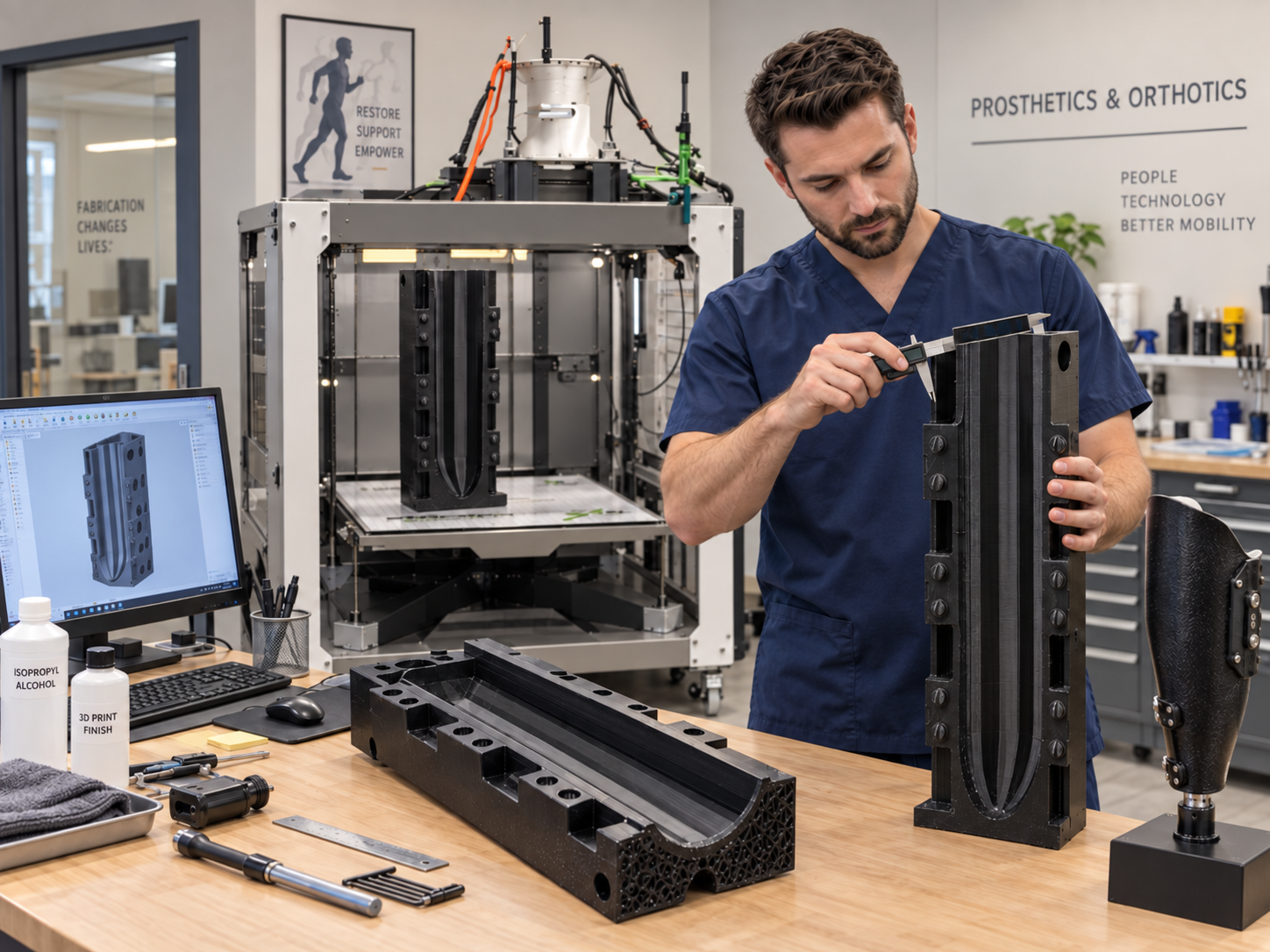
The applications were substantial enough that a typical desktop printer was not going to be sufficient. He needed the ability to produce full-scale parts for prosthetics and orthotics, including:
- Prosthetic socket-related components
- Orthotic braces
- Positive molds and forming tools
- Full-size prototypes
- Test components and fixtures
- Development parts for new clinical and fabrication workflows
Large build volume mattered. Reliability mattered. Material options mattered.
But so did cost.
Instead of pushing the practitioner toward an expensive new platform, JaegerTech started with a refurbished Stacker large-format 3D printer and rebuilt it around the requirements of the application.
The objective was not to give the customer the newest machine.
It was to give him the right machine.
Giving an Existing Platform a Second Life
Large-format industrial printers are substantial mechanical systems. Even when the original electronics, extrusion system, or controls become dated, the underlying frame and motion platform can still have years of useful life remaining.
That makes certain machines excellent candidates for modernization.
By refurbishing and rebuilding the Stacker platform, we were able to preserve the parts of the machine that still made sense while creating a system better suited to the customer’s current needs.
The result was a large-format additive manufacturing platform capable of producing the types of full-scale parts that mattered to his practice without requiring the investment normally associated with a new professional system.
More importantly, the machine was not treated as an experiment sitting in the corner.
It became a working tool.
Moving From Outsourcing to Iteration
Once large-format printing became available inside the practice, the way the practitioner could approach development changed.
A design could be modified and printed again without going through a lengthy external process.
A mold could be produced digitally.
An orthotic concept could be evaluated at full scale.
A prosthetic component could be adjusted, tested, and refined.
Prototype geometry that might previously have been difficult or time-consuming to fabricate could be turned into a physical part quickly.
That ability to iterate is one of the most important advantages of additive manufacturing.
The value is not simply that a printer can make a part.
The value is that it can make the next version of that part just as easily.
For prosthetics and orthotics, where individual anatomy, fit, clinical requirements, and practitioner preferences can all influence a design, that flexibility can be particularly valuable.
Large Format Makes a Difference
Many organizations begin experimenting with 3D printing using smaller machines. That can be an excellent way to learn the technology, but the limitations become obvious when the parts themselves are large.
Prosthetic and orthotic applications frequently require significant build volume.
Printing components in multiple sections can introduce additional bonding, alignment, finishing, and dimensional considerations.
A large-format platform allows many of these components to be produced at or near full scale in a single build.
It also opens the door to much more than finished clinical components.
The same machine can support:
- Forming tools
- Molds
- Check fixtures
- Assembly aids
- Development tooling
- Educational models
- Test geometries
- Prototype devices
That makes the printer a general fabrication tool rather than a machine dedicated to a single application.
Lowering the Risk of Additive Manufacturing Adoption
The larger lesson from this project applies well beyond prosthetics and orthotics.
One of the biggest barriers to industrial additive manufacturing is often not the technology itself.
It is the perceived cost of getting started.
Organizations sometimes assume they must choose between inexpensive hobby equipment and an expensive professional system.
There is a large space between those two extremes.
A properly selected and rebuilt industrial platform can provide an organization with enough capability to develop processes, train employees, validate applications, and determine where additive manufacturing provides the greatest return.
That means the organization can make its next investment based on experience instead of speculation.
For this practitioner, the rebuilt large-format platform provided exactly that opportunity.
He was able to get his hands on the technology, incorporate it into real work, and begin producing molds, prosthetic components, orthotic devices, and prototypes faster and with greater flexibility than he had previously been able to achieve.
That is ultimately what successful technology adoption should look like.
Not buying a machine because the technology is impressive.
Building a capability because it solves a problem.
The Right Machine for the Job
At JaegerTech, we do not believe every manufacturing problem requires a brand-new piece of equipment.
Sometimes the best solution is a new system.
Sometimes it is modifying an existing machine.
And sometimes it means taking a solid industrial platform that still has years of mechanical life remaining and rebuilding it around an entirely new workflow.
The goal is the same in every case:
Create a practical manufacturing capability that makes sense technically and economically.
Need an Additive Manufacturing Capability Without the Cost of Starting From Scratch?
If you are considering 3D printing but are not ready to make a large capital investment in a new industrial system, JaegerTech can help evaluate other options.
We work with companies, laboratories, manufacturers, and specialized practices to identify equipment, rebuild existing platforms, develop workflows, and create additive manufacturing systems around real production requirements.
Have an older machine that needs to be brought back to life, or an application that needs the right platform? Contact JaegerTech and let’s talk about it.
About the Author: jaegertechgroup.com

STAY IN THE LOOP
Subscribe to our free newsletter.
Leave A Comment
From 3D Scan to Perfect Fit: The Corvette Bumper Project Moves Forward A few weeks ago, we shared a project that demonstrated
Custom 3D Printed Speaker Pods for a 2005 Ford Mustang Sometimes the problem is not the speaker. It is everything around it.
Still Using Cura or Simplify3D? JaegerTech Can Help Build an OrcaSlicer Profile for Your 3D Printer A 3D printer does not become
When the Manufacturer Disappears: Support for Orphaned 3D Printers Industrial 3D printers are often purchased with the expectation that they will remain