
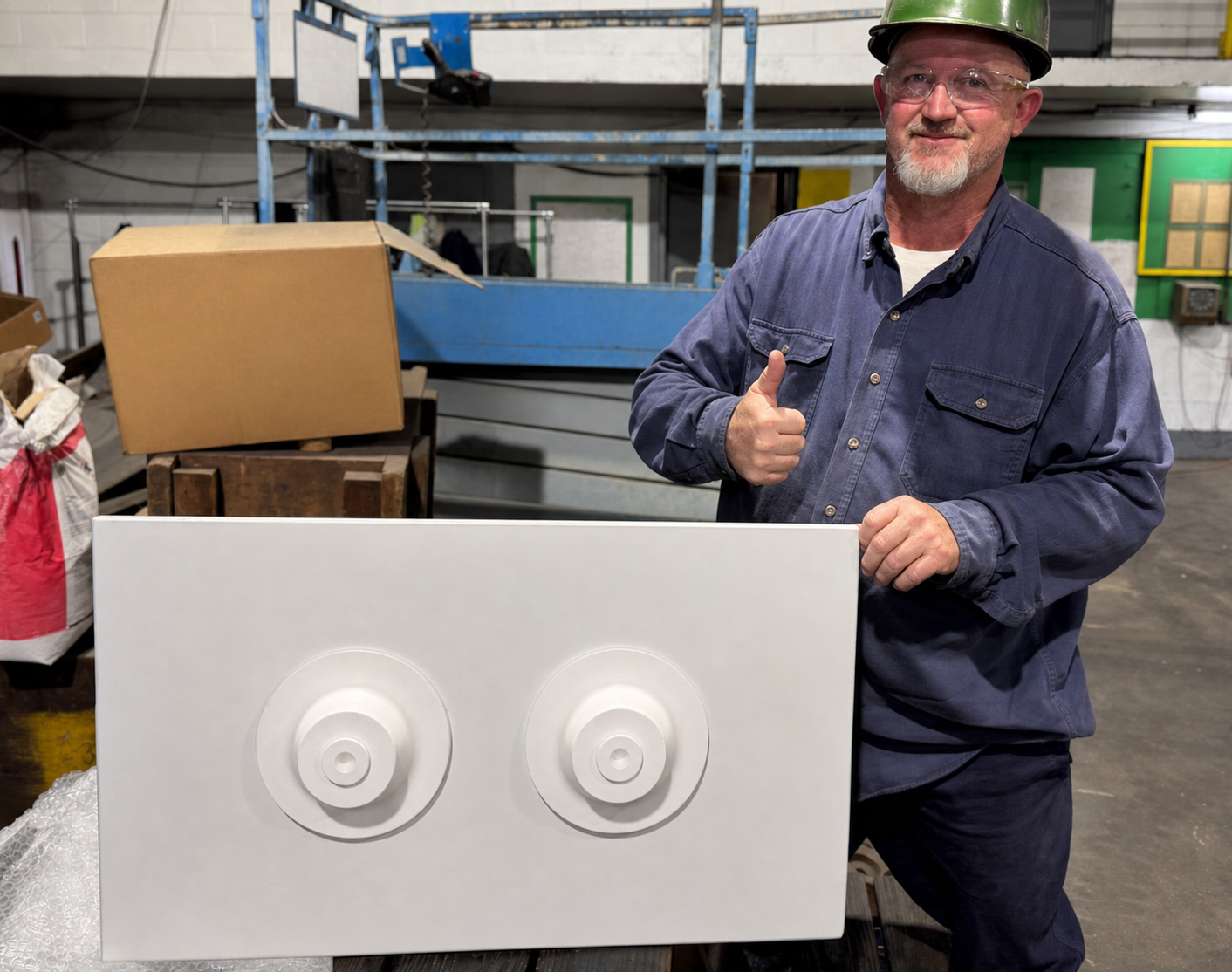
How Match Plates Work and Why Replaceable 3D Printed Tooling Helps Workflows
A match plate is one of the most efficient tools in sand casting. It combines the cope-side and drag-side pattern geometry onto opposite sides of a single plate, allowing the foundry to make both halves of the mold with better alignment, faster handling, and more repeatable results.
For foundries, match plates are valuable because they turn a part into a more controlled molding process. Instead of manually positioning loose patterns every time, the pattern geometry is fixed to a plate. The plate controls alignment, parting location, gating features, and repeatability.
At Jaeger Technology Group LLC, we produce 3D printed match plates and replaceable foundry tooling that can help foundries reduce downtime, speed up pattern replacement, and improve workflow flexibility.
How a Match Plate Works
In sand casting, the mold is usually made in two halves:
- The drag, or bottom half of the mold
- The cope, or top half of the mold
A match plate holds the pattern geometry at the parting line between those two mold halves. One side of the plate forms the drag side of the mold. The other side forms the cope side.
The basic process looks like this:
- The match plate is placed into the molding flask.
- Sand is rammed or packed around one side of the pattern.
- That half of the mold is formed.
- The flask is flipped or separated depending on the molding process.
- Sand is packed around the opposite side.
- The match plate is removed.
- The cope and drag mold halves now contain matching cavities.
- The mold is closed and prepared for pouring.
Because the cope and drag features are built onto the same plate, alignment is much more controlled than manually placing separate loose patterns. The pattern, parting line, gates, runners, risers, and locating features can all be integrated into one repeatable tool.
Why Foundries Use Match Plates
Match plates are common because they improve repeatability and reduce handling time.
A good match plate can help:
- Speed up mold production
- Reduce layout time
- Improve cope-and-drag alignment
- Improve repeatability from mold to mold
- Reduce operator variability
- Hold gating and runner geometry in position
- Make production molding more efficient
- Reduce damage compared with loose pattern handling
For repeat casting work, match plates are often far more efficient than loose patterns. They create a more standardized process, which matters when a foundry needs consistent results across multiple molds.
The Problem With Traditional Match Plate Tooling
Traditional match plates are effective, but they can be expensive and slow to produce.
Machined or conventionally built tooling may take significant time, especially when the pattern is large, complex, or likely to change. If a feature wears out, breaks, or needs to be modified, the foundry may have to stop production, repair the tool, or wait for new tooling.
That creates several practical problems:
- Tooling downtime slows production
- Pattern repairs can interrupt the schedule
- Design changes may require extensive rework
- Damaged tooling can delay customer orders
- Small-run jobs may not justify expensive tooling
- Experimental or prototype castings become harder to support
This is where replaceable 3D printed tooling becomes a major advantage.
Why Replaceable 3D Printed Tooling Is a Game Changer
With 3D printed foundry tooling, the pattern geometry can be designed digitally, printed as needed, and replaced when worn or damaged. Instead of treating the entire match plate as one permanent object, the tooling can be designed as a modular system.
That means a foundry can replace:
- Individual pattern halves
- Wear surfaces
- Inserts
- Core prints
- Gate and runner sections
- Locating features
- Customer-specific part geometry
- Damaged sections of a match plate
This can save time because the foundry does not always need to rebuild or remachine an entire tool. If one section wears out, that section can be reprinted and replaced.
For the workplace, that changes the conversation. Tooling becomes less fragile, less mysterious, and easier to maintain.
Replaceable Tooling Reduces Downtime
Downtime is expensive in a foundry. When a pattern breaks or a match plate is damaged, the cost is not just the replacement part. The cost is the stopped work, delayed pour schedule, interrupted labor, and customer delivery risk.
A replaceable 3D printed pattern section can often be reproduced quickly from the digital file. If the foundry keeps the CAD model and print settings controlled, replacement tooling can be made without reinventing the pattern.
This is especially useful for:
- Production match plates
- Short-run tooling
- Prototype casting jobs
- Repeat customer parts
- Wear-prone pattern features
- Core prints that see repeated handling
- Gating systems that may need refinement
At Jaeger Technology Group LLC, we see this as one of the strongest arguments for 3D printed foundry tooling: not just making the first pattern faster, but making the second, third, and replacement pattern easier.
3D Printed Match Plates Make Design Changes Easier
Foundry work often changes after the first trial.
Maybe the casting needs more stock.
Maybe a boss needs to move.
Maybe the gate location needs adjustment.
Maybe a riser changes.
Maybe the parting line needs refinement.
Maybe the customer changes the model after seeing the first article.
With traditional tooling, those changes can be painful. With digital 3D printed tooling, updates can often be made in CAD and printed into the next revision.
That makes the tooling more adaptable.
Instead of locking the foundry into an expensive tool too early, 3D printed match plates can support an iterative process. The foundry can test, adjust, and improve the tooling before committing to more permanent production equipment.
Better Organization on the Foundry Floor
Replaceable 3D printed tooling can also improve workplace organization.
A modular tooling system can be labeled, versioned, stored, and reproduced more easily. If a foundry has several customer jobs, each match plate or insert can be tracked by job number, revision, material, and date.
This helps reduce confusion on the floor.
A well-managed 3D printed tooling system can support:
- Clearly labeled pattern inserts
- Revision-controlled tooling
- Replacement parts stored digitally
- Faster reordering and reprinting
- Less dependency on one damaged master pattern
- Cleaner organization for repeat jobs
For a busy foundry, that can be a serious operational improvement.
3D Printed Tooling Does Not Replace Foundry Knowledge
It is important to be clear: 3D printed match plates do not replace foundry experience.
A match plate still needs proper draft, shrink allowance, fillets, parting strategy, gating, core print design, and molding practicality. The best tooling still comes from combining digital manufacturing with real foundry knowledge.
That is where Jaeger Technology Group LLC fits.
We do not look at 3D printed tooling as just “printing a shape.” We look at it as practical foundry support: reusable patterns, match plates, loose patterns, core boxes, and tooling that can survive real shop-floor use.
Work With Jaeger Technology Group LLC
If your foundry needs 3D printed match plates, replaceable pattern tooling, loose patterns, core boxes, or modular foundry tooling, Jaeger Technology Group LLC can help.
Replaceable 3D printed tooling can reduce downtime, speed up design changes, improve workplace organization, and give foundries a faster path from CAD model to mold-ready tooling.
Contact Jaeger Technology Group LLC to discuss 3D printed match plates, reusable foundry patterns, and replaceable tooling for sand casting workflows.
About the Author: jaegertechgroup.com

STAY IN THE LOOP
Subscribe to our free newsletter.
Leave A Comment
Best $150 I’ve Ever Spent on This Car Classic car projects have a way of turning simple problems into complicated ones. A
Using Development Boards in Early Hardware Prototypes Other Parts of this series: Part 2 – Choosing The Right Development Board Part 3
3D Printed Patterns for Investment Casting: Material, Support, and Ceramic Shell Considerations Investment casting has always depended on the quality of the
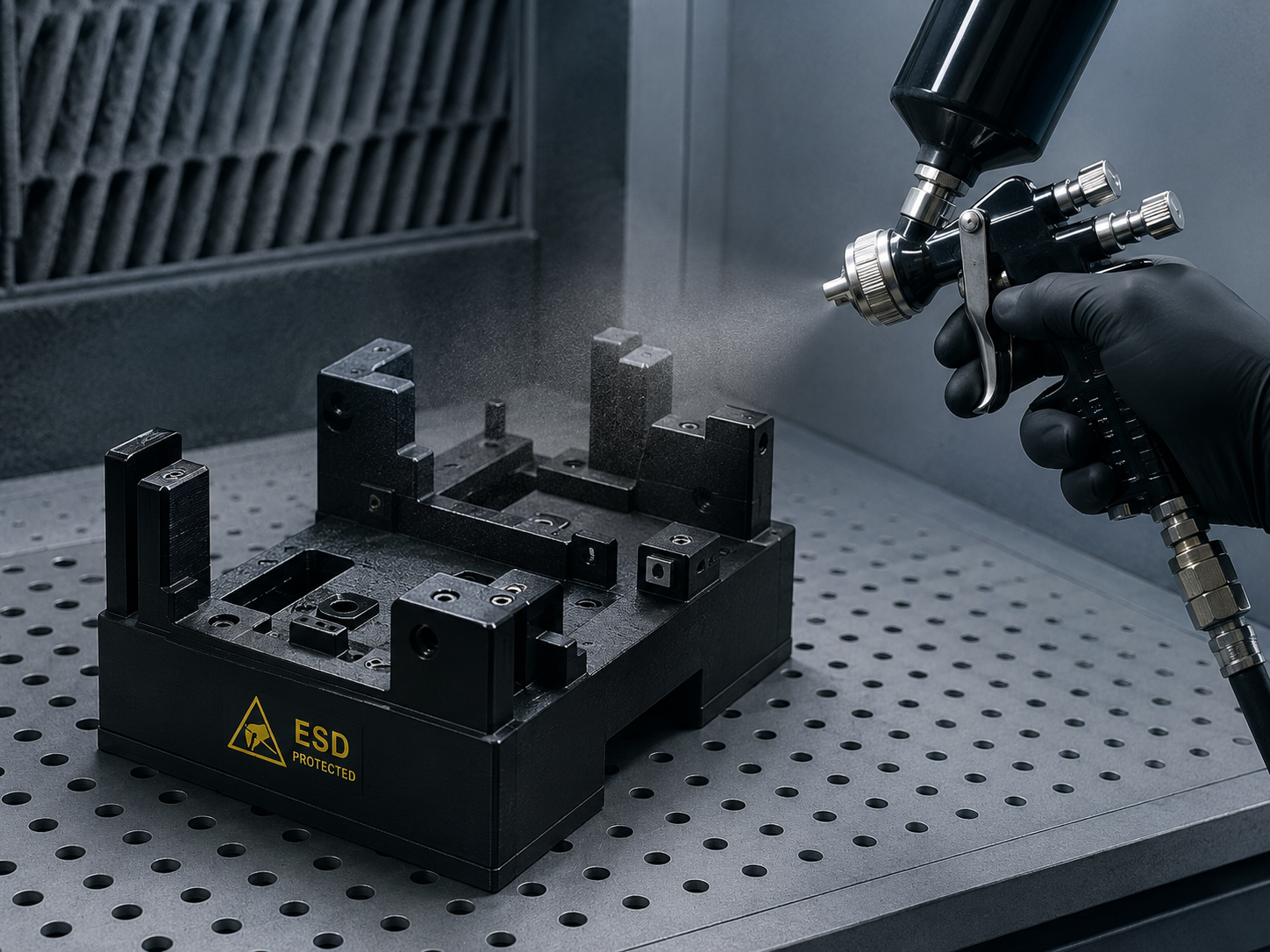
ESD-safe coatings can add static-dissipative behavior, helping reduce the risk of damage to printed parts used around electronics.