
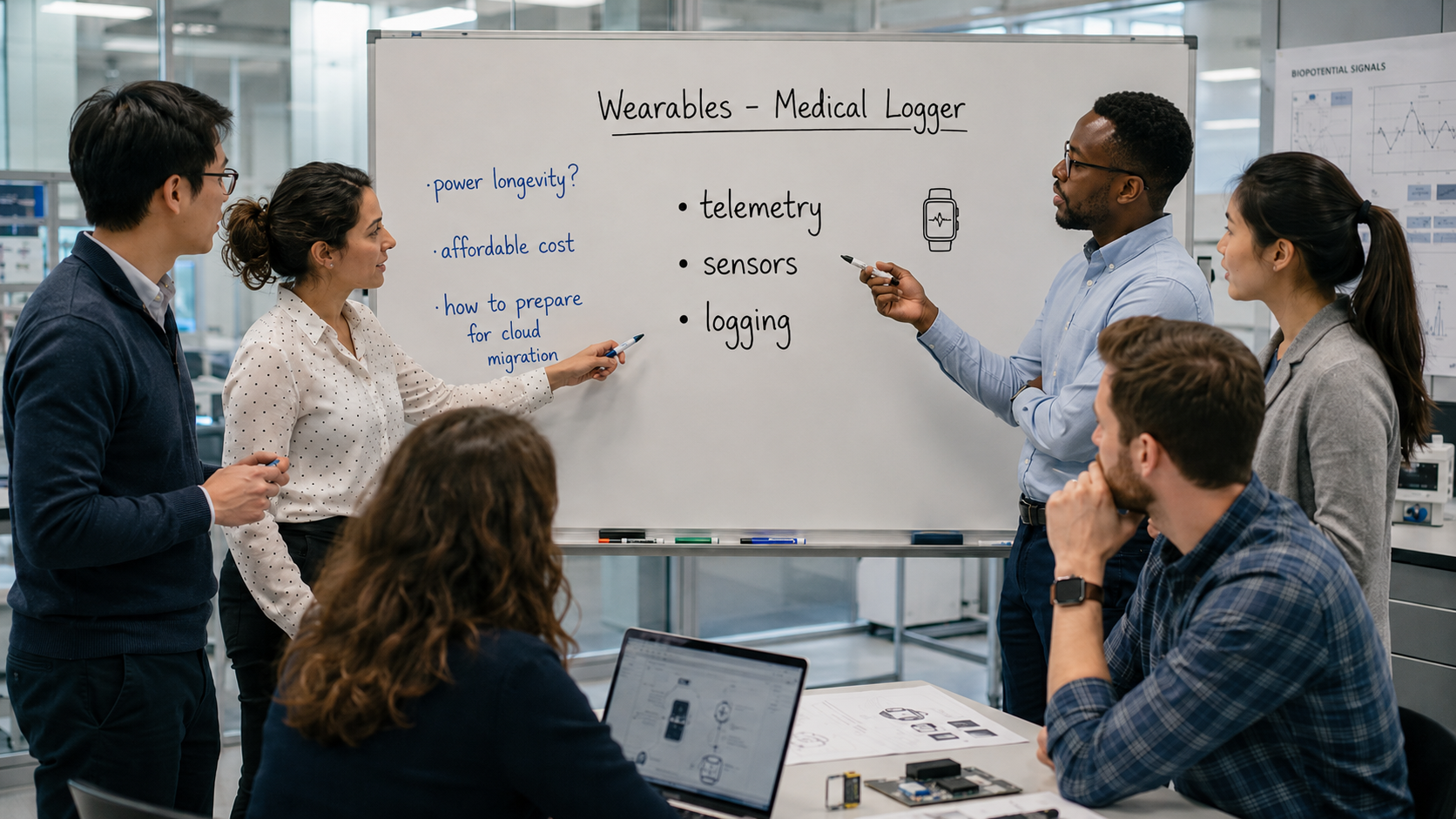
Confidential Medical Device Prototype: Sensor Integration and Local Event Logging
Helping a Research Team Move from Concept to Testable Hardware
A research team approached Jaeger Technology Group with an early-stage medical device concept requiring a functional prototype for technical evaluation and data collection. The team had strong subject-matter expertise in the underlying research problem, but limited experience with manufacturing, embedded electronics integration, material selection, or the practical design constraints involved in building a physical device.
The immediate goal was not to produce a finished medical product or clinical-use device. The goal was to create a research-oriented prototype capable of capturing defined device-use events and storing those observations locally for later review and analysis.
Because the project involved confidential research, specific device geometry, sensing methods, test criteria, and intended clinical application are not disclosed.
The Challenge
In early medical-device research, a promising concept often needs to become a physical, testable system before a research team can make informed decisions about the next phase of development.
In this case, the team needed support in several practical areas:
- Selecting materials appropriate for a functional prototype.
- Determining how sensing elements could be integrated into a small physical device.
- Choosing a suitable development-board and data-logging architecture.
- Packaging electronics in a usable prototype enclosure.
- Recording specific, predefined events locally for later research review.
- Keeping the prototype simple, serviceable, and appropriate for an early feasibility phase.
A central requirement was that the prototype operate independently during testing and record relevant events to removable local storage. For this phase, local data logging offered a practical alternative to adding unnecessary wireless communications, cloud infrastructure, user accounts, or remote-data complexity.
Our Approach
Jaeger Technology Group worked with the research team to translate the functional research goals into a buildable prototype architecture.
Rather than beginning with a highly integrated or production-oriented electronics design, we focused on a modular prototype approach. This allowed the team to evaluate the concept while preserving flexibility for later changes to sensor selection, housing geometry, firmware, and testing procedures.
Our support included:
- Review of the prototype’s intended function and physical constraints.
- Material recommendations for the prototype housing and functional components.
- Selection and integration planning for an appropriate sensor package.
- Selection of a development-board platform suitable for embedded sensing and local data acquisition.
- Design and fabrication of prototype components and enclosure features.
- Integration of onboard data logging to a removable SD card.
- Support for testing, revision, and preparation for subsequent research evaluation.
The resulting system was intended to observe predefined prototype events and record timestamped or sequential data locally. The stored data could then be removed from the device and reviewed by the research team without requiring cloud connectivity or a more complex communications architecture during the feasibility stage.
Why Local SD Card Logging Was Appropriate
During the prototype phase, the best electronics architecture is not always the most advanced one. In many research devices, the first question is simply whether the proposed physical interaction or device behavior can be observed and measured consistently.
For this project, local SD card logging offered several practical advantages:
- It reduced electronics and software complexity.
- It eliminated dependence on wireless pairing or network access during testing.
- It simplified data recovery and review.
- It allowed the research team to collect raw data in a straightforward format.
- It kept the prototype focused on validating the underlying research concept rather than building unnecessary infrastructure.
Wireless communications, mobile applications, or cloud-connected reporting may become appropriate in later phases. For early prototype evaluation, however, a local logging architecture can often provide cleaner data with fewer failure points.
Materials and Physical Integration
For research teams without significant manufacturing experience, material and enclosure decisions can be as important as the electronics.
A medical-device prototype must allow sensors and electronics to be positioned repeatably while also surviving handling during bench or controlled research testing. Materials must be selected with consideration for dimensional stability, manufacturability, surface finish, assembly, revision speed, and the expected testing environment.
Jaeger Technology Group provided guidance on materials and manufacturing methods appropriate for the prototype phase, then incorporated those decisions into the fabricated components and enclosure arrangement. This allowed the sensing and logging hardware to be treated as part of a coherent physical device rather than as separate bench-top electronics attached after the fact.
Sensor Package and Electronics Integration
The research team required the device to identify and record particular events associated with prototype operation. Our role was to help convert those functional requirements into a practical sensor and electronics package.
This included evaluating:
- What type of physical event needed to be observed.
- Which sensing methods were practical within the available space.
- How sensors could be positioned and protected in the prototype.
- How data should be recorded for later analysis.
- What level of integration was justified during a feasibility-stage effort.
The final prototype architecture was deliberately structured to support testing and revision. This is important in medical-device research, where early results frequently lead to changes in sensor placement, mechanical design, firmware thresholds, or study procedure.
Outcome
The project produced a functional research prototype with integrated sensing and local SD card data logging suitable for the intended prototype-stage evaluation.
The research team received a physical device platform that allowed them to begin collecting structured technical observations without first having to develop in-house manufacturing, enclosure design, electronics integration, or embedded data-logging capabilities.
The work also established a practical foundation for subsequent development decisions, including potential refinement of sensor placement, enclosure geometry, materials, electronics architecture, and future data-management requirements.
The Broader Lesson
Many research teams have deep expertise in a medical problem but do not have the internal manufacturing and product-development resources required to quickly build a credible working prototype.
In these situations, the value of a prototype partner is not limited to 3D printing a housing or connecting a sensor. The more important contribution is helping the team make sound early decisions about:
- What should be measured.
- How it can be measured.
- How the device should be physically built.
- What materials are appropriate for the development stage.
- How much electronics complexity is justified.
- How the resulting data can be recovered and evaluated.
For this confidential medical-device research project, a carefully scoped prototype with integrated sensors and local data logging provided the team with a practical path from concept to testable hardware.
Need Support Developing a Research Prototype?
Jaeger Technology Group assists research teams, product developers, and industrial clients with functional prototypes that combine custom-fabricated components, embedded electronics, sensors, local data acquisition, and practical enclosure design.
Our role is to help turn technically promising ideas into physical systems that can be built, tested, evaluated, and improved.
This case study describes prototype-development support for a confidential research project. Specific technical, institutional, and device-related information has been intentionally omitted. The prototype was developed for research and evaluation purposes; no statement is made regarding clinical efficacy, regulatory clearance, or suitability for patient use.
About the Author: jaegertechgroup.com

STAY IN THE LOOP
Subscribe to our free newsletter.
Leave A Comment
From 3D Scan to Perfect Fit: The Corvette Bumper Project Moves Forward A few weeks ago, we shared a project that demonstrated
Custom 3D Printed Speaker Pods for a 2005 Ford Mustang Sometimes the problem is not the speaker. It is everything around it.
Still Using Cura or Simplify3D? JaegerTech Can Help Build an OrcaSlicer Profile for Your 3D Printer A 3D printer does not become
When the Manufacturer Disappears: Support for Orphaned 3D Printers Industrial 3D printers are often purchased with the expectation that they will remain