
Four Hours From Problem to Part
Emergency 3D Printing for Manufacturing Downtime
When a production line is down, the clock starts immediately.
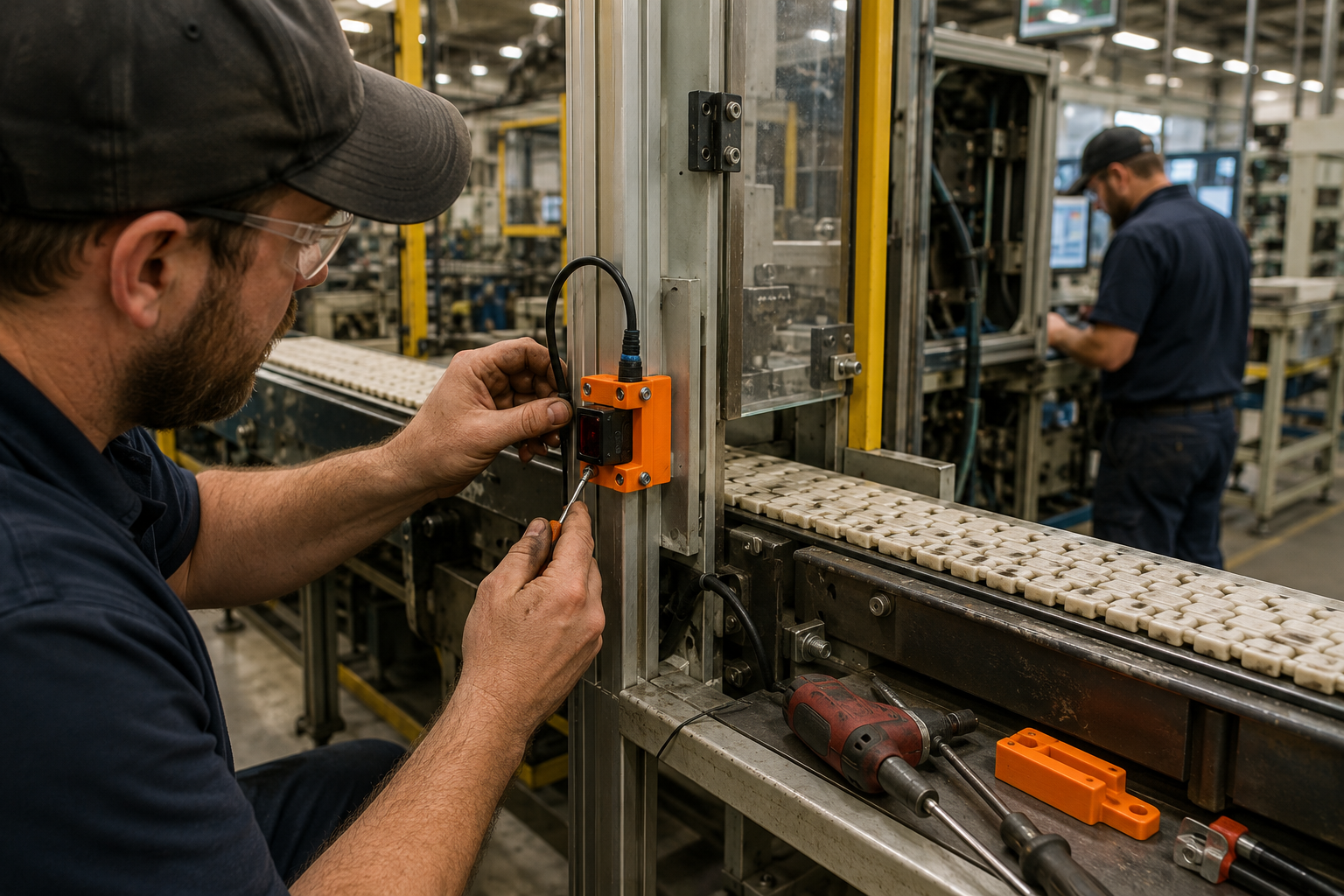
A customer recently reached out to JaegerTech with an urgent manufacturing problem. A sensor holder had failed, and the equipment was completely down. This was not a routine improvement project or a “we’ll get to it next week” request. They needed a usable replacement as quickly as possible.
Within four hours of hearing about the problem, JaegerTech had designed, 3D printed, and delivered a working sensor holder to the customer.
But we did not simply copy the broken part.
We looked at why the original holder was vulnerable, redesigned the geometry, and produced a replacement that not only helped get the machine moving again, but also improved the way the sensor was protected.
The Problem
In manufacturing, small parts can create large problems.
A sensor holder may not look like a critical component at first glance, but when a sensor is out of position, unsupported, damaged, or exposed to impact, the entire machine can stop. The failed part itself may be inexpensive. The real cost comes from downtime, lost production, delayed shipments, missed schedules, and the pressure placed on maintenance teams to get the line running again.
That was the situation here. The customer needed a sensor holder immediately, and a standard purchasing process was not going to solve the problem fast enough.
They needed a fast, local manufacturing response.
The JaegerTech Response
After receiving the request, JaegerTech moved quickly.
We reviewed the failed part and the application, designed a replacement sensor holder, improved the geometry to better protect the sensor, 3D printed the part, and delivered it to the customer within four hours.
The goal was not just speed. The goal was to provide a practical, usable solution that could help the customer recover from a downtime situation.
That is one of the most valuable uses of industrial 3D printing: fast, local problem solving when the normal supply chain cannot respond quickly enough.
Better Than a Basic Replacement
In emergency repair work, it is tempting to simply duplicate the broken part and move on. Sometimes that is the right answer. But when there is an obvious opportunity to improve the design, a small change can make a big difference.
For this sensor holder, the new design was made to be less vulnerable to the same issue that caused the original problem. Instead of only replacing the failed part, we used the opportunity to make a better part.
That matters because the best emergency repair is not just the one that works today. It is the one that reduces the chance of the same problem happening again tomorrow.
This is where 3D printing is especially useful. Design changes can be made quickly, tested quickly, and produced without waiting on tooling, long lead times, or minimum order quantities.
Why This Matters for Manufacturing
Manufacturing teams deal with real-world problems every day:
- broken brackets
- damaged sensor mounts
- missing covers
- worn guards
- failed clips
- obsolete plastic parts
- exposed cables
- improvised shop-floor fixes
- production equipment waiting on a small replacement part
Not every part is appropriate for 3D printing, and not every repair should be handled the same way. But for the right applications, additive manufacturing can be an extremely effective support tool for industrial maintenance, production equipment, and manufacturing operations.
It can help bridge the gap between a machine being down and a customer getting back into production.
Local Manufacturing Changes the Timeline
The major advantage in this case was not just the printer. It was the ability to respond locally, evaluate the problem, design the part, manufacture it, and get it to the customer quickly.
That is difficult to do through a traditional procurement process.
A small part can stop a large operation. A fast response can make the difference between hours of downtime and days of waiting.
From Emergency Response to Prevention
This project also highlights a bigger opportunity.
If a failed sensor holder can be redesigned, printed, and delivered in four hours during an emergency, what could be done with a little planning?
Many facilities have repeat failure points, vulnerable sensors, exposed cables, weak brackets, missing covers, and temporary fixes that everyone knows about but no one has had time to address.
Those are exactly the kinds of problems JaegerTech can help solve before they become downtime events.
The Takeaway
A customer called with equipment completely down. JaegerTech responded with a working, improved 3D printed sensor holder within four hours.
That is practical industrial 3D printing.
Not theory. Not a trade show demonstration. A real manufacturing problem solved quickly enough to matter.
If JaegerTech can design, print, and deliver a line-saving part in four hours, imagine what we can help prevent before there’s an emergency.
About the Author: jaegertechgroup.com

STAY IN THE LOOP
Subscribe to our free newsletter.
Leave A Comment
Integrating a Tablet, Scanner, and Maintenance Hardware Into One Aerospace Field Tool In aerospace maintenance, the challenge is rarely just collecting information.
From 3D Scan to Perfect Fit: The Corvette Bumper Project Moves Forward A few weeks ago, we shared a project that demonstrated

Great Conversations and New Connections at SMD in Huntsville Last week, Janelle and I had the opportunity to attend SMD in Huntsville,
Custom 3D Printed Speaker Pods for a 2005 Ford Mustang Sometimes the problem is not the speaker. It is everything around it.