
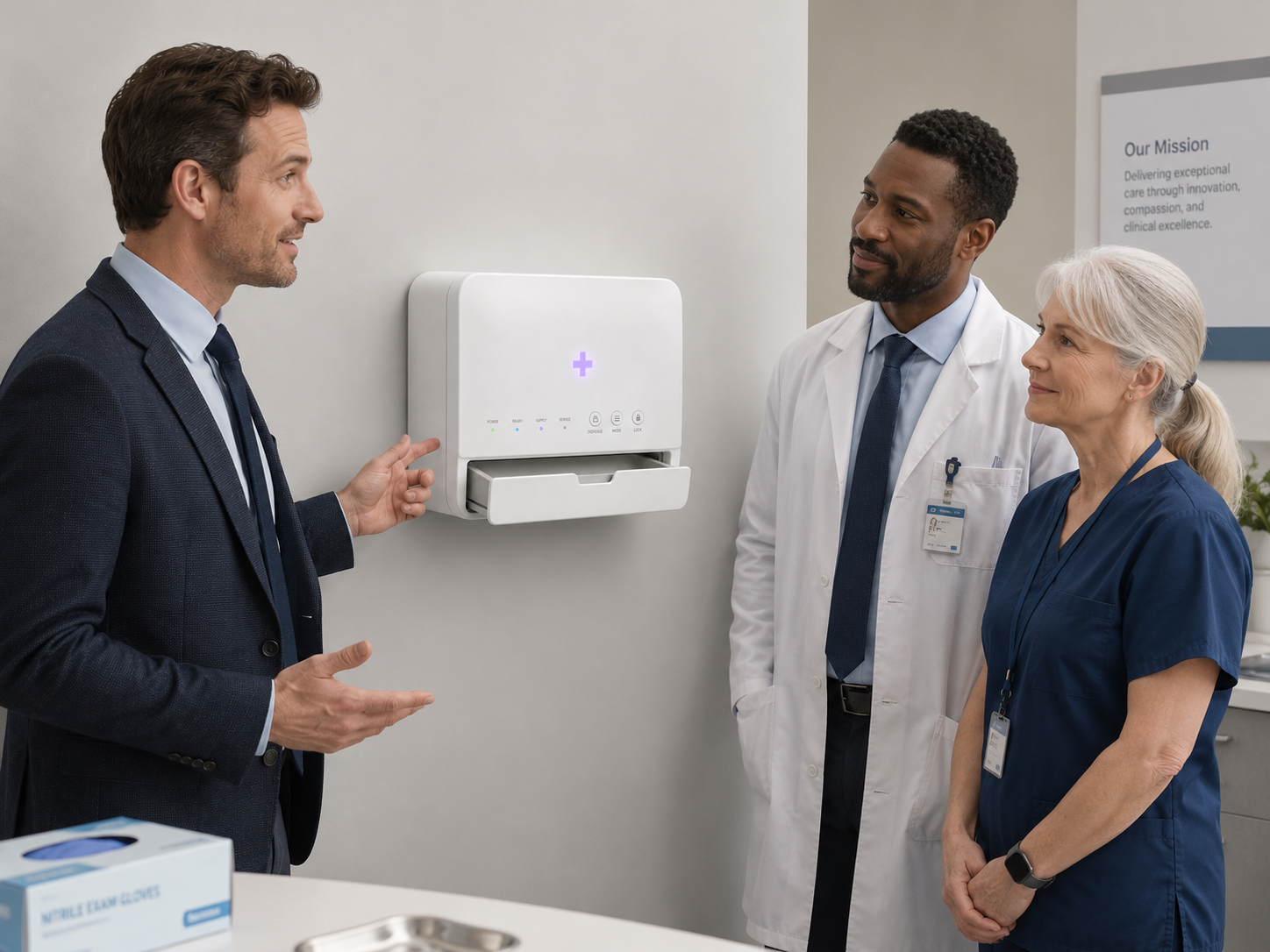
Case Study: From Concept Renderings to a Functional Room Device Prototype
One customer came to us with a medical device concept intended for use in a clinical room environment. The team had renderings and a general design direction, but they needed more than images. They needed to understand whether the concept could become a practical, usable physical system.
The device required several coordinated elements: a wall-mounted support cage, an attractive outer enclosure, internal space for electronic and mechanical components, trays for service access, areas for consumables, tactile buttons, and internal organization that allowed the prototype to approximate selected aspects of the intended final unit.
The challenge was not simply to create something that looked good. The challenge was to create a physical prototype that helped communicate how the final device could function, how users might interact with it, and where practical design issues might appear before committing to more expensive engineering or tooling decisions.
Using 3D printing, we helped create a prototype enclosure and related components that gave the customer useful physical design input. The team could evaluate the overall size of the unit, how components fit inside the enclosure, how the wall mount might function, how trays could slide or open, where consumables could be accessed, and how prospective clinical users, support personnel, and technical stakeholders might interact with the device in a non-clinical review setting.
That kind of information is difficult to obtain from renderings alone.
Physical Prototypes Create Better Feedback
Once a prototype exists in physical form, the conversation changes.
Instead of asking people to imagine the device, you can ask them to interact with it.
Prospective users and stakeholders can stand in front of the unit and react to the size, shape, reach, buttons, doors, trays, and access points. Support technicians can evaluate whether the device appears serviceable. Founders can see whether the design communicates the intended value. Engineers can identify internal conflicts, access issues, and packaging constraints. Investors can better understand what the company is actually trying to build.
That physical interaction creates a different class of feedback.
A person may not notice a poor access point in a rendering. But when they try to reach a tray and it feels awkward, the problem becomes obvious. A service technician may not object to an internal layout on a screen, but once they see how difficult a component would be to remove, they can provide more useful feedback. A stakeholder may not fully understand the intended workflow until they can physically interact with a device-like prototype.
This is one of the most important roles of 3D printing in early medical device development: it exposes practical design issues early, when they are still relatively inexpensive to correct.
The Prototype Became a Communication Tool
In this case, the prototype did more than generate technical feedback. It became a communication tool.
The customer was able to show something much closer to the final intent: not just an attractive enclosure, but a device with internal structure, tactile interaction, service access, trays, consumable areas, and a physical presence appropriate for a room-based clinical product.
That matters because medical devices are rarely evaluated by one person. They may need to be understood by founders, engineers, clinicians, hospital administrators, support technicians, regulatory advisors, investors, and manufacturing partners.
Each group looks at the device differently.
A founder may care about product vision. A clinician may care about workflow. A technician may care about service access. An investor may care about execution risk. A manufacturing partner may care about how the device could eventually be produced.
A strong physical prototype helps bring those groups into the same conversation.
An Unexpected Outcome: Investor Interest
One of the most interesting outcomes of this project was not purely technical.
After others had a chance to see the physical prototype, an unexpected investor expressed interest in helping carry some of the burden that had previously rested on the founders.
That is an important lesson.
Investors often hear ideas. They see pitch decks, renderings, market summaries, and financial projections. But a credible physical prototype can change the perceived maturity of a project. It demonstrates that the concept has moved beyond speculation. It shows execution. It gives people something concrete to evaluate.
A prototype does not guarantee investment, and it does not replace a sound business plan, regulatory strategy, market need, or formal product development process. But it can make a project easier to understand and easier to believe in.
In this case, the physical prototype helped others see the device as something more real.
3D Printing Helps Answer the Questions That Matter
For early-stage medical device development, 3D printing can help answer practical questions such as:
- Will the components fit inside the enclosure?
- Is the device appropriately sized for the intended room?
- Can the device be wall-mounted safely and logically?
- Can users access the right areas without confusion?
- Are buttons, trays, doors, and consumables placed correctly?
- Can support technicians service the unit efficiently?
- Does the physical form match the intended use case?
- Does the prototype communicate the product vision clearly?
- What needs to change before investing in tooling or production design?
These are not minor questions. They directly affect usability, cost, risk, serviceability, and product credibility.
3D Printing Is Especially Useful Before Hard Tooling
Medical device enclosures may eventually require injection molding, thermoforming, machining, sheet metal fabrication, urethane casting, or other production methods. Those processes can be expensive, especially once tooling is involved.
3D printing allows teams to evaluate design intent before committing to those larger investments.
An early prototype may not use final materials. It may not be sterilizable. It may not be suitable for clinical use. It may not represent the final manufacturing method. But it can still provide significant value as a development tool.
That distinction is important.
A prototype does not need to be the final product to be useful. It needs to answer the right questions at the right stage.
For medical device founders, that can mean reducing uncertainty before spending heavily on engineering, tooling, regulatory submissions, or investor presentations.
Medical Device Prototypes Need Practical Thinking
A medical device prototype should not be treated as a cosmetic model only. It should be built around the questions the team needs answered.
For an enclosure or room-based device, that may include:
- Internal component layout
- User interface placement
- Wall mounting strategy
- Cleaning and access considerations
- Cable routing
- Service tray movement
- Consumable replacement
- Ventilation or airflow assumptions
- Fastener access
- Assembly sequence
- Early usability and workflow feedback
- Visual presentation for stakeholders
This is where Jaeger Technology Group’s approach is different from simply printing parts. We help think through how the prototype will be used, who needs to evaluate it, and what decisions it needs to support.
From Idea to Physical Design Input
In medical device development, progress often depends on reducing uncertainty. A team needs to understand whether the device fits the intended workflow, whether the enclosure can hold the components, whether users can interact with the design, and whether the concept can be refined into something manufacturable.
3D printing helps create that feedback earlier.
It turns assumptions into physical observations. It allows the team to discover problems before they become expensive. It helps founders communicate more clearly. It helps investors, clinicians, and technical reviewers see the project with less imagination required.
A rendering can show what a medical device might become.
A physical prototype can show whether the idea is beginning to work.
How Jaeger Technology Group Can Help
Jaeger Technology Group supports medical device developers, founders, research teams, clinicians, and engineering groups with practical prototype development and applied manufacturing support.
Our work includes 3D printed medical device enclosures, concept models, room-device prototypes, component packaging studies, trays, fixtures, wall-mount concepts, anatomical models, research devices, and early-stage development support.
We can help move a project from CAD and renderings into a physical prototype that stakeholders can evaluate, handle, review, and improve.
For medical device teams, that can mean better design feedback, clearer communication, stronger investor presentations, and a more disciplined path toward future engineering and production.
If your medical device concept needs to move beyond renderings, Jaeger Technology Group can help turn it into a physical prototype that supports real development decisions.
Prototype-use disclaimer: This case study describes non-clinical prototype development work. The prototype was used to support design communication, component-fit evaluation, workflow discussion, service-access review, and stakeholder feedback. It was not represented as a finished medical device, sterile product, validated device, production-equivalent unit, or device suitable for diagnostic, therapeutic, patient-contact, or clinical use.
About the Author: jaegertechgroup.com

STAY IN THE LOOP
Subscribe to our free newsletter.
Leave A Comment
From 3D Scan to Perfect Fit: The Corvette Bumper Project Moves Forward A few weeks ago, we shared a project that demonstrated
Custom 3D Printed Speaker Pods for a 2005 Ford Mustang Sometimes the problem is not the speaker. It is everything around it.
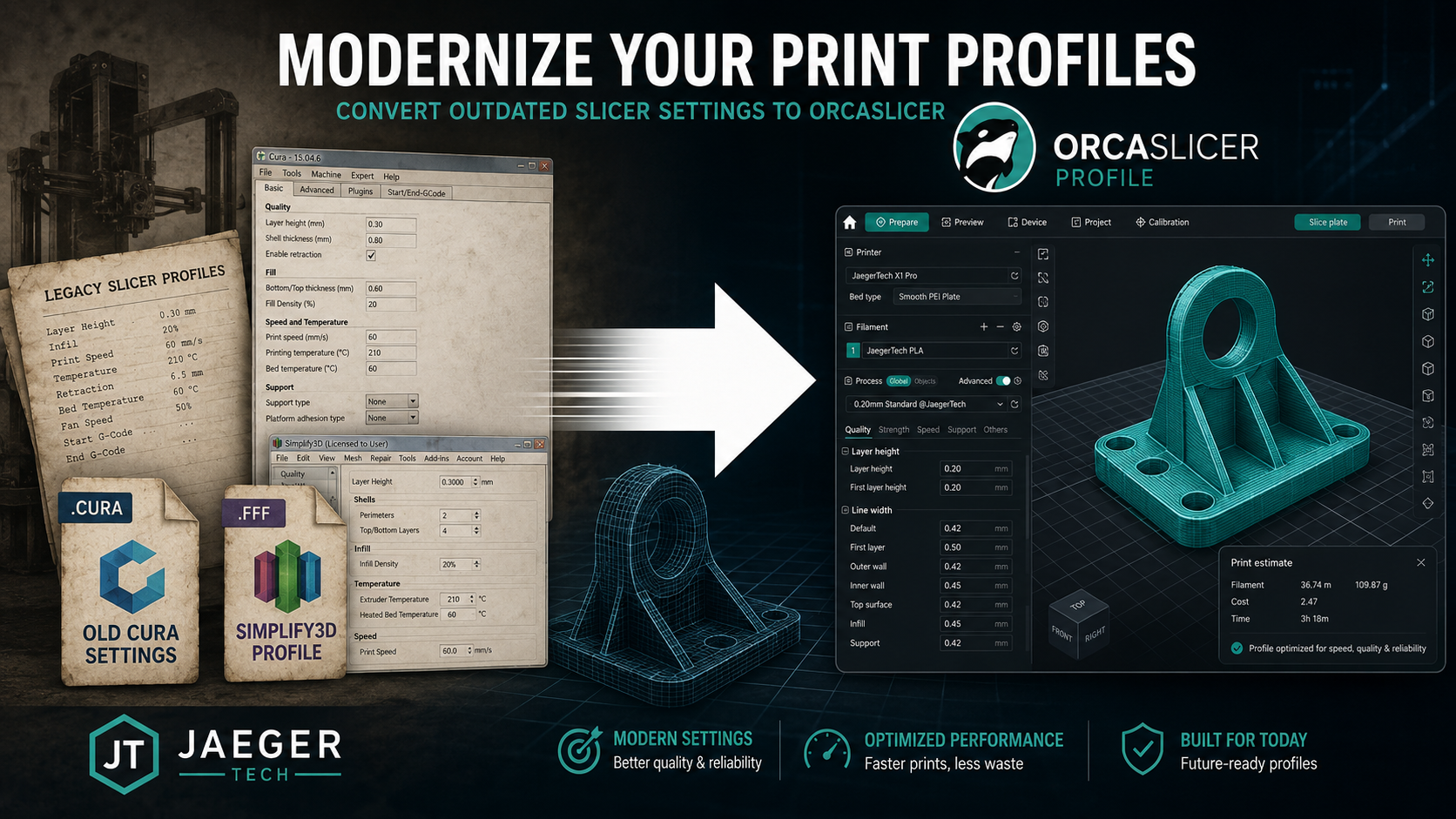
Still Using Cura or Simplify3D? JaegerTech Can Help Build an OrcaSlicer Profile for Your 3D Printer A 3D printer does not become
When the Manufacturer Disappears: Support for Orphaned 3D Printers Industrial 3D printers are often purchased with the expectation that they will remain