
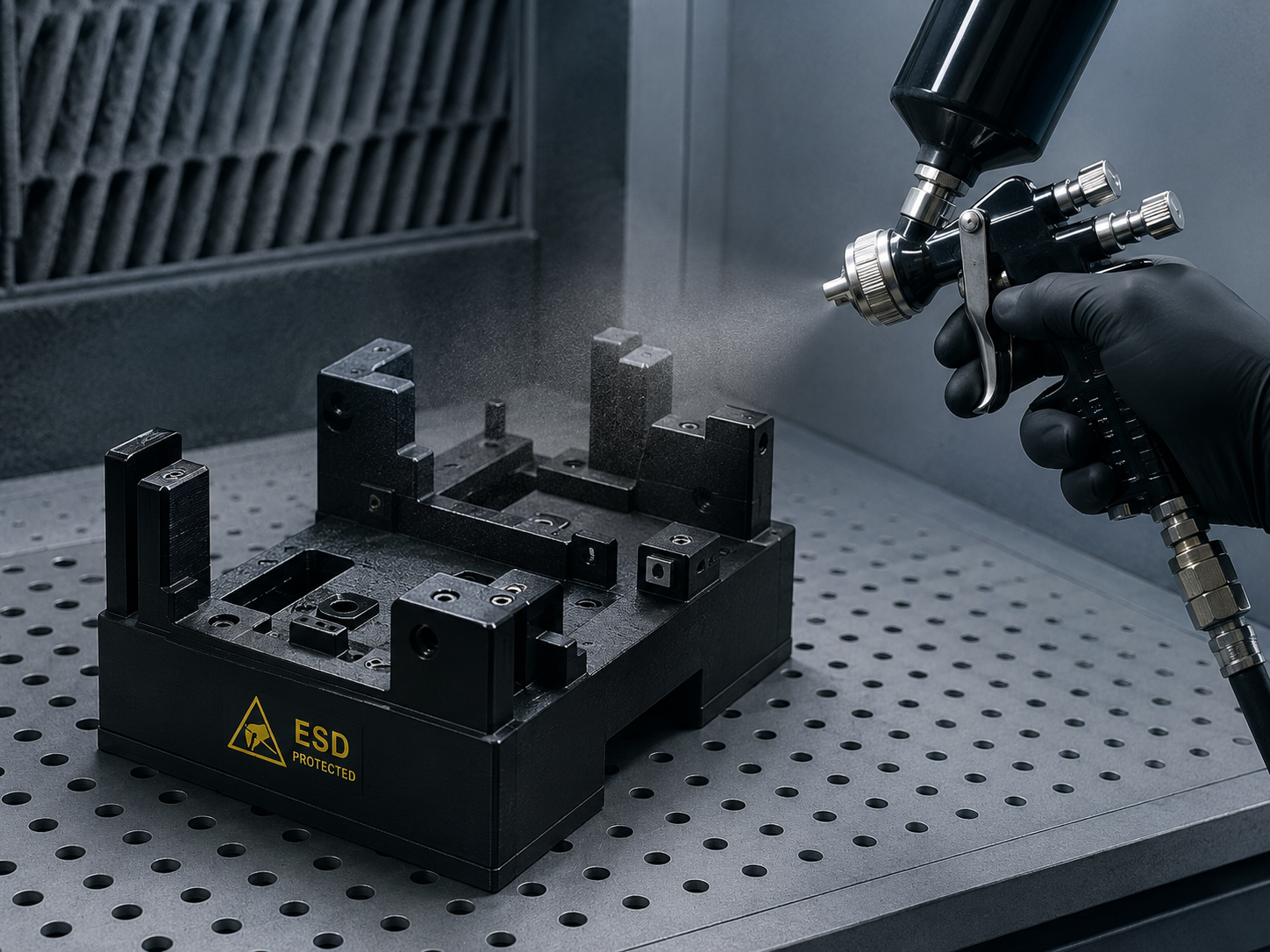
ESD-Safe Coatings
ESD-safe coatings can add static-dissipative behavior to a printed part used around electronics.
Common Uses
ESD coatings can be useful for:
- Electronics trays
- PCB holders
- Work-cell organizers
- Test fixtures
- Assembly aids
- Inspection nests
- Component holders
Advantages
Benefits include:
- Adds ESD behavior without changing the base print material
- Useful for large fixtures
- Can be applied to custom tooling
- May be faster than sourcing ESD-safe filament
- Useful for electronics work cells
Disadvantages
Limitations include:
- Must be verified for the required resistance range
- Can wear or scratch
- May need reapplication
- Surface preparation matters
- Not all coatings are equally durable
- Not a substitute for a complete ESD control program
JaegerTech View
ESD-safe coatings are useful when the printed part geometry is right but the surface needs static control. Critical ESD applications should be tested and verified.
Share This Story!
About the Author: jaegertechgroup.com

STAY IN THE LOOP
Subscribe to our free newsletter.
Leave A Comment
Using 3D Printing to De-Risk Production Tooling Production tooling is expensive for a reason. Whether the final process is injection molding, thermoforming,

Integrating a Tablet, Scanner, and Maintenance Hardware Into One Aerospace Field Tool In aerospace maintenance, the challenge is rarely just collecting information.

From 3D Scan to Perfect Fit: The Corvette Bumper Project Moves Forward A few weeks ago, we shared a project that demonstrated

Great Conversations and New Connections at SMD in Huntsville Last week, Janelle and I had the opportunity to attend SMD in Huntsville,