
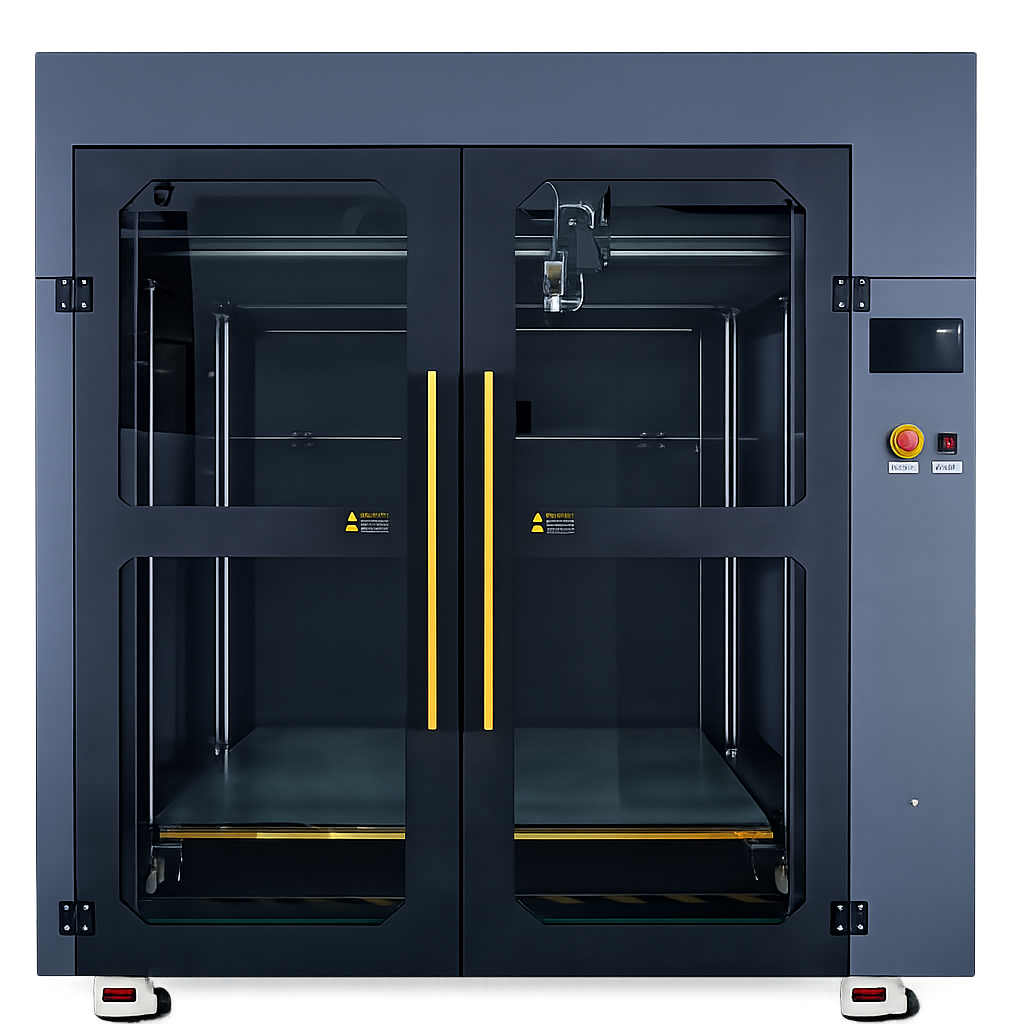
M100 Large-Format 3D Printer: Production-Scale 3D Printing Without Enterprise Pricing
Large-format 3D printing changes what manufacturers, product developers, pattern shops, labs, and production teams can do in-house.
Small desktop machines are useful, but they eventually hit a wall. The part is too large. The batch is too big. The material is too difficult. The print time is too long. The machine is not rigid enough. The job needs more than a hobby-class motion system can reliably deliver.
That is where the M100 fits.
The M100 is an enclosed large-format FDM 3D printer designed for organizations that have outgrown desktop-class machines and need true production-scale capability without stepping into the cost structure of traditional enterprise systems. With a 1000 × 1000 × 1000 mm build volume, the M100 can produce large individual parts, full-size prototypes, tooling, fixtures, patterns, and batch production runs in a single machine envelope.
Built for Large Parts and Batch Runs
The most obvious advantage of the M100 is its size.
A one-meter build volume means the machine can handle parts that would normally need to be split across multiple smaller printers. For manufacturers, that can reduce assembly time, bonding, alignment problems, post-processing labor, and the risk of dimensional mismatch between printed sections.
It also means the same machine can be used for batch production. Instead of printing one or two parts at a time on a smaller system, the M100 can be loaded with multiple components and run as a production platform.
That matters for applications such as:
- Large jigs and fixtures
- Foundry patterns
- Vacuum forming tools
- Assembly aids
- Large prototype housings
- Industrial covers and guards
- Batch production parts
- Large-format tooling
- Low-volume manufacturing
- Full-scale fit-check models
The M100 is not just a bigger desktop printer. It is intended for organizations that need scale.
Closed-Loop Servo Motion
One of the most important features of the M100 is its closed-loop servo motor system.
On many conventional 3D printers, motion is driven by open-loop stepper motors. Steppers can work well, but if the system skips steps under load, the printer does not truly know that it lost position. On a large-format machine, that risk becomes more serious because the moving mass, travel distance, and print duration are all larger.
The M100 uses closed-loop servo motors with encoder feedback. That positional feedback helps eliminate missed steps at higher speeds and supports more reliable motion control across a large build envelope.
For production work, that matters. A failed small print is annoying. A failed multi-day large-format print can be expensive.
Industrial Linear Rails for Full-Travel Rigidity
Large-format printers need more than a big frame.
They need rigidity across the entire motion envelope. A printer that performs well in the center of the bed but loses accuracy near the edges is not a production tool.
The M100 uses industrial linear guide rails to support full-travel rigidity across its one-meter motion envelope.
That helps support repeatability, accuracy, and more stable motion over large parts. For tooling, patterns, fixtures, and production support parts, that stability can be just as important as raw build volume.
Enclosed Build Chamber for Engineering Materials
Large parts are more sensitive to temperature than small parts.
Materials such as ABS, ASA, nylon, carbon fiber blends, and other engineering plastics can warp, curl, or delaminate if the print environment is unstable. The larger the part, the more important chamber control becomes.
The M100 includes an enclosed build chamber for improved thermal stability when printing warp-sensitive engineering materials.
The system supports materials including PLA, ABS, PETG, PLA-CF, nylon, and other materials within the machine’s 300°C nozzle temperature range.
For practical production work, that opens the door to stronger and more useful parts than basic visual prototypes.
Klipper Firmware and Tuning Flexibility
The M100 uses Klipper firmware, giving the system a tunable and extensible control platform.
That is important for organizations that want more control over machine behavior, slicing strategy, motion tuning, and process optimization. Klipper’s flexibility allows the machine to be adapted as production requirements change.
For experienced users, this is a major advantage. A production printer should not be a sealed black box if the customer needs to optimize print behavior, tune performance, or integrate the machine into a broader workflow.
Multi-Spool Filament System for Long Runs
Large-format prints consume material.
A long print can easily exceed a standard spool, especially when printing large tooling, batch runs, thick-walled parts, or high-infill components. If the machine cannot support larger spool sizes, long jobs become harder to manage.
The M100 includes a multi-spool filament system compatible with 1 kg and 3 kg spools. The machine also includes an independent filament cabinet to help support longer runs and reduce interruptions.
That is a practical production feature. The goal is not just to start a large print. The goal is to finish it reliably.
Touchscreen Control and Shop-Floor Usability
The M100 includes a 7-inch TFT touchscreen interface, allowing direct machine control without requiring an external PC at the printer.
That matters on a shop floor. Operators and technicians need clear machine access, straightforward controls, and the ability to monitor and manage the printer without building an awkward workstation around it.
Connectivity options include USB, LAN Ethernet, Wi-Fi, and USB flash drive support. The system is compatible with common workflows using STL, OBJ, and G-code files, along with slicers such as Simplify3D, OrcaSlicer, Cura, and other Klipper-compatible slicers.
Technical Specifications That Matter
The M100 is an FDM large-format printer with a 1000 × 1000 × 1000 mm build volume. Machine dimensions are listed at 1575 × 1290 × 1600 mm, with a machine weight of 380 kg. The system supports 110–220V AC power and uses a 3600W power supply.
Key specifications include:
- Build volume: 1000 × 1000 × 1000 mm
- Max print speed: up to 500 mm/s
- Nozzle temperature: up to 300°C
- Bed temperature: up to 110°C
- Motion control: closed-loop servo motors with encoder feedback
- Guide system: industrial linear guide rails
- Firmware: Klipper
- Print accuracy: ±100 microns
- Minimum layer thickness: 0.05 mm
- Filament diameter: 1.75 mm / 3.0 mm
- Nozzle sizes: 0.2 mm through 2.0 mm
- Operating system compatibility: Windows, macOS, and Linux
Those specifications make the M100 suitable for large-format functional printing where scale, motion control, and workflow flexibility matter.
Where the M100 Fits Best
The M100 is especially useful for organizations that need large parts or many parts, but do not want to pay enterprise-machine pricing for every large-format application.
Good applications include:
- Foundry patterns
- Large production fixtures
- Composite layup tools
- Vacuum forming tools
- Automotive and aerospace mockups
- Equipment covers
- Industrial guards
- Low-volume manufacturing
- Large prototypes
- Manufacturing support tooling
- Batch production of medium-sized parts
It is also a strong fit for labs, makerspaces, research groups, job shops, and manufacturers that want large-format capability available in-house instead of outsourcing every oversized print.
Why Large-Format 3D Printing Changes the Economics
The value of a machine like the M100 is not only in part size.
It is in what that size allows a company to avoid.
A large-format printer can reduce:
- CNC machining costs for low-load tooling
- Lead time for prototype tooling
- Mold and pattern development delays
- Outsourcing dependency
- Multi-piece assembly labor
- Fixture fabrication time
- Design iteration delays
- Downtime waiting for replacement tooling
For many shops, the return on investment comes from solving repeated problems faster.
A fixture that used to take weeks may be printed in days.
A pattern that would have required heavy manual work may be generated from CAD and printed directly.
A prototype that would have been split into multiple pieces may be printed closer to full scale.
A production support tool can be revised digitally and reprinted when the process changes.
That is the practical value of large-format additive manufacturing.
Work With Jaeger Technology Group LLC
Jaeger Technology Group LLC offers the M100 for organizations that need large-format, production-scale 3D printing capability without enterprise-level pricing.
If your team has outgrown desktop printers, needs larger parts, wants to bring tooling production in-house, or needs a platform for large-format prototypes, fixtures, patterns, and batch production, the M100 is worth a serious look.
Jaeger Technology Group LLC can help evaluate whether the M100 fits your application, material needs, production workflow, and budget.
Contact Jaeger Technology Group LLC to learn more about the M100 large-format 3D printer, related machines, and production-scale 3D printing services.
About the Author: jaegertechgroup.com

STAY IN THE LOOP
Subscribe to our free newsletter.
Leave A Comment
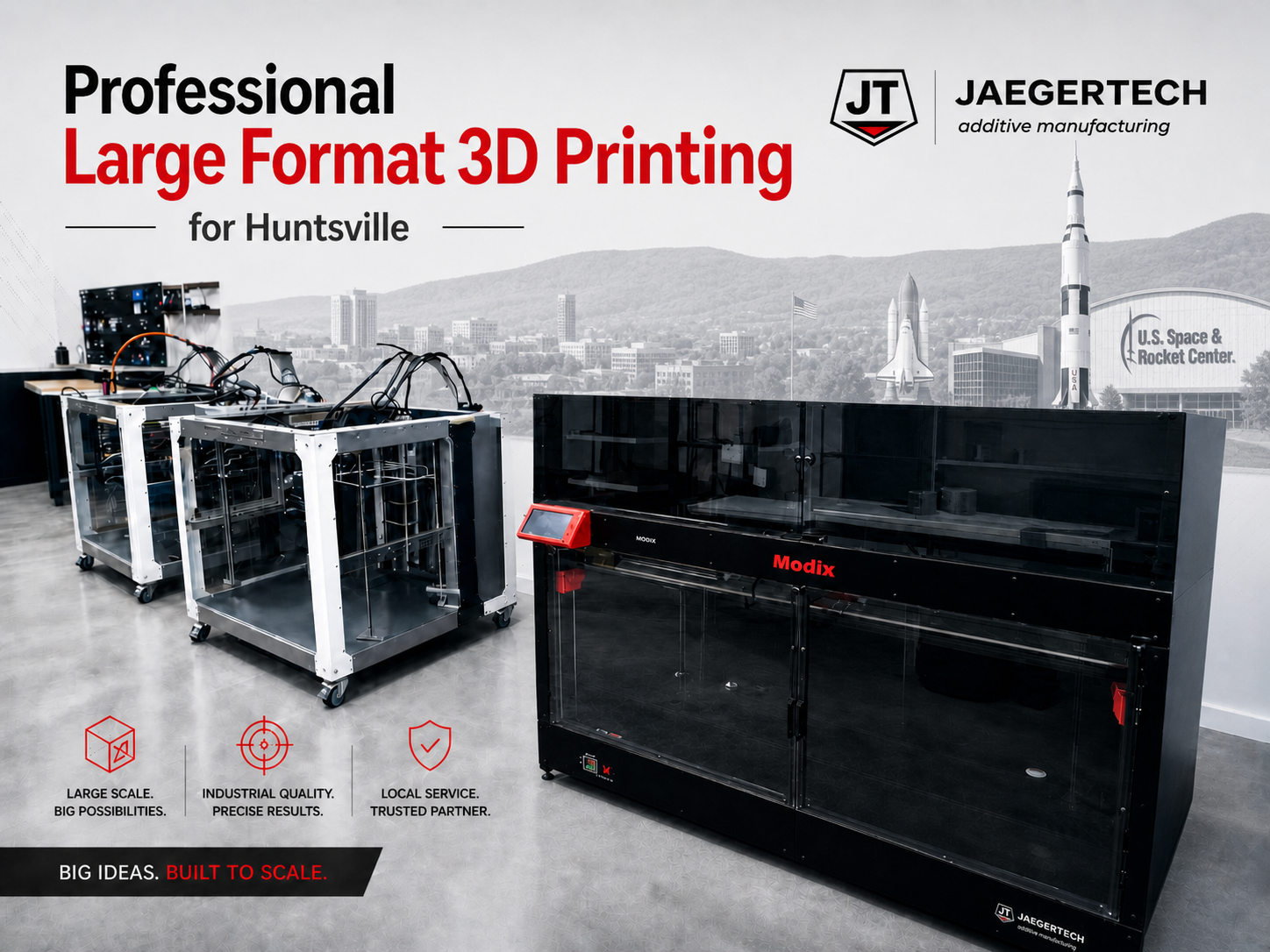
Modernizing Large-Format 3D Printers Instead of Replacing Them One of the biggest advantages of open-source and openly serviceable 3D printers is that
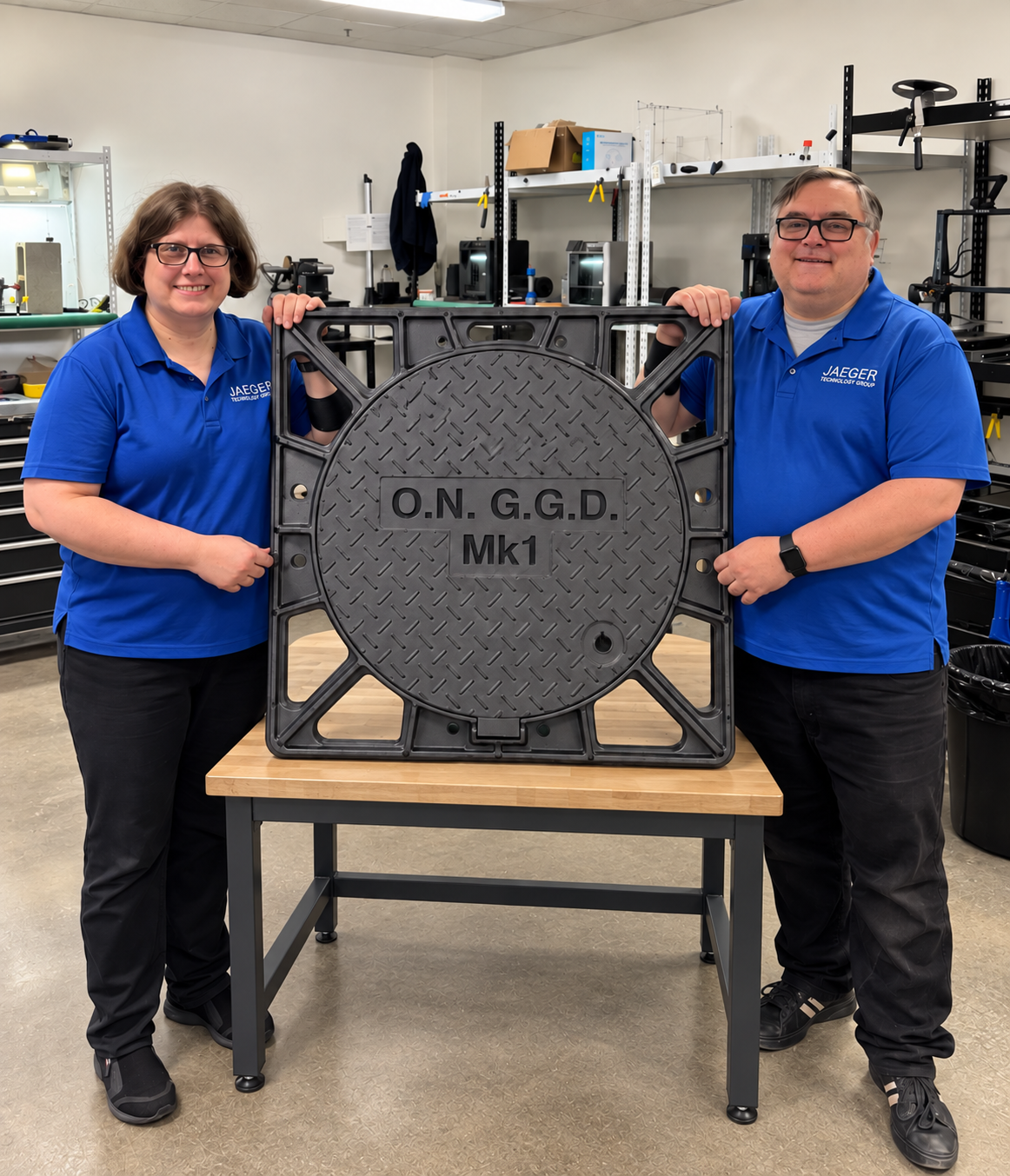
How Large-Format 3D Printing Helped Validate a Production Mold in 9 Days When an energy company was preparing to invest in an
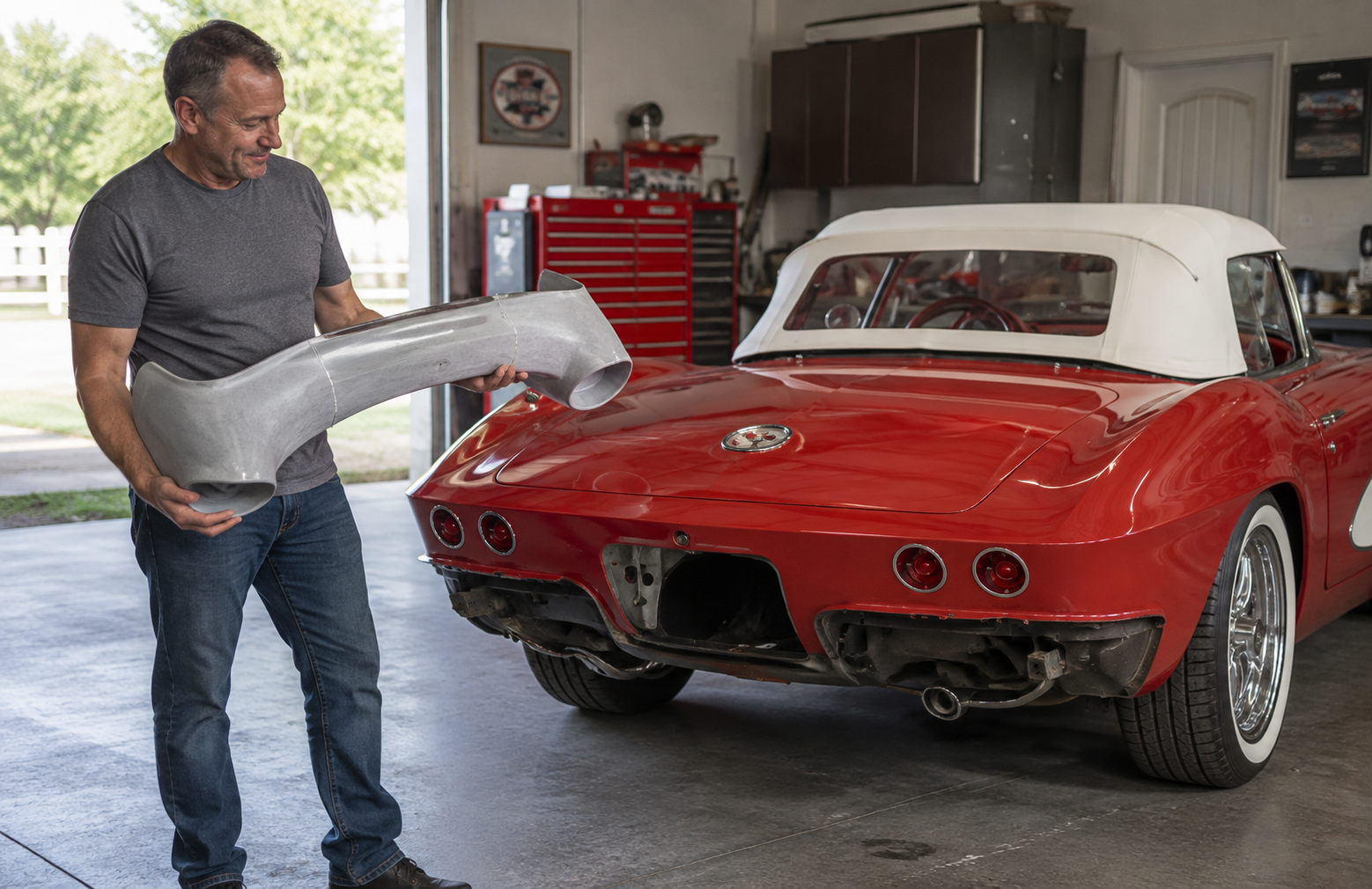
From 3D Scan to Perfect Fit: The Corvette Bumper Project Moves Forward A few weeks ago, we shared a project that demonstrated
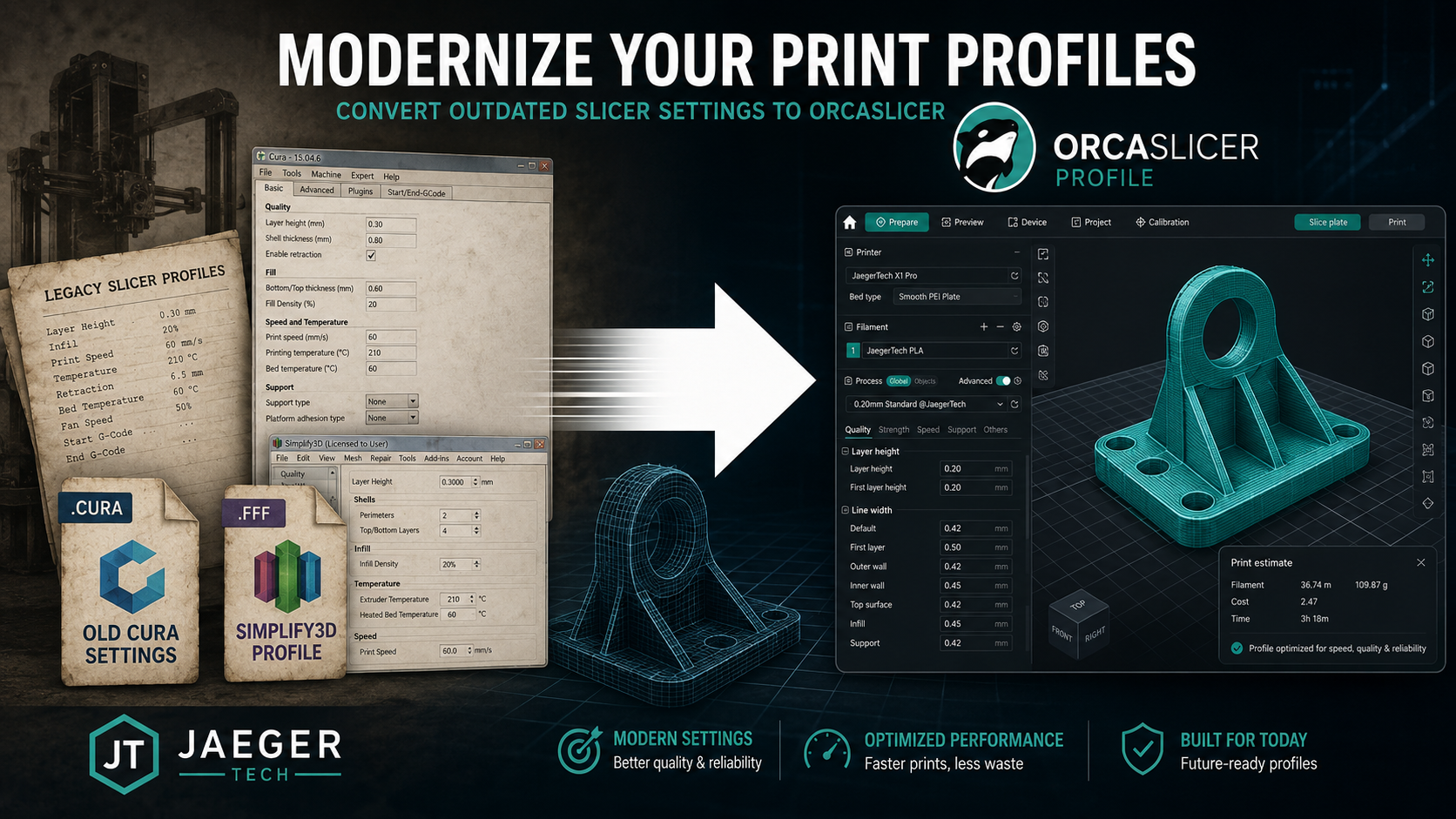
Still Using Cura or Simplify3D? JaegerTech Can Help Build an OrcaSlicer Profile for Your 3D Printer A 3D printer does not become