
A Small MRO Part That Saved Thousands: Using Additive Manufacturing to Reduce Fleet Damage
In maintenance, repair, and overhaul work, the best solutions are not always large, complex, or expensive.
Sometimes the biggest savings come from understanding a repeated failure, identifying the weak point in the system, and designing a small part that changes how the equipment fails.
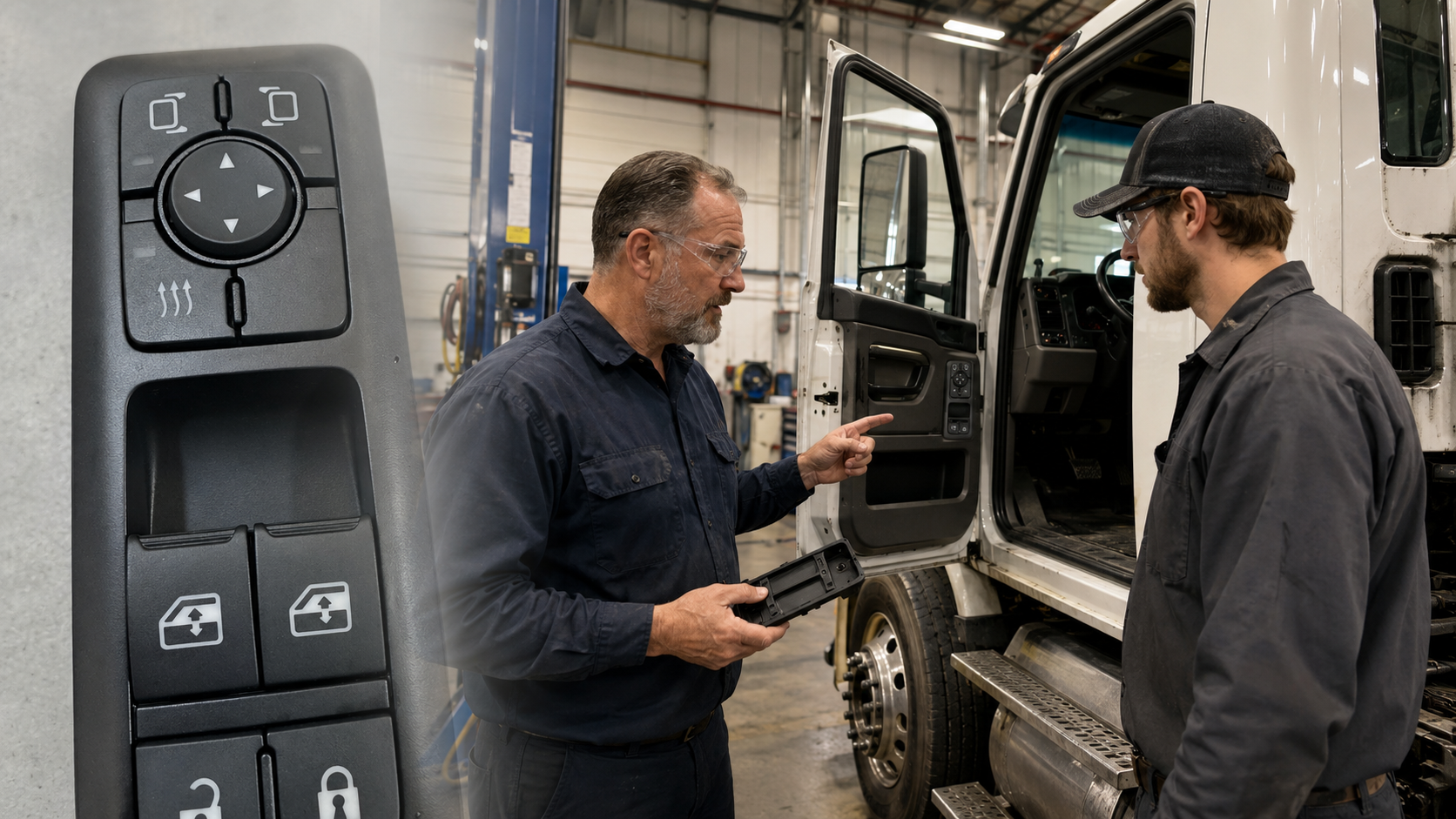
That was the case when an automotive MRO customer contacted Jaeger Technology Group about a recurring durability problem on a fleet of bobtail trucks.
The issue was not with the engine, drivetrain, suspension, or any of the major systems normally associated with high repair costs. It was a small door-mounted switch assembly that was being damaged during routine use.
The trucks were used frequently. Drivers were in and out of the cab throughout the day. Over time, a common pattern emerged: when the door was closed, the driver’s hand or body position would occasionally impact the switch area. The motion was not necessarily intentional or careless. It was simply part of how the trucks were being used in the real world.
But the result was expensive.
The Problem: A Small Impact Causing a Costly Failure
On these trucks, the switch was mounted to a plate inside the door area. During door closing, the driver could knock or strike the switch. That impact transferred energy directly into the switch assembly.
Over repeated use, the kinetic motion from closing the door caused the switch to separate from the plate.
Once the switch assembly failed, the repair was not just a simple nuisance. It created downtime, parts replacement, labor, and fleet maintenance cost. Across the customer’s operation, the repeated failures were adding up to roughly $20,000 per year in replacement parts and related maintenance cost.
The original component was not necessarily defective. It was simply exposed.
The switch was placed in a location where normal operating behavior could damage it. The customer did not need a complete redesign of the truck. They needed a practical way to protect a vulnerable component from repeated incidental impact.
The MRO Question: What Should Break First?
In repair environments, the instinct is often to make everything stronger.
That is not always the right answer.
If a switch, connector, sensor, bracket, or expensive assembly is being damaged by repeated impact, making the surrounding area stronger may simply transfer the force somewhere else. The better approach is often to introduce a sacrificial or replaceable protection feature.
That was the design logic behind this project.
Instead of trying to make the switch indestructible, JaegerTech designed a small protective switch cover that absorbed the abuse before the switch did.
The idea was simple:
Let the inexpensive cover take the impact.
Protect the expensive switch assembly.
Make the cover easy to replace if it eventually wears out or breaks.
This is a common principle in practical equipment design. A well-designed sacrificial part can protect a more expensive system by becoming the controlled failure point.
The Solution: A Custom Switch Cover
JaegerTech developed a small cover that fit over the vulnerable switch area and reduced direct impact to the switch itself.
The part did not need to be large. It did not need to be complicated. It needed to do a very specific job:
- Shield the switch from incidental contact
- Fit the existing door and plate geometry
- Avoid interfering with normal operation
- Be durable enough for fleet use
- Be inexpensive enough to replace if damaged
- Fail before the switch assembly failed
This is where additive manufacturing and practical design work well together.
The customer did not need a high-volume injection molded component with expensive tooling. They needed a low-volume, purpose-built protection part that could be designed, tested, revised, and produced quickly.
By using 3D printing and a functional design approach, JaegerTech was able to create a part that addressed the actual failure mode without requiring major modification to the truck.
Why the Small Part Mattered
The value of the part was not measured by its size.
It was measured by the failure it prevented.
Before the cover was added, the switch assembly was exposed to repeated impact. Once the cover was installed, the impact was redirected into a replaceable protective component.
If the cover eventually broke, it could be replaced at low cost. That was far better than repeatedly replacing the original switch assembly.
The customer’s estimated savings were significant: approximately $20,000 per year in avoided parts cost compared with the original recurring failure.
That is the kind of MRO improvement that matters. It does not require a full engineering program, expensive tooling, or a major equipment redesign. It requires careful observation, a practical understanding of how equipment is actually used, and a willingness to solve the real failure point.
Additive Manufacturing for MRO Support
This project is a strong example of where additive manufacturing fits into maintenance and fleet support.
3D printing is often discussed in terms of prototypes or end-use production parts. But in MRO environments, some of the best applications are small, practical, and highly specific:
- Protective covers
- Switch guards
- Sensor shields
- Cable routing clips
- Replacement brackets
- Alignment fixtures
- Drill guides
- Inspection tools
- Assembly aids
- Spacers and adapters
- Covers for vulnerable components
- Low-volume service parts
These parts may not exist in a catalog. They may not justify injection molding. They may only be useful for one fleet, one machine, one production line, or one recurring maintenance problem.
That is exactly where custom additive manufacturing can be effective.
Designing for Real-World Use
MRO design is different from designing around ideal conditions.
In the real world, trucks get slammed, tools get dropped, fixtures get abused, operators work quickly, and equipment is used in ways that are not always obvious from a drawing.
A good MRO solution has to account for that.
For this project, the design was not simply about covering the switch. It was about understanding the force path. The driver’s motion during door closing created an impact. That impact needed to be redirected away from the switch and into a lower-cost replaceable feature.
The final part improved durability by changing the way the system responded to abuse.
That is often the difference between a part that merely looks correct and a part that actually works.
Small Improvements Can Produce Large Savings
In many maintenance environments, recurring failures become accepted as normal.
A component breaks. A replacement is ordered. A technician installs it. The equipment goes back into service. Then the same failure happens again.
Over time, the organization absorbs the cost as part of doing business.
But repeated failures are opportunities.
If the same part keeps breaking, there is usually a reason. The cause may be impact, heat, vibration, poor access, operator contact, cable strain, chemical exposure, or simple wear. Once the pattern is understood, a small design change may dramatically reduce the cost of ownership.
In this case, a small protective cover helped preserve a much more expensive switch assembly and reduced annual replacement costs.
That is practical engineering.
JaegerTech MRO Support
Jaeger Technology Group supports MRO teams, fleet operators, manufacturers, maintenance departments, and repair organizations that need practical parts and tooling to keep equipment working.
We can help with:
- Identifying recurring failure points
- Designing protective covers and guards
- Creating replacement brackets and adapters
- Building custom fixtures and service tools
- Supporting legacy equipment
- Producing low-volume functional parts
- Iterating designs based on field feedback
- Creating parts for additive manufacturing
- Developing practical improvements without major tooling cost
Our goal is to help customers solve the kinds of problems that cost money every month but often go unnoticed because they are too small for a traditional engineering program.
Practical MRO Parts That Pay for Themselves
The switch cover project is a good reminder that MRO improvements do not have to be complicated to be valuable.
A small part, designed around the actual failure mode, helped reduce damage to a fleet of bobtail trucks and saved the customer thousands of dollars over the original recurring repair cost.
That is where JaegerTech can help.
When equipment keeps breaking in the same way, the answer may not be to keep buying the same replacement part. The answer may be to design a better protective part around it.
About the Author: jaegertechgroup.com

STAY IN THE LOOP
Subscribe to our free newsletter.
Leave A Comment
Integrating a Tablet, Scanner, and Maintenance Hardware Into One Aerospace Field Tool In aerospace maintenance, the challenge is rarely just collecting information.
Repairing a Discontinued Polypropylene ATV Snorkel With Plastic Welding When a customer could not locate a replacement snorkel for his 21-year-old ATV,
Four Hours From Problem to Part Emergency 3D Printing for Manufacturing Downtime When a production line is down, the clock starts immediately.
Soft 3D Printed Protection for MRO Overhaul and Repair TPU Cylinder Head Supports That Help Prevent Damage in the Shop In overhaul