
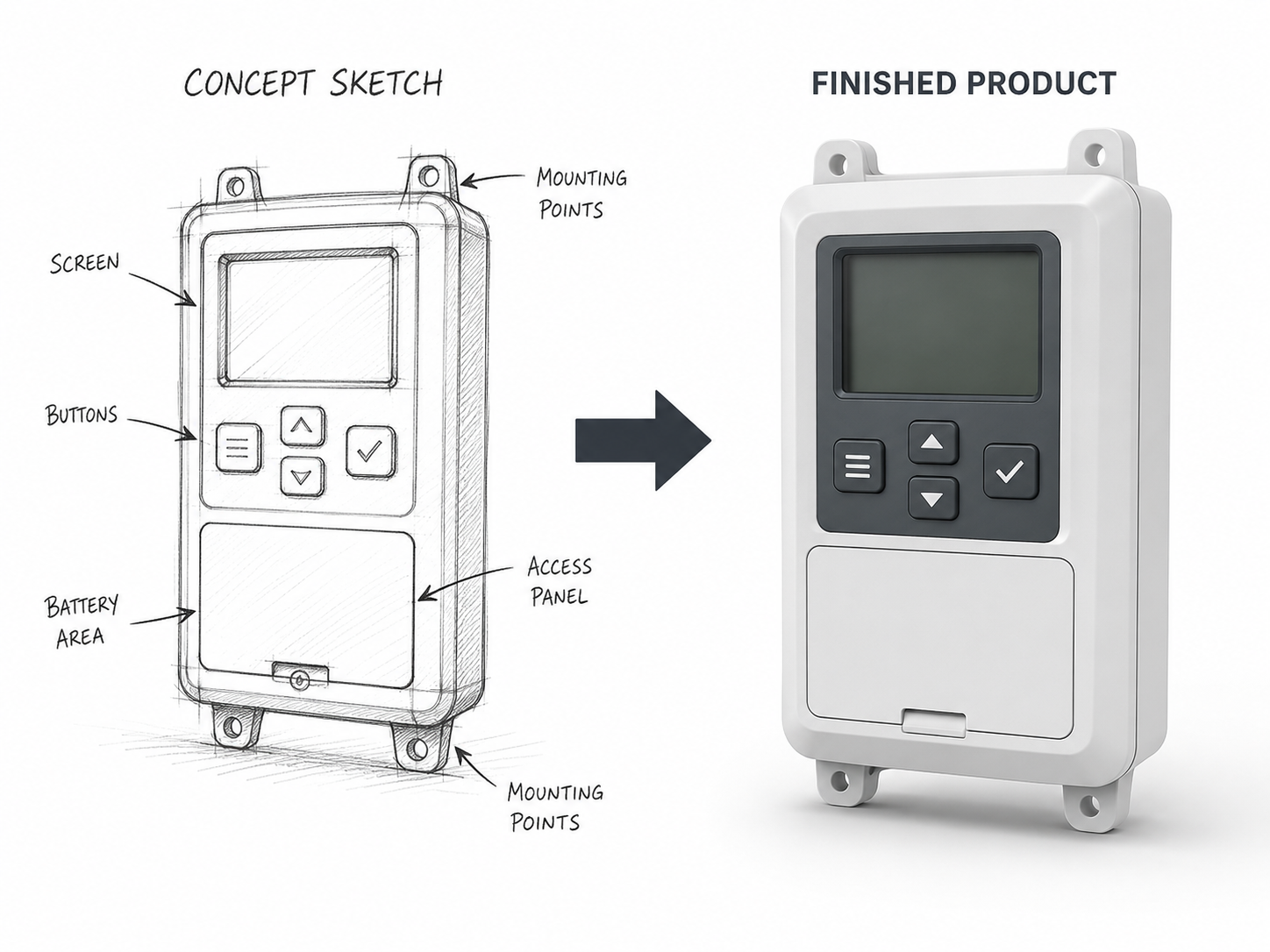
How 3D Printing Has Changed Enclosure Design
Product enclosures are often treated as simple housings. In reality, the enclosure is usually one of the most important parts of a device.
It controls how the product is mounted, how electronics are protected, how users interact with it, how components are serviced, and how professional the final product feels. For medical devices, industrial controls, laboratory equipment, consumer electronics, and field-use products, the enclosure is not just a box. It is part of the product.
3D printing has changed how these enclosures are developed.
From Rendering to Real Object
A CAD rendering can make almost any concept look finished. It does not show whether the device is too large, awkward to handle, hard to mount, or difficult to service.
A 3D printed enclosure gives the team something real to evaluate. Designers, engineers, investors, customers, technicians, and end users can hold it, open it, mount it, and interact with it.
That physical feedback is extremely valuable. It often reveals problems that are not obvious on a screen.
Faster Design Iteration
Traditional prototype enclosures can be expensive and slow to revise. Machining, sheet metal, urethane casting, or tooling all have their place, but they often require more commitment before the design is fully proven.
3D printing allows enclosure designs to be tested and revised quickly.
A first version can be printed, reviewed, marked up, adjusted, and reprinted. This makes it much easier to improve button placement, internal clearance, wall thickness, access panels, mounting points, cable routing, and service features before committing to more expensive production methods.
The result is usually a better product with fewer late-stage surprises.
Better Internal Layout
Modern devices often contain circuit boards, batteries, displays, sensors, connectors, wiring, fans, switches, LEDs, antennas, and other components. Getting all of that hardware to fit cleanly inside an enclosure is often one of the hardest parts of product development.
3D printing allows the enclosure to be designed around the actual components.
Mounting bosses, standoffs, wire channels, trays, covers, brackets, strain reliefs, and access panels can all be built into the prototype. This helps prove whether the device can actually be assembled, used, repaired, and manufactured.
In many products, the enclosure becomes the mechanical backbone of the entire system.
Using Existing Electronics
3D printing also makes it easier to build professional prototypes around existing commercial hardware.
For example, a team can start with a standard tablet and design a custom enclosure around it. That enclosure can include a larger battery, internal wiring, speakers, sensors, lights, switches, charging access, wall mounts, handles, or other supporting components.
This approach can save significant time and money. Instead of designing a custom touchscreen computer from scratch, the team can use reliable existing electronics and focus on the product’s function, layout, usability, and appearance.
For many early-stage devices, this is a practical bridge between a rough prototype and a fully custom product.
Functional Material Choices
3D printed enclosures are not limited to basic plastic mockups. Depending on the application, prototypes can be printed in PLA, PETG, PCTG, ABS, ASA, nylon, polycarbonate blends, flexible materials, carbon-fiber-filled materials, engineering resins, and other specialty materials.
For electronic devices, ESD-safe materials can also be useful. These materials help reduce electrostatic discharge risk around sensitive electronics and may be appropriate for electronics housings, test fixtures, assembly tools, control boxes, and certain industrial or laboratory applications.
Material choice should match the purpose of the prototype. Some prints only need to show size and shape. Others need to test strength, heat resistance, impact resistance, snap fits, hinges, mounting features, or field handling.
Improved Communication
A physical enclosure prototype improves communication.
Everyone can look at the same object, touch the same controls, open the same access panels, and discuss the same design issues. This is especially useful when the project involves both technical and non-technical stakeholders.
A prototype helps turn abstract discussion into specific feedback.
Is the screen at the right angle?
Can the user reach the buttons?
Can the technician replace the battery?
Will the device mount securely?
Does it look like a serious product?
These questions are much easier to answer with a physical prototype.
A Bridge to Manufacturing
3D printing is not always the final production method. Many enclosure designs eventually move to injection molding, urethane casting, thermoforming, sheet metal, or machining.
But 3D printing is an excellent bridge to those processes.
It helps identify design problems before expensive tooling is built. It allows the team to refine assembly methods, fastener locations, wall thicknesses, split lines, service access, and user interaction before production decisions are locked in.
Used properly, 3D printing reduces risk.
Why It Matters
3D printing has changed enclosure design because it lowers the cost of learning.
It allows teams to test ideas sooner, make better decisions, and develop products with real user feedback instead of relying only on drawings and renderings.
A well-designed enclosure improves usability, credibility, serviceability, and manufacturability. It can make the difference between a device that looks like an experiment and one that looks ready for serious evaluation.
For product developers, startups, medical device teams, industrial companies, and research groups, 3D printing has made enclosure development faster, more practical, and much more effective.
About the Author: jaegertechgroup.com

STAY IN THE LOOP
Subscribe to our free newsletter.
Leave A Comment
Integrating a Tablet, Scanner, and Maintenance Hardware Into One Aerospace Field Tool In aerospace maintenance, the challenge is rarely just collecting information.
From 3D Scan to Perfect Fit: The Corvette Bumper Project Moves Forward A few weeks ago, we shared a project that demonstrated

Great Conversations and New Connections at SMD in Huntsville Last week, Janelle and I had the opportunity to attend SMD in Huntsville,
Custom 3D Printed Speaker Pods for a 2005 Ford Mustang Sometimes the problem is not the speaker. It is everything around it.