
Designing Drone Parts for Vibration, Impact, and Real-World Flight Loads
A drone part can look perfect on the bench and still fail in the air.
That is one of the biggest lessons in UAV development.
A bracket may feel rigid by hand. A camera mount may look strong in CAD. A printed arm may survive a static load test. But once the aircraft is flying, that part is exposed to a very different environment:
motor vibration → propeller imbalance → resonance → repeated load cycles → hard landings → crashes → heat → weather → fastener movement
Real flight loads are dynamic.
That means drone parts need to be designed for more than simple static strength.
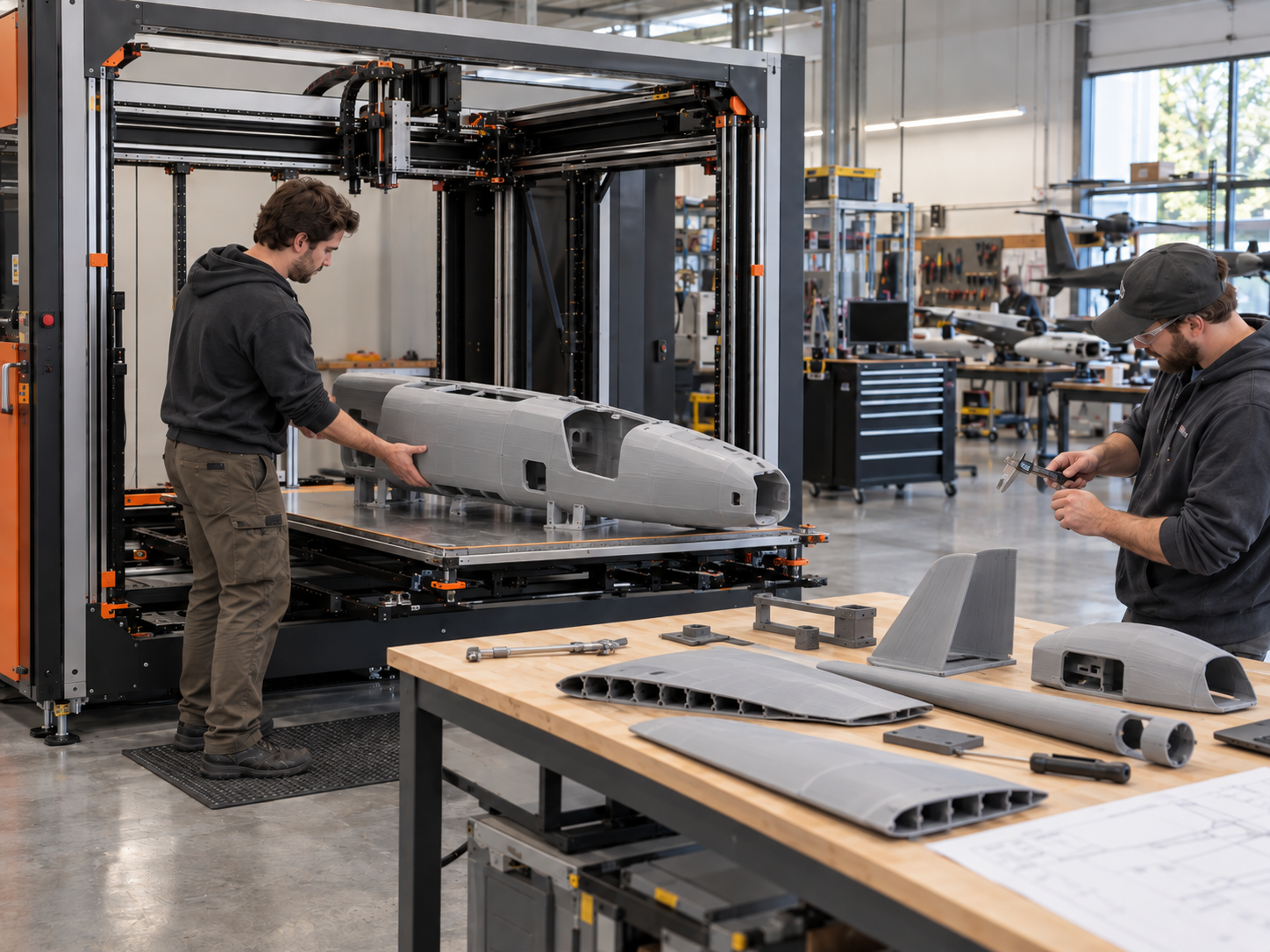
At Jaeger Technology Group, we have seen this repeatedly in drone and aerospace-related work, including student Design-Build-Fly projects, custom UAV components, lightweight structural parts, and additive-manufactured hardware intended for real-world use.
The best drone part is not necessarily the part with the highest infill percentage or the thickest wall.
It is the part that is designed around how the load actually enters the structure, how vibration travels through it, how it will be manufactured, and how it will fail.
Bench Strength Is Not Flight Strength
One of the easiest mistakes to make is judging a drone component by how it feels in your hand.
A printed mount may feel extremely stiff.
That tells you almost nothing about how it will respond to:
- repeated high-frequency vibration
- abrupt acceleration
- propeller imbalance
- motor torque
- landing shock
- gyroscopic loads
- impact
- temperature changes
- thousands of load cycles
A component can survive a large static force once and still fail after being subjected to a much smaller force thousands of times.
That is fatigue.
And on drones, fatigue matters.
A useful way to think about it is:
Static Strength ≠ Fatigue Life
and:
Bench Test ≠ Flight Test
Motor Vibration Travels Through the Entire Airframe
Brushless motors generate vibration even when everything is working correctly.
Add a slightly imbalanced propeller, a bent shaft, a damaged bearing, or a poorly seated motor mount and those vibration levels can increase dramatically.
That vibration travels through:
- motor mounts
- arms
- center frames
- battery trays
- electronics mounts
- sensor housings
- camera mounts
- payload structures
If the structure has a resonant frequency near the excitation frequency created by the motor and propeller, relatively small input vibration can turn into much larger movement.
That can create problems far beyond simple structural failure.
It can affect:
- cameras
- IMUs
- accelerometers
- gyroscopes
- GPS systems
- connectors
- wiring
- fasteners
- optical sensors
A mechanically strong part can still be a bad drone part if it transmits too much vibration.
Stiffness Matters as Much as Strength
Drone arms are a good example.
An arm may technically be strong enough to support the motor.
But if the arm flexes too much, it can affect motor alignment and aircraft response.
The relationship can become:
Motor Thrust → Arm Deflection → Motor Angle Change → Flight-Control Correction
The flight controller may compensate for some structural movement.
That does not mean the structure should be allowed to flex excessively.
For many components, increasing stiffness can be more valuable than simply increasing ultimate strength.
Ways to improve stiffness may include:
- increasing section depth
- adding ribs
- changing cross-sectional geometry
- moving material farther from the neutral axis
- adding local reinforcement
- changing print orientation
- changing material
- separating a large component into better load-carrying subassemblies
A thicker solid block is not always the best answer.
Good geometry often saves more weight than simply adding material.
Separate the Part Into Functional Regions
This is an area where additive manufacturing becomes particularly useful.
A drone component does not necessarily need the same structure everywhere.
Different areas of the part may have very different requirements.
For example:
Motor Interface → High Stiffness / High Fastener Strength
Main Arm → Lightweight Structural Section
Electronics Area → Vibration Isolation
Impact Zone → Toughness and Replaceability
Instead of treating the entire part as one uniform block, the design can be divided into functional regions.
That might mean:
- thicker walls near motor mounts
- additional perimeter count around fasteners
- ribs along primary load paths
- lower-density internal regions
- dense material around inserts
- flexible isolation features around electronics
This is much more efficient than simply printing the entire part at extremely high infill.
Adaptive Infill Can Put Material Where It Matters
One of the strengths of additive manufacturing is the ability to vary internal structure.
A drone part may not need 80% infill throughout the entire component.
The center of a large section may contribute relatively little compared with the outside walls and structural ribs.
Depending on geometry, a more efficient strategy may be:
More Perimeters + Strategic Infill + Local Reinforcement
rather than:
Maximum Infill Everywhere
Modern slicers can also allow different regions of a component to use different settings.
That makes it possible to create:
- dense motor attachment zones
- reinforced fastener regions
- lightweight central sections
- stronger landing-impact areas
- additional structure around inserts
- lower-density noncritical volumes
Adaptive or modifier-based infill can reduce weight without weakening the regions that actually carry the loads.
Layer Orientation Can Determine Whether the Part Survives
For FDM parts, layer orientation remains one of the most important design considerations.
A printed part is anisotropic.
That means:
Strength Along the Extruded Material ≠ Strength Between Layers
If the primary load attempts to pull layers apart, the component may fail much earlier than expected.
This becomes particularly important around:
- motor mounts
- landing gear
- arm joints
- payload brackets
- screw bosses
- hinges
- snap features
Sometimes the best solution is simply changing print orientation.
Other times, the better solution is splitting the component into multiple pieces so each part can be printed in an orientation that better follows its load path.
Separate Parts Can Be Stronger Than One Large Printed Part
There is a natural tendency to try to print an entire assembly as one piece.
Sometimes that works.
Sometimes it creates a weaker product.
Breaking a design into several parts may allow:
- better print orientation
- easier replacement after a crash
- stronger joints
- simpler printing
- less support material
- easier maintenance
- different materials in different locations
For example:
Rigid Structural Arm + Replaceable Motor Mount + Flexible Electronics Isolator
may perform much better than attempting to print all three functions into one large part.
This also has an important operational advantage.
If the motor mount is damaged, the entire arm does not necessarily need to be replaced.
Design-Build-Fly Is a Good Example
Student Design-Build-Fly projects are an excellent demonstration of the tradeoffs involved in UAV design.
Weight matters.
Strength matters.
Manufacturability matters.
Repairability matters.
And the aircraft still has to perform its mission.
We have supported student engineering teams working in this space, and projects like these make one thing very clear:
Every gram needs a reason to be there.
A component that is unnecessarily heavy reduces performance somewhere else.
That extra weight may mean:
- larger motors
- more battery
- reduced payload
- reduced flight time
- greater structural loads
- poorer handling
The goal is not simply to make every component stronger.
It is to put enough material in the right places.
JaegerTech has previously discussed supporting Design-Build-Fly teams and related drone material and generative-design work on our site. Pasted text
Fasteners Are Often the First Thing to Move
One of the most common real-world vibration problems is not the printed part breaking.
It is the hardware loosening.
Repeated vibration can gradually work fasteners loose.
That can affect:
- motor mounting screws
- electronics mounts
- payload brackets
- frame joints
- landing gear
- camera assemblies
Potential design approaches include:
- locking fasteners
- appropriate threadlocker
- captive nuts
- threaded inserts
- prevailing-torque nuts
- mechanical locking features
- proper preload
But the joint itself also has to be designed correctly.
A poorly designed fastener boss may creep or deform, reducing preload even if the screw initially stays tight.
Threaded Inserts Can Help
For printed components that will be repeatedly assembled and serviced, heat-set threaded inserts can provide a major improvement over running screws directly into printed plastic.
They can provide:
- more consistent threads
- improved serviceability
- better clamp load
- repeated assembly
- better wear resistance
However, the surrounding geometry still matters.
The insert needs enough material around it.
The boss needs to resist splitting.
And the insert should be oriented so that the expected load does not simply pull it out of the plastic.
Electronics Need Isolation, Not Just Protection
Drone electronics can be mechanically fragile even when they are electrically robust.
Sensitive electronics may benefit from isolation from high-frequency structural vibration.
That can include:
- IMUs
- cameras
- sensors
- flight controllers
- payload electronics
Possible methods include:
- elastomer mounts
- rubber grommets
- TPU isolators
- foam interfaces
- tuned mounting features
But too much isolation can create a different problem.
A mount that is excessively soft may allow the component to move too far.
That is why vibration isolation has to be designed, not guessed.
The objective is not simply:
Make It Soft
It is:
Reduce Undesirable Frequency Transmission Without Allowing Excessive Movement
TPU Can Be Extremely Useful
Flexible materials such as TPU can play an important role in drone design.
We have used and evaluated flexible additive materials for other MRO and industrial applications because they can provide controlled compliance where rigid materials are undesirable. Your existing site already includes work involving soft TPU supports for aviation MRO. Pasted text
In drone applications, TPU can be useful for:
- camera isolation
- wire strain relief
- landing feet
- antenna mounts
- bumpers
- battery retention
- protective covers
It should not automatically be used for everything flexible.
The geometry, durometer, thickness, and load still matter.
Crash Loads Are Different
Normal flight loads can often be modeled reasonably well.
Crash loads are different.
They may be:
- high magnitude
- extremely short duration
- directional
- unpredictable
That makes sacrificial design valuable.
Instead of trying to make every component survive every possible crash, it may make sense to design certain parts to fail first.
For example:
Impact → Replaceable Mount Fails → Main Frame Survives
That can be much better than:
Impact → Main Frame Cracks → Entire Aircraft Requires Major Repair
Replaceable printed components can be particularly useful in this role.
Sacrificial Parts Can Reduce Repair Cost
Some drone components are ideal candidates for intentional replaceability.
Examples might include:
- landing feet
- camera guards
- antenna mounts
- propeller guards
- motor protectors
- payload brackets
- bumpers
These can be inexpensive parts designed to absorb damage before more expensive components do.
This is one area where 3D printing can provide significant operational value.
Instead of stocking an expensive complete assembly, you may be able to keep several inexpensive replacement components available.
Large Printed Parts May Need to Be Divided
We have also seen cases where trying to print a very large component as a single part creates more problems than it solves.
Large UAV components may benefit from segmentation.
Reasons include:
- printer build-volume limits
- better print orientation
- easier replacement
- reduced warping
- stronger localized material choices
- reduced support requirements
- simpler shipping
A properly designed mechanical joint can sometimes outperform an awkwardly oriented one-piece print.
This is especially true if the joint is designed to transfer loads through mechanical geometry rather than depending only on fasteners.
Material Choice Still Matters
JaegerTech has already written specifically about why drone material selection matters, and that remains important here. Pasted text
The correct material depends on the component.
Possible options include:
PLA
Useful for:
- fit checks
- early prototypes
- low-temperature testing
But generally not our first choice for demanding outdoor UAV structures because of temperature sensitivity and brittleness.
PETG / PCTG
Useful for:
- durable prototypes
- moderate-impact components
- general-purpose housings
ASA
Useful where:
- UV resistance
- weather resistance
- higher temperature capability
are important.
Nylon
Often an excellent choice where toughness and fatigue resistance matter.
Carbon-Fiber-Reinforced Materials
Potentially useful when greater stiffness is needed.
But carbon-filled material is not automatically better.
Different fiber-filled materials can have very different:
- interlayer strength
- impact behavior
- fatigue properties
- printability
Material should be selected around the application, not the marketing label.
Generative Design Can Help, But It Needs Engineering Judgment
Generative design and topology optimization are attractive for UAVs because weight reduction matters so much.
JaegerTech has previously covered generative design and 3D-printed UAV components. Pasted text
These tools can identify interesting load paths.
But the generated geometry still needs to be evaluated for:
- print orientation
- minimum wall thickness
- fastener access
- supports
- manufacturing
- fatigue
- serviceability
The mathematically lightest shape is not always the best manufactured part.
A useful workflow may be:
Load Cases → Optimization → Engineering Review → Manufacturing Constraints → Physical Testing
Camera and Sensor Payloads Need Special Attention
Payload structures can be particularly sensitive to vibration.
A camera mount might be strong enough but still produce unusable footage.
A sensor may remain mechanically attached but generate poor data because of vibration.
That means payload mounts need to consider:
- stiffness
- resonance
- isolation
- center of gravity
- cable movement
- connector retention
- serviceability
A good payload mount is not simply a bracket.
It is part of the sensing system.
Center of Gravity Can Change Structural Loads
Adding a payload changes more than the weight of the aircraft.
It may change where the load acts.
If a payload is mounted far from the aircraft center of gravity, it can create additional bending moments.
That means:
Payload Weight × Distance = Additional Moment
A relatively light sensor mounted far from the center of the aircraft may have a greater structural effect than expected.
This is another reason that bracket design cannot be considered independently from aircraft layout.
Wire Management Matters in Vibration Environments
Wires should not be allowed to move freely inside a UAV.
Repeated movement can lead to:
- connector fatigue
- insulation wear
- broken conductors
- intermittent faults
Cable routing should include:
- strain relief
- controlled bend radius
- support points
- connector retention
- separation from moving components
A wire that is fine on the bench may become a failure point after hours of vibration.
Flight Testing Should Be Progressive
A new component should not necessarily go immediately from the printer to a full mission.
A better progression might be:
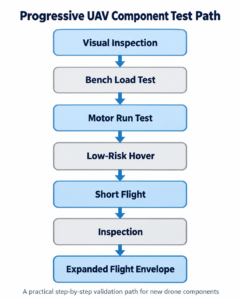
After testing, inspect for:
- loosened hardware
- cracks
- layer separation
- insert movement
- cable wear
- deformation
- heat damage
This can identify developing failures before they become catastrophic.
Real-World Drone Design Is a System Problem
A drone part does not exist by itself.
Every component interacts with the rest of the aircraft.
A small structural change can affect:
Weight → Center of Gravity → Motor Load → Battery Consumption → Flight Time
A stiffer component can affect:
Vibration Transmission → Sensor Performance
A material change can affect:
Temperature Resistance → Weight → Impact Behavior → Print Orientation
That is why drone design needs to be treated as a system.
Where Additive Manufacturing Fits Best
3D printing is particularly valuable in UAV development because it allows teams to rapidly test different ideas.
It can be especially effective for:
- custom payload mounts
- camera brackets
- sensor housings
- aerodynamic covers
- wiring guides
- antenna mounts
- landing components
- structural prototypes
- production parts in appropriate applications
It also enables something traditional manufacturing often cannot:
Rapid Design Change → Immediate Physical Part → Flight Test → Revision
That feedback loop can significantly accelerate UAV development.
Design for the Flight, Not the Workbench
One of the biggest lessons we have learned working around aerospace, student flight projects, UAV components, and additive manufacturing is simple:
A part that looks good on the bench is not necessarily ready for flight.
Real-world drone components need to account for:
- vibration
- resonance
- fatigue
- stiffness
- impact
- fasteners
- wiring
- electronics isolation
- environmental exposure
- manufacturing method
Sometimes the answer is a stronger material.
Sometimes it is more perimeters.
Sometimes it is adaptive infill.
Sometimes it is changing the layer orientation.
Sometimes it is dividing one complicated printed part into three simpler parts.
And sometimes the best answer is deciding that a particular component should not be 3D printed at all.
That is engineering.
Need Help Designing or Manufacturing UAV Components?
Jaeger Technology Group works with engineers, manufacturers, researchers, student teams, and product developers on custom UAV and aerospace-related components.
Whether you need to:
- redesign a part that keeps failing
- reduce weight without sacrificing stiffness
- develop a custom sensor or camera mount
- select the right material
- optimize a design for additive manufacturing
- produce a one-off prototype
- move a tested component into small-batch production
- integrate electronics and mechanical hardware
- turn a rough CAD model into a flight-ready component
we can help take the project from design through physical hardware.
If your drone project has moved beyond what an off-the-shelf bracket or generic printed part can handle, contact Jaeger Technology Group and tell us what you are trying to build.
We are based in Decatur, Alabama and support projects throughout the Southeast and across the United States.
About the Author: jaegertechgroup.com

STAY IN THE LOOP
Subscribe to our free newsletter.
Leave A Comment
Beyond ESP32 and Raspberry Pi: Designing Electronics for Real Products Development boards are one of the best tools available for product development.
From MVP to Market: How Consumer Electronics Become Real Products A working MVP is an important milestone. It proves that the idea
Designing Products for Serviceability, Maintenance, and Field Repair A product can work perfectly on the day it is delivered and still be
When a Customer Has an Idea but No CAD: How Product Development Actually Starts A surprising number of product-development projects do not