
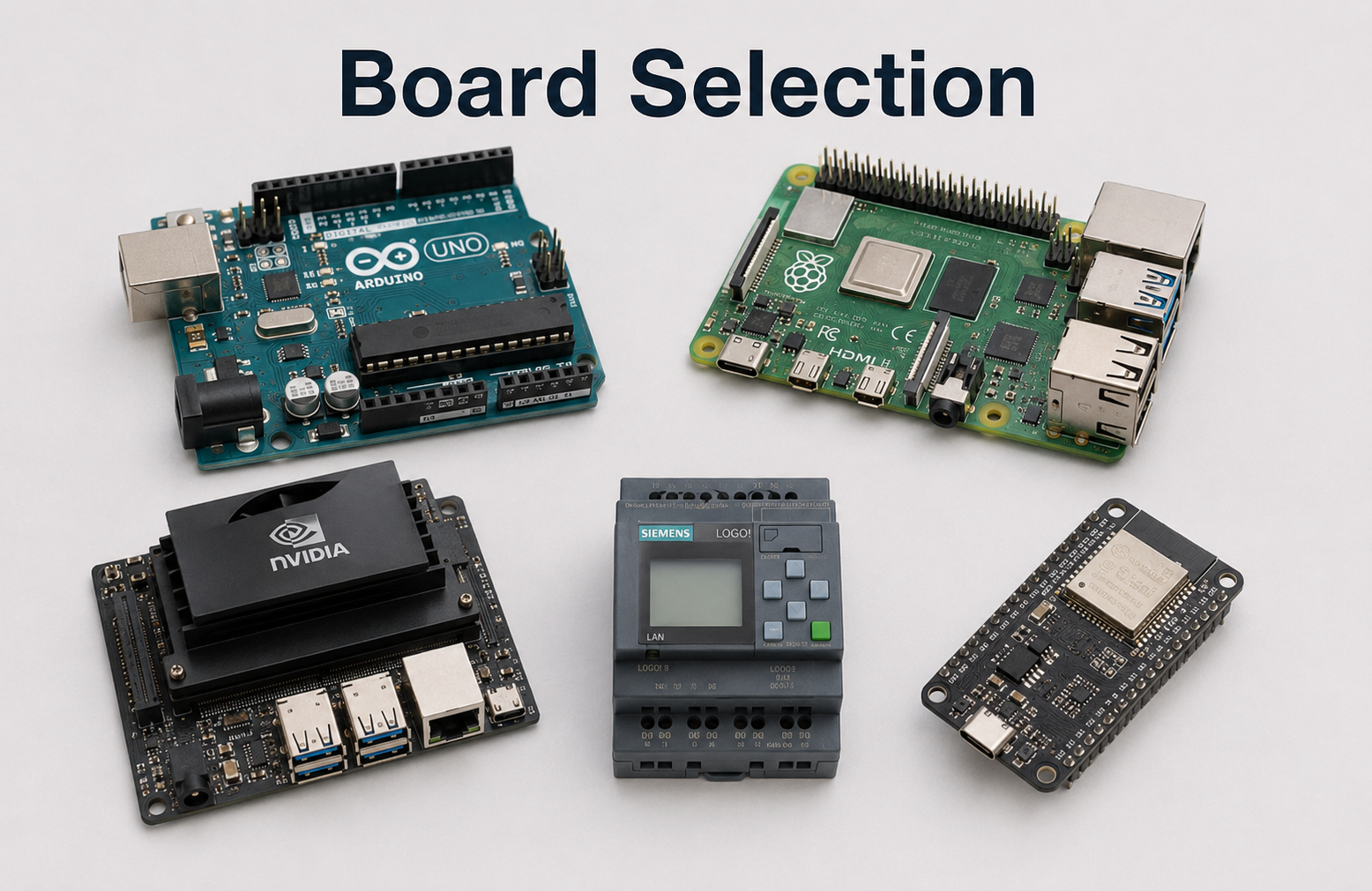
Choosing the Right Development Board for a Hardware Prototype
Putting Hardware Into Your Prototype: Part 2 of a Five-Part Series
In the first article in this series, we discussed why development boards can be a practical substitute for custom electronics during early prototype development.
That leads to the next question:
Which development board should you use?
For many project teams, the familiar names are Arduino, ESP32, and Raspberry Pi. Those are reasonable starting points, but they are not the only options. Development boards now range from very simple microcontroller platforms to industrial control devices, cellular-connected sensor systems, Linux computers, audio-processing boards, and artificial-intelligence platforms capable of running machine-vision applications directly at the edge.
The correct choice is rarely determined by which board is most powerful or most popular.
The better question is:
What type of electronics architecture does your prototype actually need?
A board intended to read a switch and turn on an indicator light is very different from one intended to stream sensor data over cellular service, process live video, control machinery, collect research-grade measurements, or support an eventual commercial product.
Choosing correctly at the beginning can make a prototype faster to build, easier to test, easier to document, and less expensive to revise.
Begin With the Job, Not the Brand Name
Development boards are sometimes treated like interchangeable building blocks. They are not.
Two boards may both have small processors and input/output pins while being intended for very different types of work.
Before discussing particular platforms, the development team should define what the board must accomplish:
- Read sensors or switches
- Control lights, relays, valves, motors, pumps, or other hardware
- Perform predictable real-time actions
- Save data locally
- Communicate over Wi-Fi, Bluetooth, Ethernet, cellular, CAN bus, serial, or industrial protocols
- Operate from batteries or a fixed power source
- Support a display, camera, microphone, or speaker
- Run a user interface or web dashboard
- Operate in an industrial, mobile, outdoor, laboratory, or medical-development environment
- Provide a practical path toward a later commercial product
Once those requirements are known, choosing a board becomes much more manageable.
The First Major Decision: Microcontroller or Small Computer?
The most important distinction in development-board selection is whether the prototype requires a microcontroller or a small computer.
Microcontroller-Based Boards
Boards such as many Arduino-compatible platforms, ESP32 boards, Raspberry Pi Pico boards, STM32 Nucleo boards, and Teensy boards are microcontroller-based systems.
They are generally intended to interact directly with physical hardware. They can read sensors, control outputs, communicate with peripheral devices, and execute programmed actions with relatively predictable timing.
Microcontroller boards are commonly appropriate for:
- Sensor acquisition
- Switch and button inputs
- LED indicators
- Relays and motor-driver control
- Servo or actuator control
- Battery-powered devices
- Small connected sensors
- Repeatable control sequences
- Equipment monitoring
- Embedded functions that need to start quickly and operate reliably
A microcontroller does not normally run a desktop-style operating system. That is often an advantage. There is less software overhead, lower power consumption, faster startup, and more predictable behavior.
Single-Board Computers
Boards such as a full Raspberry Pi or BeagleBone are small computers. They usually run Linux or another operating system and are capable of handling more complex software functions.
Single-board computers are commonly appropriate for:
- Touchscreen interfaces
- Cameras and image processing
- Local dashboards
- Web servers
- Databases
- Advanced networking
- Audio recording or playback
- File management
- Local data analysis
- Complex software libraries
- Integration with higher-level software systems
A small computer can provide impressive capability quickly, but it also brings additional requirements. It needs an operating system, storage, startup configuration, reliable shutdown handling, software updates, and more attention to system reliability.
Sometimes a Prototype Needs Both
A sophisticated prototype may use a microcontroller and a small computer together.
For example, a microcontroller might read sensors, control motors, and provide immediate hardware response, while a Raspberry Pi or similar computer handles:
- A touchscreen interface
- Data visualization
- Cloud communication
- Camera processing
- Database storage
- Advanced analysis
This division of labor can be appropriate when a product needs both predictable hardware control and more sophisticated computing capability.
A Practical Starting-Point Matrix
The following table provides a useful first approximation when selecting a development-board family.
| Prototype Requirement | Likely Starting Platform |
|---|---|
| Simple sensors, switches, LEDs, relays, or actuator control | Arduino-compatible board or Raspberry Pi Pico-class board |
| Wireless sensing through Wi-Fi or Bluetooth | ESP32-class board |
| Compact battery-powered prototype with add-on modules | Adafruit Feather or similar compact ecosystem |
| Very small embedded prototype with limited enclosure space | Seeed Studio XIAO or similar miniature board |
| Higher-performance real-time control or audio processing | Teensy or STM32-class board |
| More formal embedded firmware development and debugging | STM32 Nucleo board |
| Screen, camera, local dashboard, database, or Linux software | Raspberry Pi or BeagleBone-class computer |
| Cellular-connected remote equipment or field monitoring | Particle or similar cellular IoT platform |
| Industrial monitoring, cabinet installation, or PLC-style control | Industrial controller or micro PLC platform |
| Machine vision, robotics, or edge artificial intelligence | NVIDIA Jetson or similar edge-computing platform |
This table is not a substitute for engineering evaluation. It is a way to narrow the field before committing time and budget.
Arduino-Compatible Boards: The Familiar Starting Point
Arduino is often the first platform people encounter when discussing embedded electronics. It has earned that position because it makes basic control and sensor integration accessible.
An Arduino-compatible board can be an excellent starting point for prototypes that need to:
- Read switches or buttons
- Monitor simple sensors
- Control indicator lights
- Activate relays
- Drive servos or send commands to motor drivers
- Log basic measurements
- Demonstrate a control sequence
- Interact with common electronic modules
For project managers, Arduino is useful because the ecosystem is familiar, documentation is widely available, and many common prototype functions can be demonstrated rapidly.
For developers, it is important not to assume that “Arduino” means only one small introductory board. The broader Arduino ecosystem includes simple controller boards, higher-performance embedded boards, and industrial-oriented products.
For instance, Arduino’s higher-performance Portenta family is intended for more demanding embedded and professional applications, while Arduino Opta is a micro PLC intended for industrial and building-automation use.
When Arduino-Compatible Boards Are a Good Choice
Arduino-compatible boards are often appropriate when:
- The prototype is primarily about physical control
- Wireless communication is not the central requirement
- Sensor and actuator complexity is moderate
- Rapid development matters more than maximum processing capability
- The team benefits from a large ecosystem of examples and add-on modules
Where They May Become Limiting
A basic Arduino-compatible board may become limiting when the project requires:
- Extensive wireless capability
- Large amounts of local data storage
- Camera processing
- Rich graphical interfaces
- Advanced audio processing
- Complex networking
- High-speed sensor processing
- Significant industrial communications support
At that point, another board family may provide a cleaner route.
ESP32 Boards: Connected Sensors and Compact IoT Prototypes
ESP32-class boards have become extremely important in prototype development because they combine microcontroller functionality with built-in wireless capability.
An ESP32 is often a strong candidate when a product needs:
- Wi-Fi connectivity
- Bluetooth communication
- Wireless sensor monitoring
- Mobile-device interaction
- Compact connected hardware
- Battery-powered remote sensing
- Local control combined with network reporting
For example, a prototype might use an ESP32 to read temperature, orientation, force, touch, or equipment-status sensors and transmit those readings to a local interface or cloud-connected system.
Different ESP32 variants support different capabilities. An ESP32-S3 may be useful where wireless connectivity is combined with richer peripherals or modest AI-oriented processing. An ESP32-C6 may be useful where a design benefits from newer wireless protocol options such as Wi-Fi 6, Bluetooth Low Energy, Thread, or Zigbee capability.
The important point is not memorizing every ESP32 variant. It is recognizing that ESP32 is often a practical starting family for wireless, compact, connected devices.
When ESP32 Boards Are a Good Choice
ESP32 platforms are often appropriate when:
- Wi-Fi or Bluetooth is central to the concept
- The product is fundamentally a sensor-and-communications device
- Cost and physical size matter
- Battery operation is under consideration
- The system does not require a full operating system
- The prototype may eventually move toward an integrated connected product
Questions to Address Early
An ESP32 can make wireless communication accessible, but a connected product still needs a plan:
- What happens if Wi-Fi is unavailable?
- Will Bluetooth require a mobile application?
- Is local data storage needed during communication outages?
- How will the device be updated?
- Is the data sensitive?
- Will wireless transmission substantially reduce battery life?
- Does the device need local control even when the network fails?
Wireless hardware is only one part of a reliable connected product.
Raspberry Pi Pico-Class Boards: Low-Cost Embedded Control
The Raspberry Pi name can create confusion because the Raspberry Pi Pico family is not the same type of device as a full Raspberry Pi computer.
A Raspberry Pi Pico-class board is a microcontroller board. It is intended for embedded control tasks rather than for running a Linux operating system.
These boards can be appropriate for:
- Switches and buttons
- LED control
- Basic displays
- Motor-driver signals
- Sensor reading
- Educational devices
- Fixtures and test hardware
- Cost-conscious embedded prototypes
A Pico-class board may be considered alongside Arduino-compatible boards when the project primarily requires direct hardware interaction rather than advanced networking or operating-system software.
When Pico-Class Boards Are a Good Choice
They can be a good fit when:
- The required control task is straightforward
- The design needs a compact and cost-conscious controller
- The prototype does not depend heavily on wireless communication
- The developer is comfortable selecting the necessary software environment and add-on hardware
A Pico-class device may be especially useful when the prototype needs embedded control but does not need the larger ecosystem or specific board features of another platform.
STM32 Nucleo Boards: A More Engineering-Oriented Embedded Path
STM32 microcontrollers are widely used in embedded-product development. STM32 Nucleo boards provide a convenient way to develop and test applications around those processors without immediately designing a custom circuit board.
These boards are particularly relevant when a prototype may eventually move toward more formal embedded firmware development or a dedicated production PCB.
STM32 Nucleo boards commonly provide:
- A broad range of available microcontroller options
- Integrated programming and debugging hardware
- Expansion connectors
- Support for structured firmware development
- A closer development path toward custom embedded electronics
For a project manager, the distinction is that STM32 Nucleo boards may be selected not merely to demonstrate a feature, but to begin developing software around a processor family that could reasonably appear in a later product.
For an embedded developer, integrated debugging and the STM32 software ecosystem may make these boards more suitable than simpler platforms when testing timing, peripherals, power behavior, or more complex firmware architecture.
When STM32 Nucleo Boards Are a Good Choice
They are often worth considering when:
- The device has serious embedded-control requirements
- Firmware architecture and debugging matter early
- Precise timing or low-power operation may be important
- The project is likely to migrate toward a custom microcontroller PCB
- A development team is already familiar with embedded C/C++ workflows
- The product needs a more deliberate engineering path than a quick demonstration board
STM32 Nucleo is not necessarily the fastest route for every simple prototype. It can, however, be an excellent route when a product-development team knows that embedded electronics will become a central part of the finished product.
Teensy Boards: High-Performance Control and Audio Applications
Teensy boards are compact microcontroller development boards known for providing substantial real-time processing capability in a small package.
They can be especially useful when a prototype requires:
- Fast sensor processing
- Precise timing
- Higher-performance control
- Audio input or output
- Signal analysis
- Multiple simultaneous data streams
- Compact packaging
Audio is an important example. A prototype that needs an alert buzzer may be satisfied with a basic controller. A prototype that needs recording, playback, filtering, signal analysis, mixing, or interaction through microphones and speakers may benefit from a platform designed to support more demanding audio work.
When Teensy Boards Are a Good Choice
Teensy may be appropriate when:
- Audio processing is part of the product concept
- Faster real-time behavior is required
- The system needs more processing capability than an entry-level controller board
- The product remains fundamentally embedded rather than operating-system based
- A compact control platform is desirable
A Teensy board may be far more appropriate for a fast sensor or audio prototype than jumping immediately to a Linux computer simply because the project requires more performance.
Raspberry Pi Computers: Displays, Cameras, Dashboards, and Complex Software
A full Raspberry Pi is a small Linux computer. This makes it fundamentally different from Arduino-compatible, ESP32, Pico, STM32, or Teensy microcontroller platforms.
A Raspberry Pi is often valuable when the prototype needs:
- A monitor or touchscreen
- A camera
- A local web interface
- A database
- File storage
- Advanced networking
- Audio playback or recording
- Remote administration
- Complex software packages
- Higher-level data processing
For example, a prototype inspection system may use a camera, display captured images, save results locally, communicate with a network, and provide a user interface. That type of project may be much easier to develop on a Raspberry Pi than on a small microcontroller.
When Raspberry Pi Computers Are a Good Choice
A full Raspberry Pi is often appropriate when:
- The prototype behaves more like a computer than a simple controller
- Existing Linux software libraries substantially reduce development effort
- The product needs cameras, dashboards, files, databases, or rich interfaces
- Power consumption and startup time are acceptable for the application
- The prototype can tolerate operating-system complexity
Where Raspberry Pi Requires Care
Using Linux also introduces questions:
- What happens if power is removed without a proper shutdown?
- Does the product need to boot automatically after an outage?
- Can memory-card storage become corrupted?
- Who will maintain operating-system updates?
- Does the design need long-term software support?
- Is the power requirement reasonable for a portable device?
A Raspberry Pi can allow rapid progress, but it should be selected because the prototype benefits from computer-like capability, not simply because it can perform many different tasks.
BeagleBone Boards: Linux Computing With Industrial and Hardware-Control Relevance
BeagleBone is another single-board computer family worth understanding, particularly for prototypes involving industrial equipment, physical computing, or applications where Linux operation and accessible hardware interfaces are both important.
BeagleBone-class devices may be useful when a project needs:
- Linux software
- Extensive hardware input/output access
- Equipment interfaces
- Robotics development
- Industrial control experimentation
- An industrial-temperature version for harsher conditions
A BeagleBone may not have the same general consumer recognition as Raspberry Pi, but it can be relevant in industrially oriented prototypes where direct interaction with equipment is important.
When BeagleBone Is Worth Considering
BeagleBone may be appropriate when:
- The project is Linux-based but strongly tied to physical input/output
- Industrial or robotics integration is important
- The developer is familiar with the platform
- Environmental requirements make industrial variants attractive
For a project manager, the important lesson is that “small Linux computer” does not automatically mean Raspberry Pi. The best choice may depend on the required interfaces and intended environment.
Adafruit Feather: A Compact Prototyping Ecosystem, Not a Processor Category
Not every board choice is really about selecting a processor. Sometimes the important decision is selecting a useful physical ecosystem.
Adafruit Feather is a compact development-board format supported by many different microcontroller and wireless options. Feather boards can be paired with FeatherWing add-on boards for functions such as displays, data logging, relays, motor control, real-time clocks, communications, and other prototype needs.
This matters because a development team may want to test several functions quickly without wiring an entire electronic system from scratch.
Feather platforms are often attractive for:
- Portable prototypes
- Battery-powered devices
- Wearable concepts
- Compact sensor systems
- Quick integration of displays, storage, or communications modules
- Early proof-of-concept systems where modularity matters
A Feather board might contain an ESP32, an nRF wireless processor, an RP-series processor, or another microcontroller. Therefore, Feather should be understood as a board format and expansion ecosystem, rather than a separate class of processor.
When Feather Is a Good Choice
Feather may be a strong option when:
- The prototype needs compact modular add-ons
- Battery operation is being explored
- Physical size matters early
- The team wants to combine tested modules quickly
- The project is still flexible enough that components may change during evaluation
This can be extremely useful for early development, provided the team remembers that stacked add-on boards are usually not the final electronic packaging for a commercial product.
Seeed Studio XIAO: Very Small Boards for Space-Constrained Prototypes
Seeed Studio XIAO boards are another example of a development-board format rather than a single processor family. The XIAO lineup includes miniature boards based on several processor and wireless families.
Their primary attraction is physical size.
A very small development board can help when the prototype must fit into:
- A wearable device
- A handheld tool
- A compact sensor enclosure
- A small medical-development fixture
- A product where electronics volume is a major constraint
When XIAO-Class Boards Are a Good Choice
Miniature boards may be appropriate when:
- Space is extremely constrained
- Only a limited number of connections are needed
- The prototype benefits from a small physical package
- The developer understands the tradeoff between size and available connectors, expansion, debugging convenience, and power handling
A tiny board can help validate physical packaging. However, smaller boards may be less convenient for extensive wiring, troubleshooting, large numbers of sensors, or high-current peripherals.
Particle Boards and Modules: Cellular-Connected Prototypes
Many connected products cannot rely on Wi-Fi.
A field-deployed monitoring device, mobile asset tracker, remote agricultural sensor, portable industrial unit, or equipment-monitoring product may need to report data from locations where a local wireless network is unavailable or unreliable.
Particle provides cellular-enabled development boards and system-on-module options intended for connected IoT product development.
This category is important because adding cellular communication is not merely the same as substituting one wireless radio for another. Cellular-connected products may require consideration of:
- Coverage
- Antenna placement
- Data usage
- Subscription or platform costs
- Battery consumption
- Remote firmware updates
- Device fleet management
- Local data buffering during outages
- Communications security
When Cellular IoT Platforms Are a Good Choice
A cellular-connected development platform may be appropriate when:
- The product must operate away from local Wi-Fi networks
- Remote monitoring is central to the business case
- Equipment, assets, or sensors are distributed geographically
- A future production path using an integrated communications module is desirable
This type of board can be valuable for validating not only the hardware, but also the commercial practicality of remote connectivity.
Industrial Controllers and Micro PLC Platforms
A benchtop development board may be suitable for proving a sensor or control concept. It may not be the most practical option when the prototype must be installed in an electrical cabinet, connected to existing industrial equipment, or evaluated in a production environment.
Industrial-oriented controllers and micro PLC platforms may provide advantages such as:
- More practical mounting
- Terminal-style wiring
- Industrial power expectations
- Relay outputs or industrial interfaces
- Ethernet or RS-485 options
- Better suitability for equipment cabinets and field wiring
Arduino Opta is an example of this category: a micro PLC with industrial Internet of Things capabilities intended for automation and building-control work.
When an Industrial Controller Is a Good Choice
Industrial-oriented hardware may be appropriate when:
- The prototype interfaces with existing equipment
- The unit will be mounted in a cabinet or on a DIN rail
- Technicians need practical wiring and service access
- Industrial communications are needed
- The prototype is closer to a machine-monitoring or automation device than to a consumer product
This does not necessarily mean the final product will use exactly the same controller. It means that the prototype architecture reflects the environment in which it is intended to operate.
NVIDIA Jetson: Machine Vision, Robotics, and Edge Artificial Intelligence
Some prototypes require substantially more processing capability than a standard microcontroller or small Linux computer can comfortably provide.
Projects involving:
- Machine vision
- Automated visual inspection
- Robotics
- Object detection
- Local artificial-intelligence inference
- Autonomous equipment
- Advanced camera interpretation
may justify an edge-computing platform such as NVIDIA Jetson.
Jetson development kits and modules are intended for embedded AI and robotics development. They provide a path for running demanding perception and inference workloads close to the device rather than relying entirely on cloud processing.
When Jetson-Class Platforms Are Worth Considering
An edge-AI platform may be appropriate when:
- Camera interpretation is central to the product
- The system must identify, classify, or respond to visual information locally
- Robotics or autonomous behavior is part of the concept
- Cloud-only processing would create unacceptable delay, bandwidth, or reliability limitations
An AI-capable development board should not be added simply because artificial intelligence sounds attractive. It should be selected only when the prototype has a clear need for local, higher-performance processing.
Development Board, Processor Module, or Final Printed Circuit Board?
A development board is designed to make testing and programming convenient. A commercial electronic product is designed for repeatability, packaging, reliability, serviceability, compliance, and manufacturing cost.
These are not always the same thing.
An early prototype may use:
- Jumper wires
- Plug-in sensor boards
- USB connections
- Memory-card modules
- Stacked accessory boards
- Large connectors
- Off-the-shelf displays
- Exposed development boards
That may be entirely appropriate while the product is being tested.
As the product matures, several paths may be available.
Path 1: Remain With an Off-the-Shelf Controller
A low-volume fixture, laboratory device, internal manufacturing tool, or specialized industrial unit may continue using an existing controller inside a suitable enclosure.
This can be sensible when production volume is low and serviceability matters more than reducing every dollar of electronics cost.
Path 2: Use a Production Module on a Custom Carrier Board
Some platforms offer production-oriented modules that preserve a proven processor and software environment while allowing custom connectors, power systems, sensors, communications, mounting, and packaging.
Examples include compute modules, systems-on-module, cellular modules, and edge-computing modules.
This approach can reduce technical risk because the development team does not have to redesign every processor-level function from the ground up.
Path 3: Design a Fully Dedicated Printed Circuit Board
A compact, higher-volume, customer-facing product may ultimately require a custom PCB with its processor, memory, communications hardware, power regulation, sensor interfaces, connectors, and protective circuitry integrated into a production-oriented assembly.
That path may offer:
- Smaller size
- Lower assembly labor
- More reliable connections
- Better enclosure integration
- Better control over manufacturing
- Lower per-unit cost at sufficient volume
- A clearer compliance and test strategy
The correct final path depends on product volume, performance requirements, regulatory considerations, enclosure constraints, supply-chain requirements, and commercial goals.
How a Project Manager Should Discuss Board Selection With a Developer
A project manager does not need to choose a processor by memory or become an embedded-firmware engineer. However, they should be able to ask the questions that prevent the wrong board from being selected for the wrong reason.
Useful questions include:
- Is this prototype primarily a controller, a data logger, a connected sensor, a computer, an industrial device, or an AI-enabled system?
- Does the system require predictable real-time control?
- Does it need an operating system?
- What sensors and outputs must connect to it?
- What communications interfaces are required?
- Will it operate on batteries, a wall adapter, or equipment power?
- Where will it physically be located?
- Will it need to survive field, mobile, outdoor, or industrial conditions?
- Does the board choice create a reasonable path toward the intended commercial product?
- Are we selecting this platform because it fits the requirement, or simply because the developer already has one available?
That last question matters. Familiarity is valuable, but convenience should not override product requirements.
Avoiding Common Board-Selection Mistakes
A development board can accelerate a prototype, but choosing poorly can create unnecessary problems.
Common mistakes include:
Selecting a Raspberry Pi for a Job That Needs Only a Simple Controller
A Linux computer can add startup, storage, update, and power-management complexity to a product that merely needs to read a few sensors and control a few outputs.
Selecting a Simple Microcontroller for a Product That Really Needs Computer-Like Functions
A project involving cameras, large datasets, complex interfaces, or advanced networking may become unnecessarily difficult if forced onto an underpowered controller platform.
Assuming Wireless Connectivity Solves the Product Architecture
A board with built-in Wi-Fi or Bluetooth does not automatically provide secure communications, offline operation, mobile software, data management, remote updates, or a reliable user experience.
Ignoring the Intended Environment
A breadboard-style controller mounted on a workbench may prove function, but an industrial, outdoor, portable, or mobile device may require a very different enclosure, connector, power, and interface strategy.
Letting Prototype Convenience Become the Permanent Design
A prototype may work with stacked modules and temporary wiring. A commercial product usually needs a more intentional electronic architecture.
The Best Board Is the One That Reduces the Right Risk
There is no universally best development board.
An Arduino-compatible board may be the fastest way to demonstrate a simple control concept. An ESP32 may be ideal for a wireless sensor. A Raspberry Pi may make a camera-based interface possible in a matter of days. An STM32 Nucleo board may create a disciplined path toward embedded firmware and a custom PCB. A Teensy may make an audio or high-speed control prototype practical. A Particle platform may validate remote cellular reporting. An industrial controller may be appropriate in a machine cabinet. A Jetson platform may be justified when the product depends on local artificial intelligence or machine vision.
The correct choice is the one that helps the team answer the most important product question with the least unnecessary risk.
A prototype is not valuable merely because it contains sophisticated electronics. It is valuable when it produces useful evidence:
- Evidence that the device can function
- Evidence that the required data can be collected
- Evidence that the intended user can interact with it
- Evidence that the power and connectivity strategy are practical
- Evidence that the product can move toward manufacturing
JaegerTech Can Help Select and Integrate the Right Prototype Electronics
At Jaeger Technology Group, we help customers move from product concepts toward functional, testable hardware prototypes.
That work may include:
- Selecting a suitable development-board architecture
- Integrating sensors, controls, displays, audio, and communications hardware
- Designing and 3D printing prototype housings and mounting components
- Packaging electronics into practical testable assemblies
- Planning data-collection and connected-device strategies
- Developing fixtures and validation hardware
- Evaluating the path from development boards toward production electronics
The objective is not to use the most impressive board available. The objective is to create an achievable prototype that answers the correct engineering and business questions.
When electronics are selected thoughtfully, a prototype becomes more than a demonstration. It becomes a practical step toward a real product.
About the Author: jaegertechgroup.com

STAY IN THE LOOP
Subscribe to our free newsletter.
Leave A Comment

From 3D Scan to Perfect Fit: The Corvette Bumper Project Moves Forward A few weeks ago, we shared a project that demonstrated
Custom 3D Printed Speaker Pods for a 2005 Ford Mustang Sometimes the problem is not the speaker. It is everything around it.
Still Using Cura or Simplify3D? JaegerTech Can Help Build an OrcaSlicer Profile for Your 3D Printer A 3D printer does not become
When the Manufacturer Disappears: Support for Orphaned 3D Printers Industrial 3D printers are often purchased with the expectation that they will remain