
Why Bigger 3D Printed Parts Don’t Always Need High Resolution
Many customers assume the finest layer height produces the best 3D printed part.
That is not always true.
On a small detailed part, fine layers can make a major difference. On a large industrial print, fine layers may add many hours without improving the part’s function. In some cases, a larger nozzle and taller layer height can produce a faster, stronger, more practical part.
The best resolution depends on the size of the part, the material, the nozzle, the required surface finish, and how the part will actually be used.
The Basic Tradeoff: Fine Layers vs. Faster Prints
FDM 3D printing builds parts one layer at a time by extruding thermoplastic through a heated nozzle.
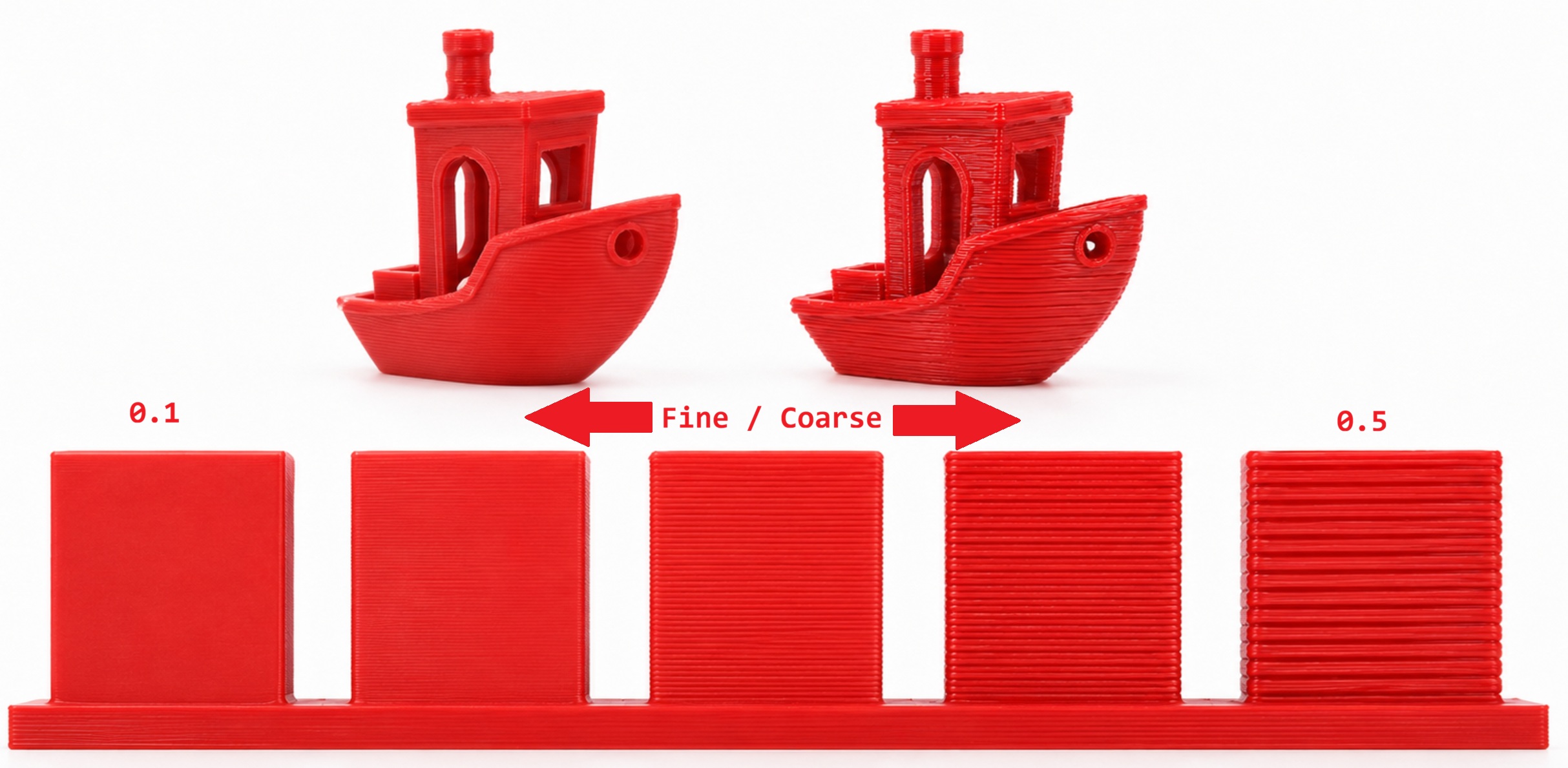
Layer height controls how thick each layer is. A smaller layer height creates finer vertical detail. A taller layer height reduces the number of layers required to complete the part.
That matters because fewer layers usually means a faster print.
For example, a part printed at 0.20 mm layer height may require roughly twice as many layers as the same part printed at 0.40 mm layer height. On a small part, that may not matter much. On a large-format print, it can add many hours or even days.
This is why high resolution is not always the correct choice. Sometimes it is just slower and more expensive.
Large Parts: Speed, Strength, and Practicality Often Matter More
Large industrial parts often do not need extremely fine layers.
A fixture, foundry pattern, duct, bracket, machine guard, handling aid, or draft prototype may be judged by fit, strength, durability, and delivery time — not by whether the layer lines are nearly invisible.
For these parts, a taller layer height can be the better manufacturing choice.
Taller layers can reduce machine time, lower cost, improve turnaround, and produce thicker extrusion paths. When combined with a larger nozzle, they can also help create strong, durable parts with robust wall sections.
This is especially useful for large-format 3D printing. A large part may already require a long print time. Choosing an unnecessarily fine layer height can tie up a machine for days while adding little practical value.
For industrial work, the question is not always “How fine can we print it?” The better question is “What level of detail does this part actually need?”
Draft Prints: Fast Feedback Beats Pretty Surfaces
Draft prints are a good example of where faster settings make sense.
A draft print is usually used to check size, fit, clearance, assembly, ergonomics, or general design direction. It does not need to be the final cosmetic version of the part.
In product development, speed has value. A quick draft print lets the customer review the design, find problems, and make changes before spending time and money on a more refined version.
It is often better to print two or three fast revisions than to spend a long time producing one beautiful part that still needs changes.
For this reason, taller layers and larger nozzles are often appropriate for early prototypes, test-fit parts, shop fixtures, and large design-verification prints.
Nozzle Size Matters Too
Layer height is only part of the resolution discussion. Nozzle size also matters.
The nozzle controls the width of the extruded material. A smaller nozzle can reproduce smaller details, but it usually prints more slowly. A larger nozzle can move more material, build stronger walls, and make large parts much more practical.
Common examples:
| Nozzle Size | Typical Use |
|---|---|
| 0.4 mm | General-purpose printing with balanced detail and speed |
| 0.6 mm | Functional parts, stronger walls, faster print times |
| 0.8 mm | Large-format parts, foundry patterns, fixtures, tooling, draft prints |
| Smaller nozzles | Tiny details, fine text, small features, cosmetic models |
A large nozzle is not automatically better. A small nozzle is not automatically better. The correct nozzle depends on the part.
For a large pattern or industrial fixture, a 0.8 mm nozzle may be the right choice. For a small component with fine lettering, small holes, or delicate geometry, a smaller nozzle may be more appropriate.
Small Parts: Fine Layers Can Make a Big Difference
Small detailed parts are different from large industrial parts.
On a small part, each layer line represents a larger percentage of the overall geometry. A 0.30 mm layer height may be acceptable on a large pattern, but it can look rough or inaccurate on a small part with fine detail.
Reducing layer height can improve:
- curved surfaces
- small chamfers
- engraved or raised details
- miniature geometry
- thread-like features
- cosmetic surfaces
- small organic shapes
- fine visual models
Fine layer heights reduce the stair-step effect on sloped and curved surfaces. This can make small parts look cleaner and can help preserve subtle geometry.
However, layer height has limits. A tiny layer height does not overcome every manufacturing constraint. If a feature is smaller than the nozzle can reliably produce, reducing layer height alone will not fix it.
That is why layer height, nozzle size, material, speed, cooling, and orientation must be considered together.
Higher Resolution Does Not Always Mean Stronger
This is an important point: higher resolution does not automatically mean a stronger part.
For functional FDM parts, strength may depend more on material, wall count, extrusion width, nozzle size, orientation, infill strategy, temperature, and layer bonding than on the smallest possible layer height.
A part printed with tiny layers may look better, but that does not necessarily make it more durable.
For some functional parts, a larger nozzle and thicker extrusion lines may produce a more useful result. Wider roads of material can create stronger walls and reduce the number of tiny toolpaths needed to build the part.
This is why industrial 3D printing is not just about resolution. It is about matching the print strategy to the job.
Where Resin Printing Fits
Resin 3D printing can produce very fine detail. It is often a strong choice for small visual models, intricate features, miniatures, dental-style detail, mold masters, and parts where surface detail is more important than toughness.
Resin printing can capture features that would be difficult or inefficient with FDM.
But resin is not automatically better.
Many resin parts are more brittle than thermoplastic FDM parts. They may be more sensitive to impact, UV exposure, heat, and long-term aging. Some engineering resins perform better than standard resins, but they still need to be matched carefully to the application.
Resin parts also require washing, curing, support removal, and careful handling. Supports can leave marks. Hollow parts may need drain holes. Large resin prints can be expensive, messy, and process-sensitive.
For small detailed parts, resin may be the right process. For large durable tooling, shop fixtures, foundry patterns, brackets, and functional prototypes, FDM is often more practical.
How We Choose the Right Print Settings
A large part may look “lower resolution” up close and still be the correct manufacturing choice.
A small part may need fine settings because a single layer line represents a much larger portion of the detail.
A draft print may need speed more than appearance.
A functional part may need toughness more than fine layers.
A cosmetic part may need finer settings or post-processing.
The correct print strategy depends on the purpose of the part.
At Jaeger Technology Group, we do not choose settings based on a generic “high quality” button. We look at the geometry, material, size, strength requirements, surface expectations, machine time, and final use of the part.
The goal is not simply to print at the highest resolution possible.
The goal is to produce the right part, at the right quality level, in the right material, at a practical cost.
The Bottom Line
Higher resolution is not always better.
For large 3D printed parts, taller layers and larger nozzles can reduce print time, lower cost, and produce strong, durable components. That can be the right choice for draft prints, tooling, fixtures, patterns, and industrial parts.
For small detailed parts, finer layer heights, smaller nozzles, or resin printing may improve detail and surface quality.
The important thing is matching the process to the job.
A good 3D printed part is not always the one printed at the finest layer height. It is the one printed with the right balance of resolution, strength, time, material, and cost.
About the Author: jaegertechgroup.com

STAY IN THE LOOP
Subscribe to our free newsletter.
Leave A Comment
From 3D Scan to Perfect Fit: The Corvette Bumper Project Moves Forward A few weeks ago, we shared a project that demonstrated

Great Conversations and New Connections at SMD in Huntsville Last week, Janelle and I had the opportunity to attend SMD in Huntsville,
Still Using Cura or Simplify3D? JaegerTech Can Help Build an OrcaSlicer Profile for Your 3D Printer A 3D printer does not become
Preventive Maintenance for 3D Printers: In-Shop and On-Site Service A 3D printer rarely fails without warning. Belts loosen, bearings collect debris, nozzles