
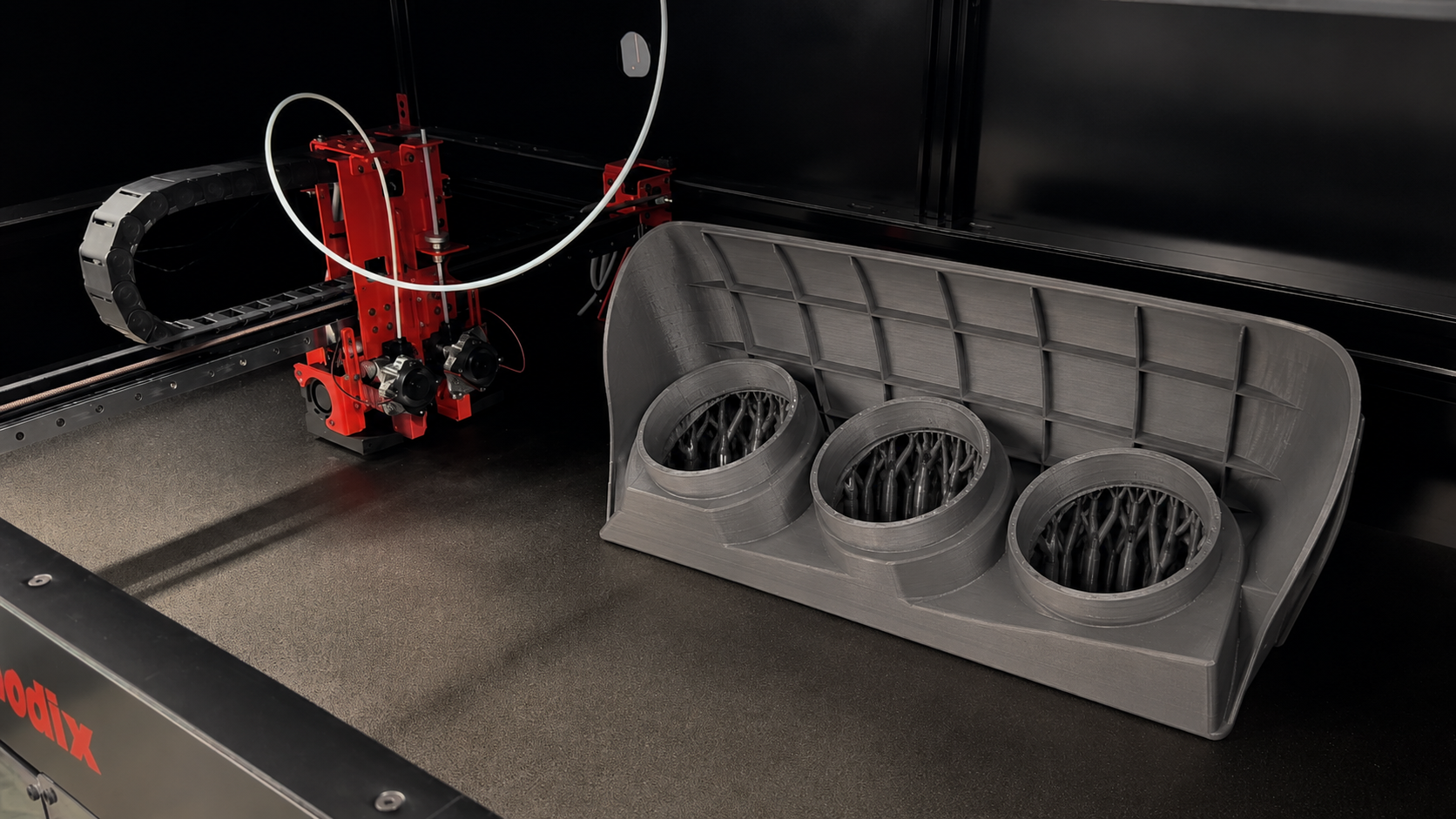
Why Supports Can Double the Cost of a 3D Printed Part
One of the most common misunderstandings in 3D printing is the idea that the cost of a part is based only on its size or material weight. In reality, the geometry of the part often matters more than the amount of plastic or resin used.
One of the biggest cost drivers is support material.
Supports are temporary structures added during printing to hold up overhangs, bridges, delicate features, or entire sections of a part that would otherwise print in midair. They are removed after printing, but they still consume machine time, material, labor, and finishing effort. In some cases, supports can nearly double the real cost of a printed part.
This applies to both FDM printing and resin printing, although the reasons are different.
Supports in FDM Printing
FDM printing builds a part by extruding melted thermoplastic layer by layer. Each new layer needs something below it. If a feature hangs out too far without support, the plastic can sag, curl, string, or fail entirely.
For simple parts, supports may be minimal. For complex parts, supports can become a major part of the print.
Supports affect FDM cost in several ways:
First, they add print time. A machine may spend hours printing structures that are not part of the final component.
Second, they add material usage. Even if the support material is removed and discarded, it still has to be paid for.
Third, they increase failure risk. Tall or narrow supports can break loose during printing. Large support areas can warp, detach, or create poor surface quality where they contact the part.
Fourth, they create labor after the print is complete. Supports must be removed manually. That may involve pliers, knives, sanding, scraping, trimming, or careful hand work around delicate features.
Finally, supports can damage the surface finish. A supported surface usually does not look as clean as an unsupported top or side wall. If the part needs to look good, the supported areas may require sanding, filling, epoxy coating, or redesign.
This is why two FDM parts of similar size can have very different prices. One may print cleanly with little support. The other may require extensive support, careful removal, and additional finishing.
Supports in Resin Printing
Resin printing works differently, but supports are just as important.
In resin printing, the part is typically printed upside down or at an angle. Each layer is cured by light and then peeled away from the film or build surface. Supports hold the part to the build plate and resist the forces created during printing.
Without proper supports, resin parts can fail in several ways. They may detach from the supports, warp, tear, shift, crack, or develop distorted surfaces.
Resin supports are especially important because every layer creates peel forces. Large cross-sections, flat surfaces, and suction cups can place significant stress on the part. A part may need to be angled, hollowed, vented, or heavily supported to survive the print.
Supports affect resin cost in several ways:
They consume resin, even though they are removed and discarded.
They increase print setup time because orientation and support placement matter significantly.
They increase cleaning time because resin parts must be washed, cured, drained, and handled carefully.
They increase labor because support removal must often happen before or after final curing, depending on the resin and part geometry.
They can leave marks on the part surface. These marks may require sanding, trimming, or surface repair.
They can also limit how many parts fit on the build plate. A heavily supported part may take up more machine space than the finished part itself.
For resin printing, supports are not just a convenience. They are part of the print strategy. Poor support design can ruin dimensional accuracy, surface finish, and part reliability.
Why Supports Change the Quote
When we quote a 3D printed part, we are not only looking at the finished volume of the part. We are also looking at how the part must be oriented, how much support it requires, how long the machine will be occupied, how much post-processing is needed, and how much risk is involved.
A small part with difficult support requirements may cost more than a larger part with clean, simple geometry.
A flat-bottomed part that prints directly on the bed may be efficient. A similar part with undercuts, thin projections, internal ledges, or cosmetic surfaces facing downward may require much more work.
This is especially true on large-format machines. A support-heavy large print can tie up a machine for days. If the print fails late in the job, the lost time and material can be significant. The support strategy becomes part of the manufacturing risk.
Design Can Reduce Support Cost
The good news is that many support-related costs can be reduced through design changes.
Sometimes a part can be split into two or more sections and bonded together after printing. This may produce a better surface finish and reduce total machine time.
Sometimes a small feature can be modified so the part prints without support.
Sometimes a raised lip, underside ledge, sharp overhang, or decorative detail can be redesigned without affecting the function of the part.
Sometimes the best solution is simply changing the orientation of the part, although that can affect strength, surface finish, and dimensional accuracy.
This is where design for additive manufacturing matters. A part designed for machining, injection molding, or casting is not always efficient to 3D print exactly as-is. Small geometry changes can make a large difference in cost.
FDM vs. Resin: Different Processes, Same Lesson
FDM and resin printing use different materials and different machines, but the lesson is the same: supports are not free.
In FDM printing, supports affect time, material, surface quality, and removal labor.
In resin printing, supports affect print survival, orientation, resin usage, cleanup, surface marks, and part accuracy.
In both processes, support-heavy geometry increases cost and risk.
The Bottom Line
Supports are temporary, but their cost is very real.
They consume machine time, material, labor, and finishing effort. They can also increase the chance of print failure and reduce the quality of supported surfaces.
That is why two parts that appear similar in size may receive very different quotes. The question is not just, “How big is the part?” The better question is, “How does this part need to be manufactured?”
At Jaeger Technology Group, we review geometry before quoting so we can identify support-heavy features, manufacturability issues, and possible design changes. In many cases, a simple adjustment can reduce cost, improve print quality, and shorten lead time.
About the Author: jaegertechgroup.com

STAY IN THE LOOP
Subscribe to our free newsletter.
Leave A Comment
Integrating a Tablet, Scanner, and Maintenance Hardware Into One Aerospace Field Tool In aerospace maintenance, the challenge is rarely just collecting information.
From 3D Scan to Perfect Fit: The Corvette Bumper Project Moves Forward A few weeks ago, we shared a project that demonstrated

Great Conversations and New Connections at SMD in Huntsville Last week, Janelle and I had the opportunity to attend SMD in Huntsville,
Custom 3D Printed Speaker Pods for a 2005 Ford Mustang Sometimes the problem is not the speaker. It is everything around it.