
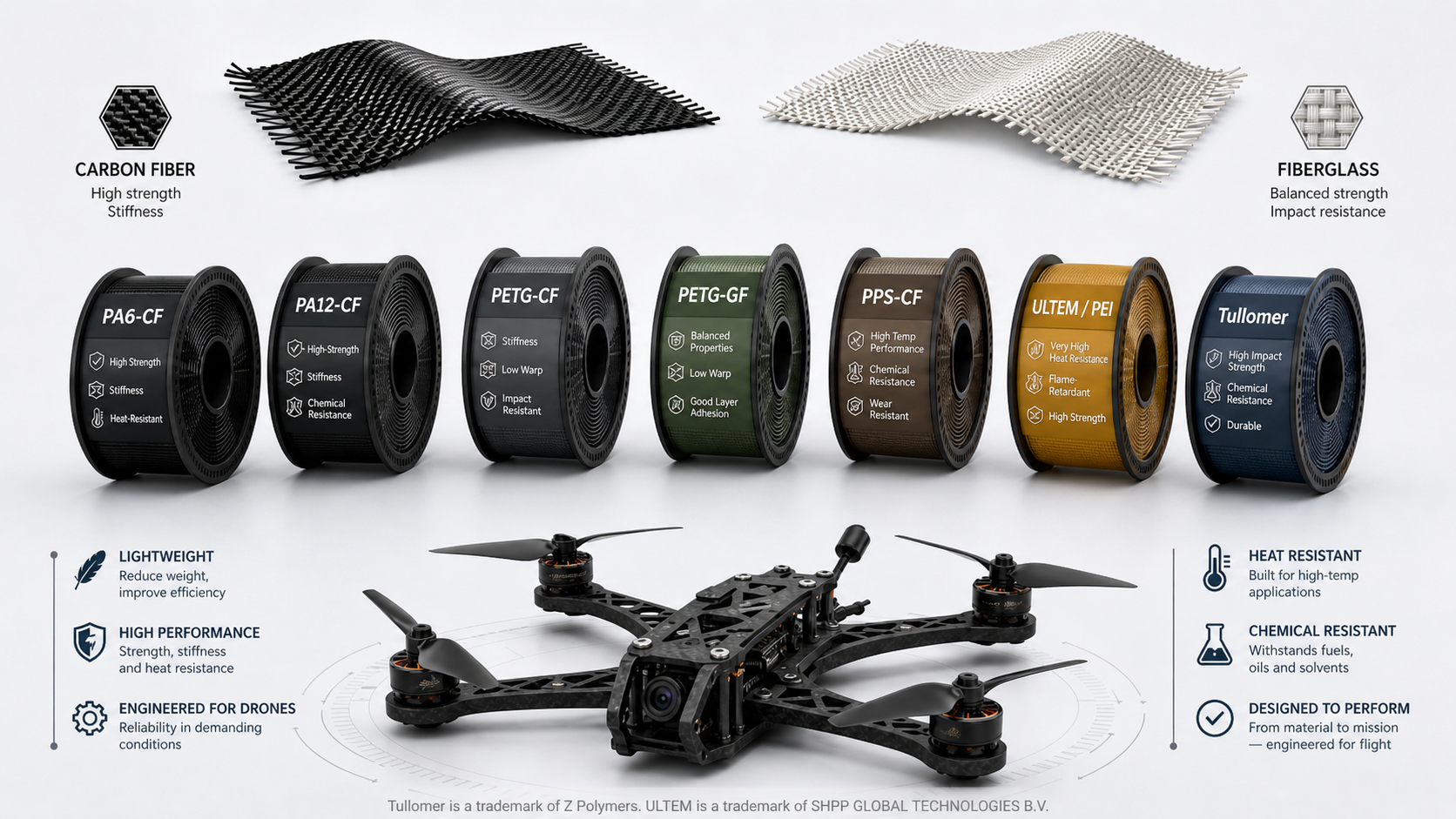
Drone Materials: Why the Right 3D Printing Material Can Matter as Much as the Design
Drone performance is not just about motors, batteries, sensors, and software.
The material matters.
A drone body, payload mount, electronics enclosure, duct, shroud, bracket, or internal frame has to balance weight, stiffness, toughness, heat resistance, vibration, moisture, UV exposure, and manufacturability. That is why industrial 3D printing is becoming such a strong fit for drone and UAV development.
The best drone parts are not just printed. They are designed around the mission, the load, the environment, and the material.
At Jaeger Technology Group LLC, we help customers choose materials that make sense for real-world use: from carbon fiber reinforced nylons to glass-filled polymers, ESD-safe materials, PPS, ULTEM/PEI, and emerging high-performance materials like Tullomer.
Carbon Fiber Reinforced Materials: Lightweight, Stiff, and Practical
For many drone applications, carbon fiber reinforced filament is the first material category worth discussing.
Carbon fiber filled polymers are popular because they improve stiffness and dimensional stability while keeping parts lightweight. That combination is especially attractive in aerospace, drone, defense, motorsports, and industrial applications where weight and rigidity both matter.
Common options include:
- PA6-CF
- PA12-CF
- PETG-CF
- PC-CF
- PPS-CF
- PEEK-CF or PEKK-CF on specialized machines
For drone parts, carbon fiber reinforced nylon is often a strong starting point. Nylon provides toughness and impact resistance, while carbon fiber improves stiffness and reduces the “rubbery” behavior that unfilled nylon can have.
That makes CF nylon useful for:
- Drone frames
- Payload brackets
- Camera and gimbal mounts
- Battery trays
- Sensor housings
- Motor-adjacent support parts
- Lightweight structural components
- Field-replaceable parts
- Prototype flight hardware
Carbon fiber materials are not magic, though. They are usually more brittle than unfilled base polymers, they are abrasive to nozzles, and they require dry filament. But when designed correctly, they can produce strong, stiff, lightweight parts with excellent practical value.
For drone work, the key is not simply choosing “carbon fiber.” The key is choosing the right base polymer underneath the carbon fiber.
PA6-CF vs. PA12-CF: Toughness, Moisture, and Stability
PA6-CF and PA12-CF are both useful, but they do not behave the same.
PA6-CF usually offers high toughness and strong mechanical performance, but it absorbs more moisture and can be more demanding to print and store.
PA12-CF generally offers better dimensional stability, lower moisture uptake, and easier handling, though it may not always match PA6 in toughness depending on the formulation.
For drone parts exposed to field conditions, dimensional stability and moisture behavior matter. A part that prints beautifully but absorbs moisture, changes dimensions, or loses stiffness in service may not be acceptable.
That is why material selection has to include the operating environment, not just the tensile strength listed on a datasheet.
Glass-Filled Materials: Tough, Stable, and Often Underappreciated
Carbon fiber gets most of the attention, but glass-filled materials deserve serious consideration.
Glass fiber reinforced polymers can improve strength, stiffness, heat resistance, dimensional stability, and warping behavior compared with unfilled materials. Glass-filled nylon, in particular, is known for better rigidity, hardness, creep resistance, dimensional stability, wear resistance, and higher service temperature compared with unfilled nylon.
Glass-filled materials can be useful where you want:
- Good stiffness
- Better impact behavior than some carbon-filled grades
- Dimensional stability
- Electrical insulation
- Lower cost than some carbon fiber materials
- Good functional performance for brackets, housings, jigs, and production tooling
For drones, glass-filled materials may be appropriate for:
- Electronics enclosures
- Non-conductive brackets
- Payload housings
- Internal supports
- Tooling and fixtures
- Battery retainers
- Covers and closeouts
- Assembly aids
One important distinction: carbon fiber can be electrically conductive depending on formulation, while glass fiber is generally non-conductive. That may matter around antennas, avionics, batteries, radios, and sensor systems.
For some drone components, glass-filled nylon or glass-filled PETG may be the smarter choice than carbon fiber.
PETG-CF and PETG-GF: Good Utility Materials, Not Always Structural Materials
PETG reinforced with carbon fiber or glass fiber can be useful for drone development, especially for prototype components, covers, enclosures, jigs, and moderate-duty parts.
PETG is easier to print than nylon, usually has good chemical and moisture resistance, and can be a practical choice when the part does not need the highest heat resistance or fatigue performance.
PETG-CF can give cleaner prints, improved stiffness, and better dimensional behavior.
PETG-GF can improve hardness and abrasion resistance, and glass fiber can be useful where electrical insulation is valuable.
For serious structural drone parts, I would usually look at nylon, polycarbonate, PPS, or higher-performance materials first. But for fast development, fit checks, housings, brackets, tooling, and non-critical assemblies, reinforced PETG can be a very practical material.
PPS and PPS-CF: High-Performance Without Jumping Straight to PEEK
PPS, or polyphenylene sulfide, is one of the most interesting materials for industrial drone and aerospace-adjacent applications.
PPS is a high-performance engineering thermoplastic known for chemical resistance, thermal stability, dimensional stability, and flame-retardant behavior. PPS-CF adds carbon fiber reinforcement to improve stiffness and strength while retaining many of PPS’s chemical and thermal advantages. UltiMaker describes PPS-CF as a precision engineering material with high durability and positions it as a cost-effective alternative to some high-end metals and PEEK-class applications.
For drone parts, PPS-CF can be attractive for:
- Hot environments
- Chemically exposed parts
- Motor-adjacent structures
- Electronics housings
- Ducting
- Brackets requiring stiffness and heat resistance
- Industrial UAV parts
- Defense-oriented prototypes
- Production tooling
PPS is not the cheapest material, and it requires a more capable machine than ordinary PLA or PETG. But for customers who need a serious engineering polymer without jumping directly to PEEK, PEKK, or ULTEM, PPS and PPS-CF are worth considering.
ULTEM / PEI: Aerospace-Grade Performance, But Demanding to Print
ULTEM is a trade name for PEI, or polyetherimide. It has a long-standing reputation in aerospace and transportation because of its strength-to-weight ratio, heat resistance, and flame/smoke/toxicity behavior.
ULTEM 9085 is especially well known in aerospace additive manufacturing. Recent research describes ULTEM 9085 as a PEI thermoplastic with excellent thermal stability and high strength-to-weight ratio, and notes that it was the first FFF material qualified by NCAMP on behalf of the FAA for aerospace applications. ULTEM materials are also valued for low flammability and toxicity performance in aircraft and rail applications, though successful printing usually requires a very high-temperature machine with an evenly heated chamber.
ULTEM can be useful for:
- Aerospace interior components
- High-temperature housings
- Electrical and avionics enclosures
- Ducts and air management parts
- Brackets and supports
- Components requiring FST considerations
- Applications where PEI is already specified
But ULTEM is not a casual material. It requires the right printer, right chamber temperature, right build surface, right drying process, and correct design practices.
For drone work, ULTEM may be excellent when the application demands heat resistance, flame resistance, and aerospace material pedigree. But it is not always the best value for every drone component.
Sometimes PA-CF, PPS-CF, or another reinforced engineering polymer is more practical.
Tullomer: A New High-Performance Material Worth Watching
Tullomer is one of the more interesting new materials in the FDM/FFF space.
Z-Polymers describes Tullomer as a high-performance filament positioned as a replacement for aluminum, steel, magnesium, PEEK, PEKK, PAEK, and ULTEM, with claims of lightweight, high stiffness, recyclability, high thermal performance, tailored coefficient of thermal expansion, and dimensional stability without annealing. ASME also reported in 2025 that Tullomer is aimed at commercial-grade material performance on consumer-level 3D printers.
For drone and UAV development, that is a very interesting idea.
If a material can deliver high stiffness, low weight, good dimensional stability, and high thermal performance on more accessible machines, it could open up serious opportunities for:
- Lightweight drone frames
- Structural brackets
- High-performance fixtures
- Payload mounts
- Thermal or dimensional stability-critical parts
- Replacement of heavier machined parts
- Prototype-to-production bridge components
That said, emerging materials should be tested carefully. Marketing claims are not the same thing as application validation. For drone parts, especially anything flight-critical, materials should be tested under expected loading, temperature, vibration, moisture, UV, impact, and fatigue conditions.
Tullomer may be promising, but it should be treated like any serious engineering material: test it, document it, and validate it for the application.
Material Choice Depends on the Part’s Job
There is no single “best” material for 3D printed drone parts.
A drone frame, battery tray, duct, camera mount, electronics housing, antenna bracket, motor guard, and assembly fixture may all require different material choices.
Here is a practical way to think about it:
Use carbon fiber nylon when you need lightweight stiffness, toughness, and practical functional performance.
Use glass-filled nylon when you need dimensional stability, rigidity, electrical insulation, and good toughness.
Use PETG-CF or PETG-GF for economical functional parts, covers, tooling, fixtures, and moderate-duty components.
Use PPS or PPS-CF when chemical resistance, heat resistance, stiffness, and dimensional stability matter.
Use ULTEM/PEI when high-temperature performance, aerospace material pedigree, and FST behavior are major drivers.
Evaluate Tullomer when you want a newer high-performance material that may offer unusually strong stiffness-to-weight and dimensional stability advantages on more accessible printing platforms.
The material should follow the engineering requirement, not the other way around.
Design Still Matters More Than the Filament Label
A poor design printed in an expensive material is still a poor design.
For drone parts, material selection has to work with:
- Print orientation
- Layer adhesion
- Fiber direction
- Wall count
- Infill strategy
- Fastener design
- Boss and insert geometry
- Vibration loading
- Heat exposure
- UV exposure
- Moisture absorption
- Fatigue behavior
- Repair and replacement strategy
Carbon fiber filled material, for example, may be stiff in one direction but still limited by layer bonding in another direction. A part may look strong in CAD but fail at a screw boss, layer line, sharp corner, or vibration-loaded interface.
This is why additive manufacturing is not just about printing. It is about design for additive manufacturing.
The strongest results come from combining the right geometry, the right material, and the right process.
Where Jaeger Technology Group LLC Fits
At Jaeger Technology Group LLC, we help customers move beyond basic plastic parts and into real industrial 3D printing.
For drone, UAV, aerospace, defense, automotive, and manufacturing customers, we can help evaluate and produce:
- Carbon fiber reinforced drone parts
- Glass-filled polymer components
- Lightweight brackets and mounts
- Battery trays and enclosures
- Avionics and electronics housings
- Camera, sensor, and payload mounts
- Ducts, shrouds, and closeouts
- High-temperature polymer parts
- PPS, ULTEM/PEI, and advanced material prototypes
- Jigs, fixtures, gauges, and production support tooling
- Short-run production parts where tooling does not make sense
The goal is not to use the most exotic material possible.
The goal is to use the right material for the job.
Sometimes that is carbon fiber nylon. Sometimes it is glass-filled nylon. Sometimes it is PPS-CF. Sometimes it may be ULTEM or an emerging material like Tullomer. And sometimes the best solution is a lower-cost reinforced polymer that solves the problem without overcomplicating the part.
Better Drone Parts Start With Better Material Decisions
Drones push materials hard.
They need lightweight structures, stiff mounts, durable housings, heat-resistant components, clean electronics packaging, and parts that can survive vibration, handling, field use, and repeated iteration.
Industrial 3D printing gives drone manufacturers a powerful way to develop and produce those parts faster. But the real advantage comes from matching the part, the material, and the design process.
If your drone component is too heavy, too expensive, too slow to machine, too complex to mold, or too difficult to assemble, it may be time to look at industrial 3D printing and advanced materials.
Contact Jaeger Technology Group LLC to discuss carbon fiber reinforced materials, glass-filled polymers, PPS, ULTEM, Tullomer, and industrial 3D printed drone components for your next project.
About the Author: jaegertechgroup.com

STAY IN THE LOOP
Subscribe to our free newsletter.
Leave A Comment
From Hesitation to Hands-On: Bringing Large-Format 3D Printing Into a Prosthetics and Orthotics Practice For many prosthetics and orthotics practitioners, the potential
Using 3D Printing to De-Risk Production Tooling Production tooling is expensive for a reason. Whether the final process is injection molding, thermoforming,

Integrating a Tablet, Scanner, and Maintenance Hardware Into One Aerospace Field Tool In aerospace maintenance, the challenge is rarely just collecting information.
From 3D Scan to Perfect Fit: The Corvette Bumper Project Moves Forward A few weeks ago, we shared a project that demonstrated