
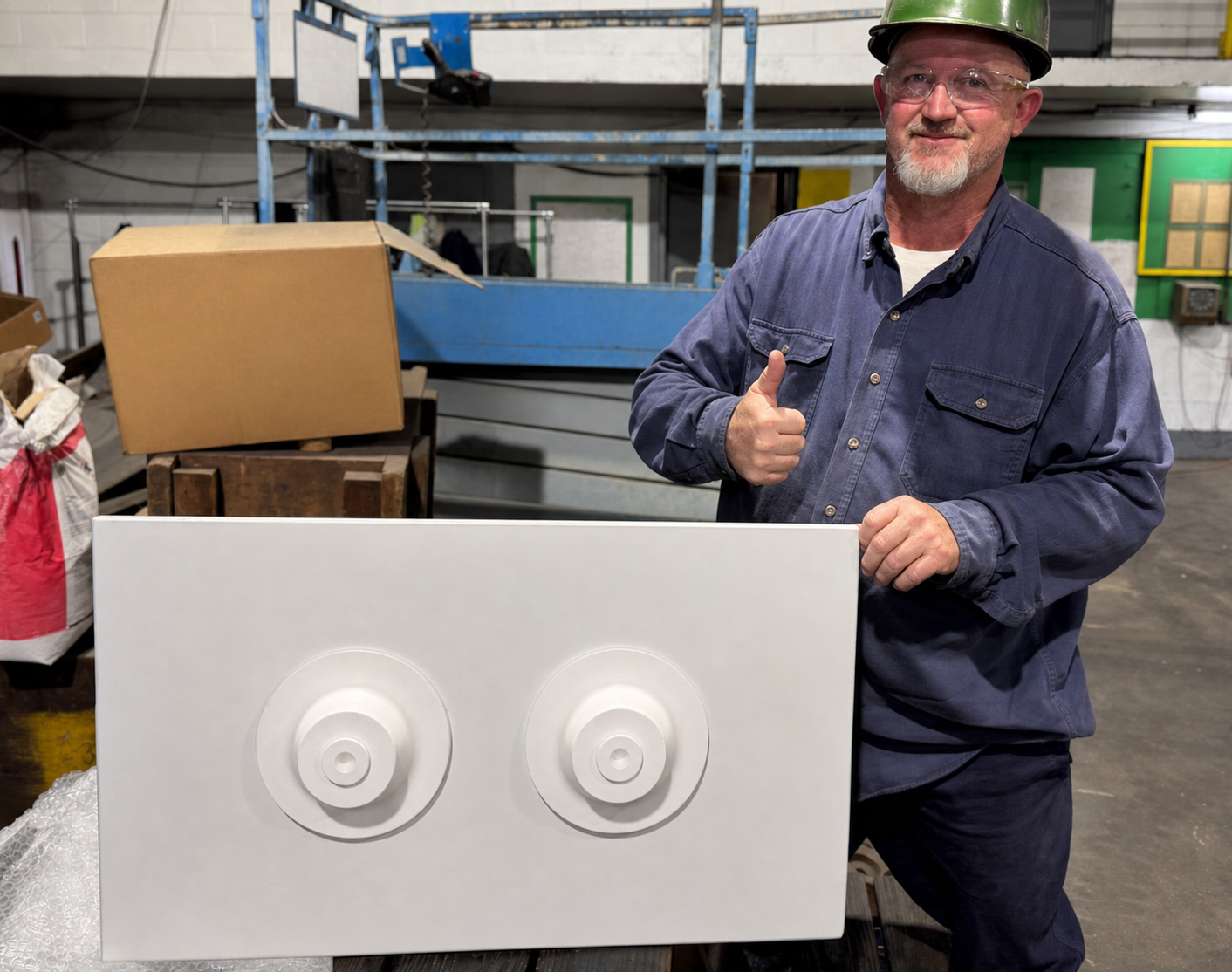
From 750 Pounds to 16 Pounds: A Better Way to Build Foundry Tooling
Some foundry problems are obvious the moment you see them.
This one was a worn-out aluminum match plate with bronze tools mounted to it. It was heavy, awkward, and difficult to handle. Worse, the tooling did not have appropriate draft, which meant the pattern fought the sand every time it was used.
The foundry manager’s concern was not theoretical. This tool weighed roughly 750 pounds, and the crew had to hand-flip it as part of the process. Every run created the same worry:
Someone was going to get hurt.
Or worse.
At Jaeger Technology Group LLC, we worked with the foundry to rethink the tooling instead of continuing to fight it.
The Old Tooling Was Not Just Heavy. It Was Costing Money.
The original match plate was built from aluminum with bronze tooling mounted to it. On paper, it may have looked durable. In practice, it had become a shop-floor liability.
The problems were stacking up:
- The plate was extremely heavy
- The tooling was difficult and dangerous to flip
- Poor draft made mold release harder than it needed to be
- The pattern dragged in the sand
- Handling time was excessive
- Labor cost was too high
- The job was no longer profitable with that tooling
- The safety risk was unacceptable
This is an important point: bad tooling does not just slow a foundry down. It can turn a job that should make money into a job the shop dreads running.
When the tool is too heavy, too slow, too hard to pull, and too risky to handle, the casting itself may not be the problem. The tooling is.
Heavy Tooling Creates Hidden Costs
A 750-pound match plate does more than take up space. It changes the workflow around it.
Every movement requires caution. Every flip takes extra labor. Every handling step creates risk. Every difficult pull increases the chance of sand damage, rework, delays, and operator frustration.
And when the tooling lacks proper draft, the problem gets worse. The mold does not release cleanly. The crew has to compensate. Time gets burned. Consistency suffers.
That is how profitability disappears.
The foundry was not just dealing with an old tool. They were dealing with a tool that made the whole job harder than it needed to be.
Rethinking the Tool Instead of Repeating the Problem
Jaeger Technology Group LLC worked with the foundry to replace the heavy, worn tooling with a much lighter 3D printed solution.
The goal was not simply to “make the same thing out of plastic.” The goal was to make the tooling better:
- Lighter
- Safer to handle
- Easier to pull
- Designed with proper draft
- Practical for the foundry floor
- More efficient for the job
- Easier to reproduce or replace later
That is where digital patternmaking and 3D printed foundry tooling make a real difference. Instead of copying every limitation of the old tool, the geometry can be rebuilt with better draft, cleaner surfaces, improved handling, and a more practical workflow.
The Result: 16 Pounds Total
The finished tooling weighed approximately 16 pounds total.
That is not a small improvement. That is a complete change in how the job feels on the floor.
A tool that once required dangerous hand-flipping and constant concern became something dramatically easier to handle. The foundry no longer had to organize the workflow around a massive, awkward plate that nobody wanted to move.
With the new tooling, the foundry gained:
- Lower handling risk
- Faster setup
- Easier molding
- Better pull behavior
- Reduced labor burden
- Better shop-floor confidence
- A more practical path to profitability
- Digital files for future replacement or revision
The weight reduction alone was significant. But the larger value was that the job could stop being a safety problem and start becoming a manageable production task again.
Safety Is a Tooling Issue
Foundry safety is not only about PPE, training, and procedures. Tooling design matters.
If a tool requires workers to manually handle excessive weight, fight bad draft, or wrestle with awkward geometry, the risk is built into the process.
Better tooling can reduce that risk.
A lighter, properly drafted 3D printed pattern or match plate can help reduce dangerous handling, improve mold release, and make the work less physically punishing. That matters for both safety and productivity.
A safer tool is often a faster tool.
A faster tool is often a more profitable tool.
A more repeatable tool is easier for everyone to trust.
Work With Jaeger Technology Group LLC
If your foundry is fighting heavy, worn, unsafe, or unprofitable tooling, Jaeger Technology Group LLC can help.
We support:
- 3D printed foundry tooling
- Lightweight match plates
- Replacement tooling
- Digital patternmaking
- Draft correction
- Loose patterns
- Core boxes
- Match plate inserts
- Reverse engineering of old tooling
- Safer foundry workflow improvements
A 750-pound tool should not be the reason a job becomes unsafe or unprofitable.
Contact Jaeger Technology Group LLC to discuss replacing heavy, worn, or difficult foundry tooling with lighter, safer, digitally produced 3D printed patterns.
About the Author: jaegertechgroup.com

STAY IN THE LOOP
Subscribe to our free newsletter.
Leave A Comment
Great Conversations and New Connections at SMD in Huntsville Last week, Janelle and I had the opportunity to attend SMD in Huntsville,
From Product Idea to Cast Metal: Developing a Custom Jewelry Collection Through Digital Design, 3D Printing, and Investment Casting Developing a new
Best $150 I’ve Ever Spent on This Car Classic car projects have a way of turning simple problems into complicated ones. A
3D Printed Sand Casting Patterns: Choosing the Right Material for Reusable Tooling By JaegerTech – Practical Guidance for Foundries and Pattern Makers