
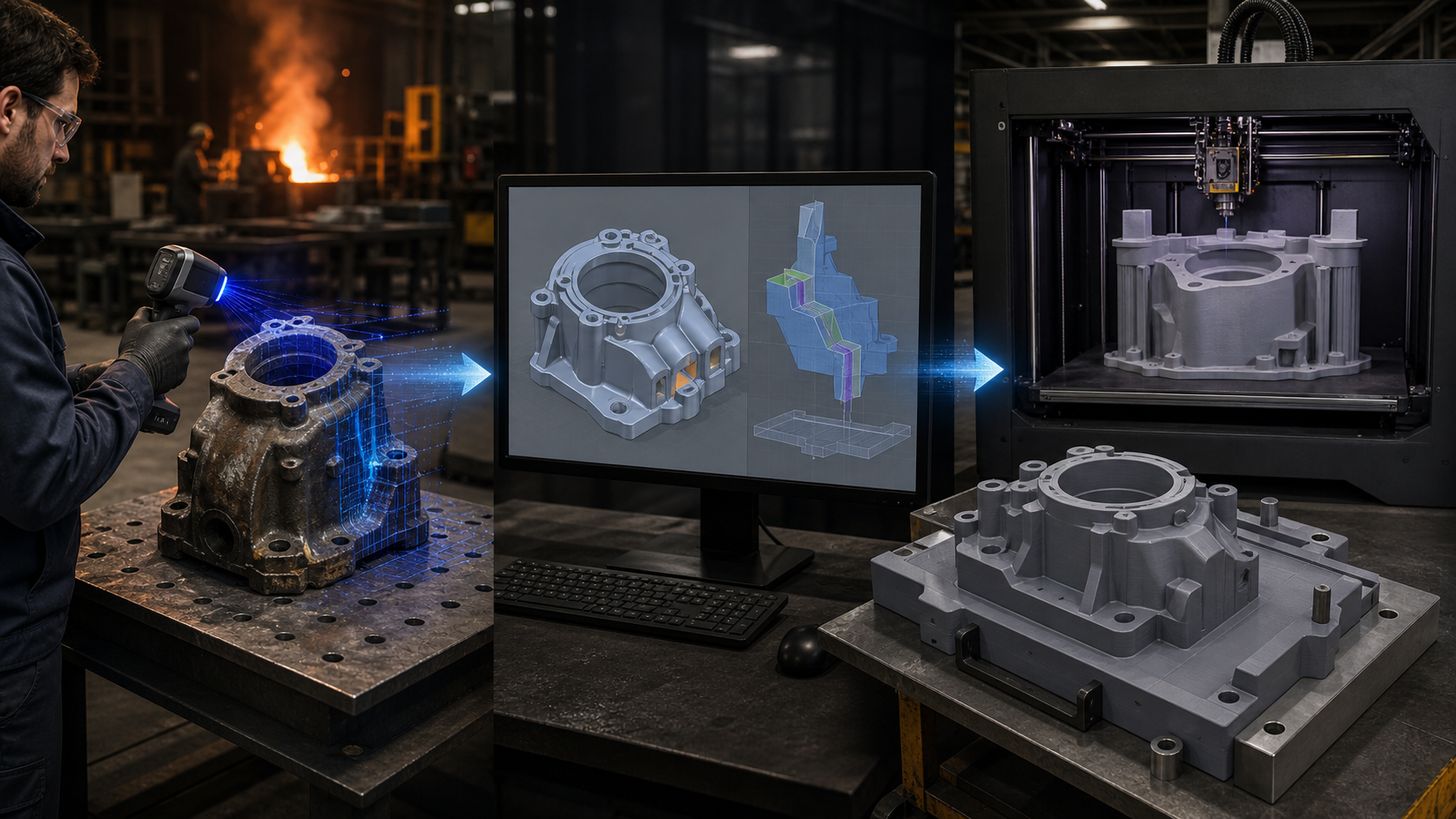
From Part to Pattern: Creating Digital Foundry Tooling from an Existing Part
Sometimes the pattern is gone.
Sometimes the drawing is outdated.
Sometimes the customer only has an old casting.
Sometimes the original tooling burned, broke, disappeared, or was modified so many times nobody trusts it anymore.
That does not mean the job is dead.
At Jaeger Technology Group LLC, we help foundries and manufacturers recreate digital foundry patterns from existing parts using 3D scanning, reverse engineering, CAD cleanup, and 3D printed tooling.
The Starting Point: An Existing Part
The process begins with the physical part. That part may be:
- An old casting
- A machined component
- A broken replacement part
- A legacy industrial part
- A customer sample
- A part with no usable CAD file
- A casting from a lost or damaged pattern
The part is scanned, measured, and reviewed so the geometry can be captured digitally.
But this is important: a casting is not the same thing as a pattern.
A pattern has to include foundry-specific changes that the finished part does not show.
Reverse Engineering the Pattern
Once the part is scanned, the digital model has to be interpreted. The goal is not just to copy the part. The goal is to create tooling that can make a new casting.
That may require adding:
- Shrink allowance
- Draft
- Machining stock
- Fillets
- Parting line strategy
- Core prints
- Core box geometry
- Gating considerations
- Cleanup of worn, broken, or machined features
This is where digital patternmaking matters. A direct scan may capture the part, but foundry tooling requires process knowledge.
Building the Digital Pattern
After the geometry is reviewed, a digital pattern can be built in CAD. That digital pattern may become:
- A loose pattern
- A match plate insert
- A cope-and-drag pattern
- A core box
- A replacement pattern section
- A prototype casting pattern
- A large-format 3D printed foundry tool
The digital file becomes the new controlled reference for the job.
That means the foundry is no longer relying only on a worn physical part, an old drawing, or somebody’s memory.
3D Printing the New Tooling
Once the pattern is built digitally, it can be 3D printed, finished, sealed, and prepared for foundry use.
3D printed tooling can help reduce lead time and make it easier to revise the pattern after the first trial. If the foundry needs more draft, different machining stock, a core print adjustment, or a change to the parting strategy, the digital pattern can be updated and reprinted.
That is a major advantage over rebuilding tooling from scratch every time something changes.
Why This Workflow Helps Foundries
Creating a digital pattern from an existing part can help foundries:
- Recover lost tooling
- Support legacy replacement parts
- Reproduce obsolete castings
- Reduce reverse engineering delays
- Create new CAD files from old parts
- Improve repeatability
- Add controlled shrink and draft
- Replace fragile or damaged patterns
- Build a digital archive for future work
It turns a one-time rescue job into a reusable digital asset.
Work With Jaeger Technology Group LLC
If you have a part but no usable pattern, Jaeger Technology Group LLC can help turn that physical part into digital foundry tooling.
We support 3D scanning, reverse engineering, CAD cleanup, 3D printed patterns, match plate inserts, core boxes, and replacement foundry tooling for sand casting and industrial casting workflows.
Contact Jaeger Technology Group LLC to discuss creating a digital pattern from an existing part.
About the Author: jaegertechgroup.com

STAY IN THE LOOP
Subscribe to our free newsletter.
Leave A Comment
From Hesitation to Hands-On: Bringing Large-Format 3D Printing Into a Prosthetics and Orthotics Practice For many prosthetics and orthotics practitioners, the potential
Using 3D Printing to De-Risk Production Tooling Production tooling is expensive for a reason. Whether the final process is injection molding, thermoforming,
From 3D Scan to Perfect Fit: The Corvette Bumper Project Moves Forward A few weeks ago, we shared a project that demonstrated
Great Conversations and New Connections at SMD in Huntsville Last week, Janelle and I had the opportunity to attend SMD in Huntsville,