
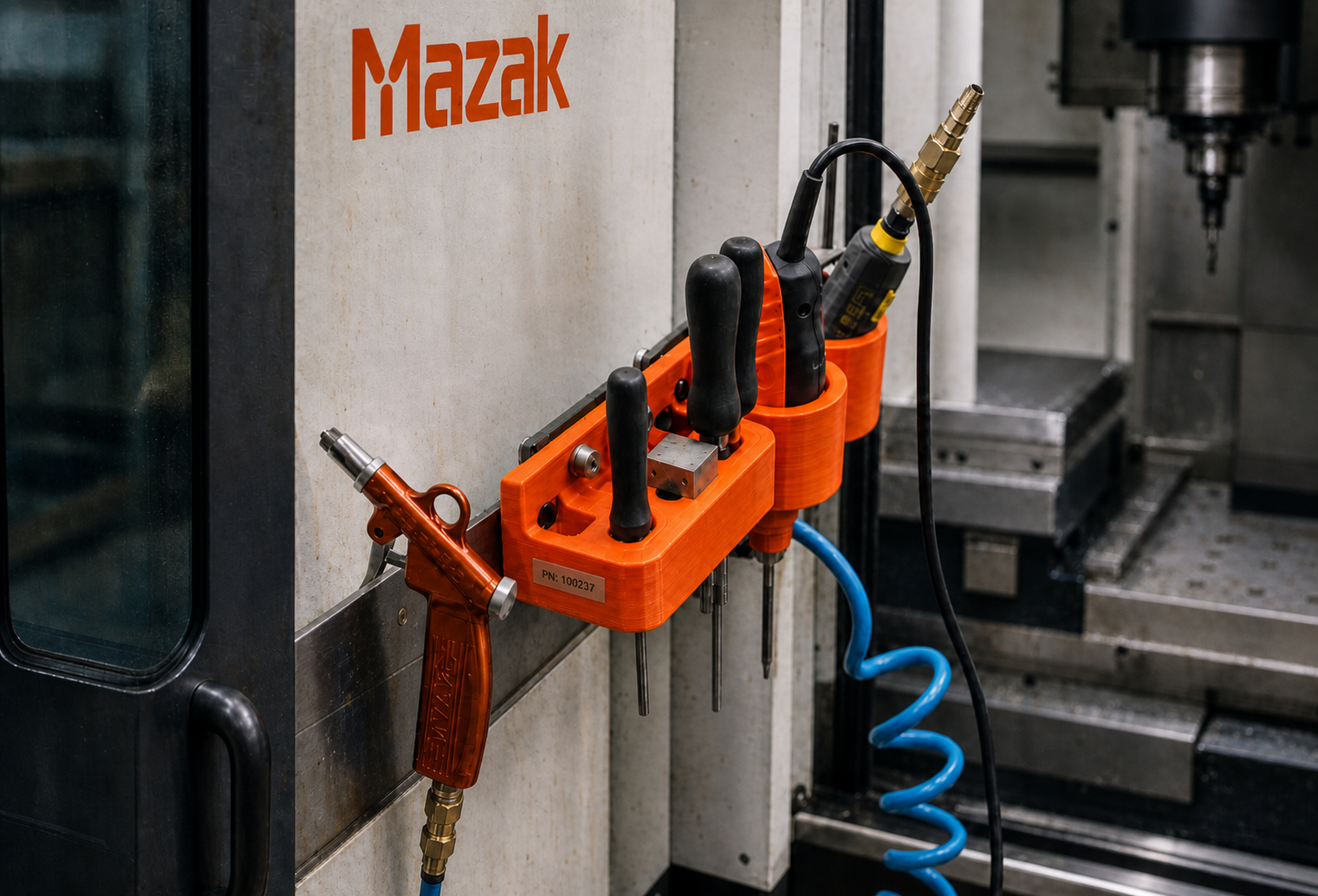
Why you need to know about 3D Printed Jigs and Fixtures
In manufacturing, precision and repeatability are not optional. Whether a company is assembling parts, inspecting finished components, marking products, painting or coating parts, welding assemblies, or preparing tooling for production, the ability to hold and position a part correctly can directly affect quality, cost, and throughput.
That is where jigs and fixtures become essential.
A well-designed fixture holds a workpiece in the correct position. A good jig guides an operation so it can be repeated accurately from part to part. Together, they reduce operator guesswork, improve consistency, speed up production, and help manufacturers produce better parts with fewer errors.
Today, 3D printed jigs and fixtures are changing how manufacturers approach shop-floor tooling. Instead of waiting weeks for machined fixtures or expensive tooling, companies can often design, print, test, and revise production aids in days — sometimes overnight.
For manufacturers that need fast, practical, custom tooling, 3D printing offers a powerful alternative to traditional fixture production.
What Are Jigs and Fixtures?
Jigs and fixtures are manufacturing tools used to hold, locate, support, guide, or position parts during production.
Although the terms are often used together, they are not exactly the same.
A fixture holds a part in a controlled position during an operation. A jig typically guides the tool, operator, or process itself. In real-world manufacturing, many shop-floor tools include features of both.
Jigs and fixtures are commonly used for:
- Assembly
- Machining support
- Drilling and trimming
- Inspection
- CMM and scanning setups
- Laser marking
- Painting and coating
- Masking and finishing
- Welding fit-up
- Bonding and adhesive alignment
- Production handling
- Packaging and repeatable placement
Good fixturing helps ensure that each part is handled the same way every time. That repeatability improves quality, reduces rework, and helps operators complete tasks faster.
Why Fixtures Matter in Manufacturing
Fixtures are often overlooked because they are not the final product. However, they can have a major impact on production performance.
A properly designed fixture can help improve:
- Part alignment
- Dimensional consistency
- Operator efficiency
- Workplace safety
- Inspection repeatability
- Assembly speed
- Process control
- Overall product quality
Research literature supports the importance of fixturing in manufacturing. Fixture systems are widely recognized as critical tools for supporting, locating, and positioning components during manufacturing and assembly operations. In practical terms, a small investment in better fixturing can produce measurable benefits on the shop floor.
How 3D Printing Improves Jig and Fixture Production
Traditional fixtures are often machined from aluminum, steel, tooling board, or other materials. That approach is still appropriate for many high-load, high-temperature, or long-term production applications.
However, traditional tooling can be slow and expensive, especially when the part is still changing or when only a small number of fixtures are needed.
3D printing changes the economics of fixture design.
With additive manufacturing, custom jigs and fixtures can be produced quickly from a digital model. Designs can be tested, revised, and reprinted without the cost and delay of conventional machining.
This makes 3D printed fixtures especially useful for:
- Prototype manufacturing
- Pilot production
- Low- to medium-volume production
- Custom assembly aids
- Inspection nests
- CMM and scanner fixtures
- Drill guides
- Trim guides
- Marking fixtures
- Paint masking fixtures
- Coating fixtures
- Soft jaws and protective part holders
- Ergonomic operator tools
- Replacement fixtures
- Short-run production tooling
3D printing also allows complex geometry that may be difficult or expensive to machine. Fixtures can include contoured nests, lightweight internal structures, part labels, handles, clamp pockets, alignment stops, masking edges, overspray shields, and custom part support features.
Common Types of 3D Printed Jigs and Fixtures
1. 3D Printed Assembly Fixtures
Assembly fixtures help position parts correctly during the build process. They may hold multiple components in alignment, guide fastener placement, support bonding operations, or help an operator repeat the same task consistently.
3D printed assembly fixtures are useful when parts have complex shapes or when hand alignment is causing variation.
They can help with:
- Holding parts at odd angles
- Aligning multiple components
- Supporting delicate parts
- Reducing operator fatigue
- Improving assembly speed
- Reducing errors and rework
Industries that commonly benefit include automotive, aerospace, electronics, medical device prototyping, industrial equipment, and consumer product manufacturing.
2. 3D Printed Inspection Fixtures
Inspection fixtures hold parts in a repeatable position for measurement and quality control. They may be used with calipers, gauges, vision systems, 3D scanners, or Coordinate Measuring Machines.
A good inspection fixture ensures that each part is checked from the same orientation. This reduces measurement variation caused by inconsistent handling.
3D printed inspection fixtures are commonly used for:
- First article inspection
- In-process quality checks
- Dimensional verification
- Go/no-go inspection
- Scanner positioning
- CMM holding fixtures
- Repeatable measurement setups
Inspection fixtures are one of the strongest uses for 3D printing because they often require custom part geometry, but not necessarily heavy-duty metal construction.
3. 3D Printed Marking Fixtures
Marking fixtures help position parts for laser marking, engraving, pad printing, inkjet marking, labeling, or other identification processes.
They are useful when parts require repeatable placement of:
- Logos
- Serial numbers
- Barcodes
- QR codes
- Lot codes
- Orientation marks
- Product labels
A 3D printed marking fixture can be designed around the exact part geometry, allowing operators to load the part quickly and mark it in the same location every time.
This is especially useful in aerospace, electronics, automotive, medical products, and industrial manufacturing where traceability matters.
4. 3D Printed Masking Fixtures for Painting, Coating, and Finishing
Masking is one of the most common but often overlooked production problems in manufacturing. Whether a part is being painted, powder coated, sprayed, sealed, bonded, plated, or surface treated, certain areas often need to remain clean, protected, or precisely exposed.
Traditional masking methods rely heavily on tape, plugs, caps, paper, hand-cut masks, or operator skill. These methods can work, but they can also be slow, inconsistent, and labor-intensive — especially when the same part must be masked repeatedly.
3D printed masking fixtures provide a more repeatable and efficient alternative.
A masking fixture can be designed to fit the exact geometry of the part, covering the areas that need protection while exposing only the surfaces that require coating or finishing. Instead of hand-masking each part from scratch, operators can load the part into a custom fixture, apply the coating process, and remove it with more consistent results.
3D printed masking fixtures can be used for:
- Paint masking
- Powder coating masking
- Primer and coating control
- Surface treatment masking
- Adhesive bonding protection
- Plating and chemical process shielding
- Laser marking protection
- Overspray control
- Edge definition
- Repeatable cosmetic finishing
- Production painting aids
For manufacturers, the benefits can be immediate. A well-designed masking fixture can reduce masking time, improve edge consistency, lower scrap and rework, and make the finishing process less dependent on individual operator technique.
These fixtures are especially useful for:
- Automotive parts
- Aerospace components
- Industrial housings
- Molded plastic parts
- Medical device housings
- Consumer product enclosures
- Brackets, panels, and covers
- Parts with repeated paint or coating operations
Masking fixtures can also be designed as part of a larger finishing workflow. For example, a fixture may include locating features, handles, hanging points, drainage clearance, overspray shields, replaceable inserts, or sacrificial surfaces.
For more demanding applications, printed masking fixtures can be combined with silicone plugs, metal hardware, threaded inserts, high-temperature materials, or commercial masking components.
Material choice matters. Simple paint masking fixtures may be produced from PETG, ABS, ASA, nylon, or carbon-fiber-reinforced polymers. Powder coating, heat-cure coatings, or solvent-heavy processes may require higher-temperature or chemically resistant materials. In some cases, the best solution is a hybrid fixture that combines a 3D printed body with commercial masking plugs, flexible seals, or metal reinforcement.
For short-run production, prototypes, restoration work, and custom industrial parts, 3D printed masking fixtures can be much faster and more cost-effective than conventional masking tooling. They are also easy to revise when the part changes or when the coating process needs adjustment.
5. 3D Printed Welding Fixtures and Fit-Up Aids
Welding fixtures hold parts in alignment during fit-up, tack welding, and welding operations. They help control spacing, angles, and position before and during the welding process.
For welding, 3D printed fixtures are most useful for:
- Prototype fit-up
- Light-duty positioning
- Layout and checking
- Tack-weld alignment
- Pre-production validation
- Non-contact support areas
- Hybrid fixtures with metal inserts
For high-heat or heavy-duty welding, printed fixtures may need protective surfaces, metal reinforcement, sacrificial contact areas, or hybrid construction. 3D printing is not always a direct replacement for steel welding fixtures, but it can be highly effective for development, layout, checking, and short-run production support.
6. 3D Printed Drill Guides, Trim Fixtures, and Shop-Floor Tools
Many manufacturers use 3D printed tooling for everyday production support. These tools may not be complex, but they often save time immediately.
Examples include:
- Drill guides
- Trim guides
- Router guides
- Deburring supports
- Masking templates
- Adhesive bonding guides
- Part handling trays
- Custom spacers
- Go/no-go gauges
- Protective nests
- Soft jaws
- Repeatable locating blocks
These are often ideal applications for 3D printing because they are highly customized, relatively low-volume, and needed quickly.
Benefits of 3D Printed Jigs and Fixtures
Faster Lead Times
3D printed fixtures can often be produced in days instead of weeks. For manufacturers dealing with urgent production problems, this speed can be the difference between downtime and continued progress.
Lower Tooling Cost
Printed fixtures can reduce machining, programming, setup, and material costs. This is especially valuable for prototypes, short runs, and custom production aids.
Better Design Flexibility
Additive manufacturing allows shapes that are difficult or costly to machine. Fixtures can be designed around the part instead of forcing the part into a generic holding method.
Fast Iteration
If a fixture needs to change, the design can be updated and reprinted quickly. This is a major advantage during product development, process improvement, and early production.
Lightweight and Ergonomic Tools
3D printed fixtures are often lighter than metal tools. This can reduce operator fatigue and make fixtures easier to handle on the shop floor.
Custom Fit to the Application
A fixture can be designed specifically for the part, operator, process, and workstation. This level of customization is one of the strongest advantages of 3D printed tooling.
Reduced Waste
Because 3D printing builds parts additively, it can reduce material waste compared with many subtractive manufacturing methods, especially for large but lightly loaded fixtures.
When 3D Printed Fixtures Make the Most Sense
3D printed fixtures are a strong fit when speed, customization, and design flexibility matter.
They are especially useful when:
- The part geometry is complex
- The design is still changing
- A fixture is needed quickly
- Only a few fixtures are required
- The tool does not need to withstand extreme heat or heavy loads
- Operator handling matters
- The fixture needs labels, handles, locating geometry, masking geometry, or custom contours
- The production team needs to solve a shop-floor problem quickly
3D printed fixtures may not be the right solution for every application. High-temperature welding, heavy clamping loads, abrasive contact, and long-term production wear may require metal tooling or hybrid construction.
However, many real manufacturing problems do not require a fully machined metal fixture. They require a well-designed tool that can be made quickly, tested, and improved.
That is where 3D printing is often the best choice.
Materials for 3D Printed Jigs and Fixtures
The best material depends on the application. Common options include:
- PLA or PLA+ for simple, low-load fixtures
- PETG for tougher shop-floor tools
- ABS or ASA for better heat resistance and durability
- Nylon for toughness and wear resistance
- Carbon fiber reinforced materials for stiffness
- High-temperature polymers for demanding applications
- Resin printing for detailed inspection or small precision fixtures
For many industrial fixtures, material selection should consider:
- Temperature exposure
- Load and clamping force
- Chemical exposure
- Abrasion and wear
- Dimensional stability
- Surface finish
- Required accuracy
- Expected service life
For masking fixtures, additional considerations may include paint compatibility, solvent exposure, coating buildup, cleaning method, cure temperature, and whether the fixture needs replaceable contact surfaces.
3D Printed Fixtures vs. Machined Fixtures
3D printed fixtures and machined fixtures both have a place in manufacturing.
Machined fixtures are often preferred for:
- High clamping loads
- High-temperature environments
- Long production runs
- Tight tolerance metal-to-metal locating
- Heavy welding fixtures
- Abrasive industrial conditions
3D printed fixtures are often preferred for:
- Fast turnaround
- Complex part shapes
- Prototype and pilot production
- Inspection nests
- Assembly aids
- Masking fixtures
- Marking fixtures
- Low- to medium-volume production
- Ergonomic tools
- Short-run tooling
- Rapid design changes
In many cases, the best solution is a hybrid fixture: a 3D printed body with metal inserts, bushings, clamps, wear pads, threaded inserts, silicone masking components, or machined reference surfaces.
Why Work With JaegerTech for 3D Printed Fixtures and Tooling?
JaegerTech provides practical, manufacturing-focused 3D printing services for companies that need custom fixtures, tooling, prototypes, and production support parts.
Unlike generic print shops, JaegerTech understands how parts are actually used in manufacturing environments. Fixture design is not just about making a part that looks correct. It must locate properly, support the workpiece, survive the process, and be easy for operators to use.
JaegerTech can assist with:
- 3D printed jigs and fixtures
- Assembly fixtures
- Inspection fixtures
- Marking fixtures
- Masking fixtures for painting, coating, bonding, and finishing
- Drill guides
- Trim guides
- Custom shop-floor tools
- Prototype tooling
- Short-run production aids
- Large-format 3D printed tooling
- Foundry patterns and industrial manufacturing support
- Design-for-additive-manufacturing consultation
JaegerTech can also design and produce custom masking fixtures for painting, coating, bonding, and finishing operations where repeatability, clean edges, and reduced labor time are important.
If your company needs a fixture quickly, needs to replace an outdated shop-floor tool, or wants to reduce the cost and lead time of custom tooling, JaegerTech can help evaluate the application and recommend a practical manufacturing path.
Contact JaegerTech to discuss custom 3D printed fixtures, tooling, and production support parts for your manufacturing operation.
Conclusion
Jigs and fixtures are essential tools for improving accuracy, repeatability, and efficiency in manufacturing. They help operators position parts correctly, reduce variation, improve inspection consistency, improve finishing consistency, and speed up production.
3D printing makes custom fixturing faster, more affordable, and more flexible. For assembly, inspection, marking, masking, welding support, drill guides, trim fixtures, and general shop-floor tooling, 3D printed fixtures offer a practical way to solve real manufacturing problems quickly.
For companies looking to reduce lead times, lower tooling costs, and improve production repeatability, 3D printed jigs and fixtures are no longer experimental. They are a practical manufacturing tool.
References and Supporting Literature
- Gameros, A., Lowth, S., Axinte, D., Nagy-Sochacki, A., Craig, O., & Siller, H. R. “State-of-the-art in fixture systems for the manufacture and assembly of rigid components: A review.” International Journal of Machine Tools and Manufacture, 123, 1–21, 2017.
This review supports the importance of fixture systems in manufacturing and assembly operations. - Fiedler, F., Ehrenstein, J., Höltgen, C., Blondrath, A., Schäper, L., Göppert, A., & Schmitt, R. “Jigs and Fixtures in Production: A Systematic Literature Review.” Journal of Manufacturing Systems, 2024.
This paper reviews jig and fixture concepts, categorization, and modern production applications. - Krznar, N., Pilipović, A., & Šercer, M. “Additive Manufacturing of Fixture for Automated 3D Scanning – Case Study.” Procedia Engineering, 149, 197–202, 2016.
This case study supports the use of additive manufacturing for custom inspection and 3D scanning fixtures. - Khandpur, M. S., Minetola, P., and co-authors. “An approach to evaluate the wear of customized additive manufactured fixtures.” Materials Today: Proceedings, 2023.
This paper supports the evaluation of wear in customized 3D printed fixtures used in inspection applications.
About the Author: jaegertechgroup.com

STAY IN THE LOOP
Subscribe to our free newsletter.
Leave A Comment
Related Posts
Best $150 I’ve Ever Spent on This Car Classic car projects have a way of turning simple problems into complicated ones. A
Using Development Boards in Early Hardware Prototypes Other Parts of this series: Part 2 – Choosing The Right Development Board Part 3
3D Printed Patterns for Investment Casting: Material, Support, and Ceramic Shell Considerations Investment casting has always depended on the quality of the
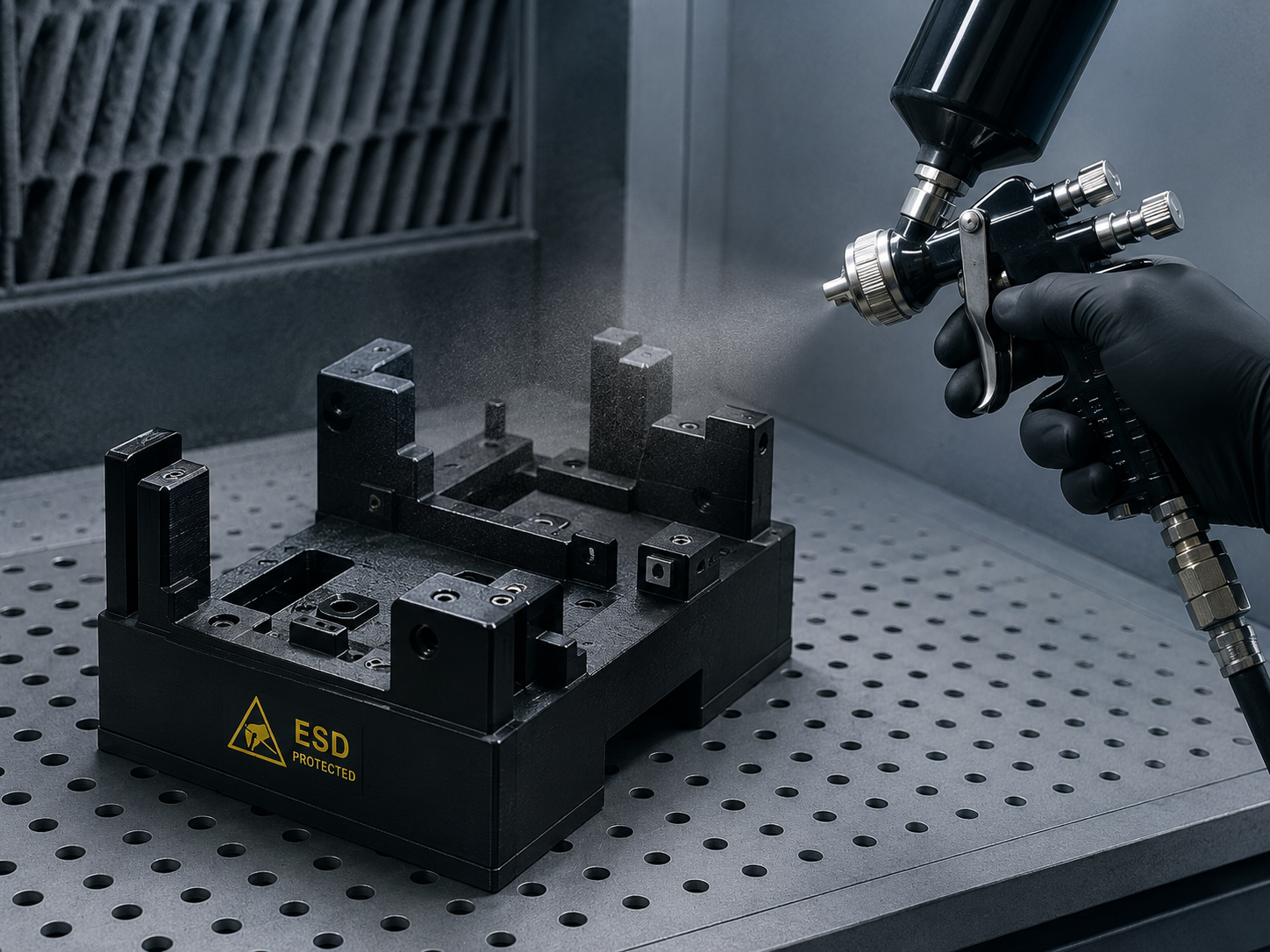
ESD-safe coatings can add static-dissipative behavior, helping reduce the risk of damage to printed parts used around electronics.